Collection of Ethnographic Drawings
Kajetan Kielisinski

Basic information
- ID
- Г-V-424_138
- Author
- Kajetan Kielisinski
- Name
- Collection of Ethnographic Drawings
- Country
- Kingdom of Poland
- Culture
- Modern times
- Technique
- drawing
- Material
- pencil
Additionally
- Type
- graphic art
- Genre
- genre art
- Provenance
- the Dzieduszycki collection
Information about author
Object description
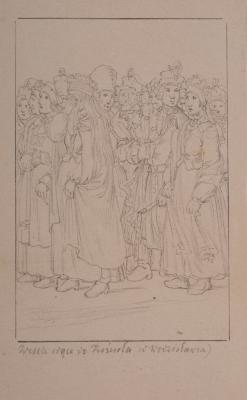
Kajetan Wincenty Kielisiński created numerous etchings and drawings devoted to folklore, life in Polish villages and towns, historical monuments, and landscapes. He was one of the first to develop bookplates in Poland. During his travels to various locations, he collected graphic materials for the publications "Polish Antiquities" and "Folk Costumes". In 1855, Poznań publisher Jan Konstanty Żupanski published "Kielisiński's Album", which collected the artist's scattered works. Kielisiński's graphic works, drawings, sketchbooks, and correspondence were kept in the Kórnik Library of the Polish Academy of Sciences, as well as in national museums (Kraków, Poznań, Warsaw) and renowned libraries (Jagiellonian University, Ossolineum, Warsaw University). The picture depicts two young people, a young man and a girl, dressed in traditional peasant festive attire. This is a scene from folk life, probably related to winter rituals, in particular, carolling. On the left stands a young man dressed in a long, festive shirt and trousers, with a belt around his waist. On his head is a tall hat decorated with feathers, similar to those worn during ritual ceremonies. In his hands, he holds a long stick or pole with a flag, ribbons, and a twig, possibly with viburnum or periwinkle – the attributes of a kolyadnyk (Christmas caroler) or a shchedruvalnyk (New Year’s caroler). On the right is a girl wearing a long, warm festive dress and a kozhukh (traditional Ukrainian fur coat). She has a headscarf or an ochipok on her head – a traditional female headdress. She looks festive, wearing jewellery, probably a necklace, although this is not detailed. The girl is leaning slightly towards the young man, as if listening or saying something. With her right arm bent at the elbow and raised to waist level, she is gesturing towards her companion. The figures are placed side by side, forming a kind of couple. Both are standing upright and looking at each other; their facial expressions are open, and the girl is smiling slightly. The characters are most likely in a village yard, as indicated by the lightly outlined space in front of the fence. The scene probably symbolises folk Christmas traditions, in particular carolling. The young man with the flag serves as the leader of the carollers or as a symbolic figure in a ritual drama. The girl is obviously also participating in the action or simply accompanying it. The graphics are executed with clear, thin lines, with attention to detail in the clothing, but without excessive artistic realism. The image has ethnographic and festive-ritual value. It conveys the atmosphere of winter holidays in the village – with warmth, attention to folk costumes and traditions. Its artistic significance lies in the accurate and detailed reproduction of folk costumes, making it a valuable source for research and study of traditional culture. From an aesthetic point of view, we are dealing with a realistic drawing, with a special emphasis on its documentary nature.
Legal regulation
Borys Voznytskyi Lviv National Art Gallery