Collection of Ethnographic Drawings
Kajetan Kielisinski

Basic information
- ID
- Г-V-424_141
- Author
- Kajetan Kielisinski
- Name
- Collection of Ethnographic Drawings
- Country
- Kingdom of Poland
- Culture
- Modern times
- Technique
- drawing
- Material
- pencil
Additionally
- Type
- graphic art
- Genre
- genre art
- Provenance
- the Dzieduszycki collection
Information about author
Object description
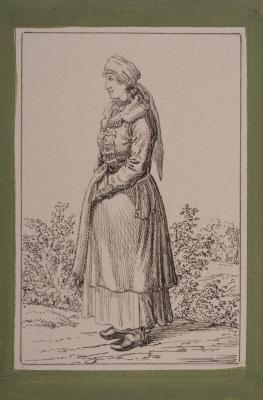
Kajetan Wincenty Kielisiński created numerous etchings and drawings devoted to folklore, life in Polish villages and towns, historical monuments, and landscapes. He was one of the first to develop bookplates in Poland. During his travels to various locations, he collected graphic materials for the publications "Polish Antiquities" and "Folk Costumes". In 1855, Poznań publisher Jan Konstanty Żupanski published "Kielisiński's Album", which collected the artist's scattered works. Kielisiński's graphic works, drawings, sketchbooks, and correspondence were kept in the Kórnik Library of the Polish Academy of Sciences, as well as in national museums (Kraków, Poznań, Warsaw) and renowned libraries (Jagiellonian University, Ossolineum, Warsaw University). The picture shows two young men in traditional peasant or townspeople's clothing. The scene depicts a moment of conversation or meeting against a natural backdrop. The two young men are dressed in winter or demi-season clothing typical of rural areas in the 18th–19th centuries. Both are wearing long kaftans or kozhukhs (traditional Ukrainian fur coat) that reach almost to their knees. The kaftans are girded with wide belts, which could be both decorative and practical. On their heads are tall fur or cloth hats typical of the winter period. They are wearing boots with high tops, which is also traditional footwear for peasants of that time. One young man is facing the viewer, the other has his back to the viewer, but is slightly turned so that part of his profile is visible. It looks like they are having a conversation, perhaps arguing or discussing something important. One of them holds his left hand in front of his chest and extends his index finger – a gesture that can express conviction or emotion – while holding a stick in his right hand. The other has raised his right hand in front of him and is extending it towards his companion. Thus, the gestures of the interlocutors are quite lively and can be interpreted in different ways. The background of the image is minimalistic, yet bushes or trees are visible, suggesting a natural environment, possibly a forest or forest edge. The ground beneath their feet is uneven – perhaps a hill or a country road. This is a genre scene from rural life, likely depicting young men who are friends, brothers, or members of a community, meeting or discussing matters. The images of the characters convey an everyday moment. The image has ethnographic value, showing what young men looked like in traditional dress. The style is calm, realistic, without excessive idealisation. Since the drawing accurately reflects and conveys the details and features of the clothing, it has a pronounced ethnographic, historical, and cultural value. Its artistic significance lies in the accurate and detailed reproduction of folk costumes, making it a valuable source for research and study of traditional culture. From an aesthetic point of view, we are dealing with a realistic drawing, with a special emphasis on its documentary nature.
Legal regulation
Borys Voznytskyi Lviv National Art Gallery