Collection of Ethnographic Drawings
Kajetan Kielisinski

Basic information
- ID
- Г-V-424_311
- Author
- Kajetan Kielisinski
- Name
- Collection of Ethnographic Drawings
- Country
- Kingdom of Poland
- Culture
- Modern times
- Technique
- drawing
- Material
- pencil
Additionally
- Type
- graphic art
- Genre
- genre art
- Provenance
- the Dzieduszycki collection
Information about author
Object description
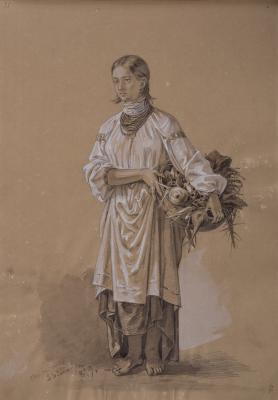
Kajetan Wincenty Kielisiński created numerous etchings and drawings devoted to folklore, life in Polish villages and towns, historical monuments, and landscapes. He was one of the first to develop bookplates in Poland. During his travels to various locations, he collected graphic materials for the publications "Polish Antiquities" and "Folk Costumes". In 1855, Poznań publisher Jan Konstanty Żupanski published "Kielisiński's Album", which collected the artist's scattered works. Kielisiński's graphic works, drawings, sketchbooks, and correspondence were kept in the Kórnik Library of the Polish Academy of Sciences, as well as in national museums (Kraków, Poznań, Warsaw) and renowned libraries (Jagiellonian University, Ossolineum, Warsaw University). The picture shows a group of people, mostly women, participating in a traditional folk festival or ritual. All are dressed in traditional peasant clothing of the time, long dresses, headscarves or headdresses, some decorated with flowers, wreaths or ribbons. There are also two men: one is a middle-aged violinist wearing a tall fur hat, and the other is a young man standing in the crowd. The young man is holding an attribute similar to a staff or a decorated branch – perhaps a symbol of ritual or part of a dance ritual. The figures stand close to each other, forming a dense group that gives the scene a sense of unity and ritual. All of them are facing partly forward and partly to the side, perhaps preparing to perform a dance or ritual. Their facial expressions are focused, calm, or slightly solemn, which corresponds to the holiday or ritual's general atmosphere. The faces are depicted without excessive detail, yet each retains individual features. Some have a slight smile, but restraint prevails, which is characteristic of ritual or solemn scenes. Most of the girls have wreaths on their heads, decorated with ribbons, flowers, or buttons – a traditional sign of unmarried girls in folk culture. Several figures wear headscarves, which may indicate older age or marriage. One of the women in the centre has a tall hat or a complex crown, possibly of ritual significance. All the female characters are dressed in long dresses or sundresses with flared sleeves, a typical feature of festive attire. Embroidery or jewellery is visible on their shoulders or chests (although not detailed, it can be seen from the hints in the lines). The clothing has several layers, with underskirts, skirts, and aprons all visible. The footwear is traditional low boots with rounded toes. The lines are soft and precise, but without a strong emphasis on facial details or fabric textures. The composition is quite dense – the figures stand very close together, creating the impression of a crowd or group activity. There is no detailed background; all attention is focused on the characters. Its artistic significance lies in the accurate and detailed reproduction of folk attire, making it a valuable source for research and study of traditional culture. From an aesthetic point of view, we are dealing with a realistic drawing, with a special emphasis on its documentary nature.
Legal regulation
Borys Voznytskyi Lviv National Art Gallery