Collection of Ethnographic Drawings
Kajetan Kielisinski

Basic information
- ID
- Г-V-424_312
- Author
- Kajetan Kielisinski
- Name
- Collection of Ethnographic Drawings
- Country
- Kingdom of Poland
- Culture
- Modern times
- Technique
- drawing
- Material
- pencil
Additionally
- Type
- graphic art
- Genre
- genre art
- Provenance
- the Dzieduszycki collection
Information about author
Object description
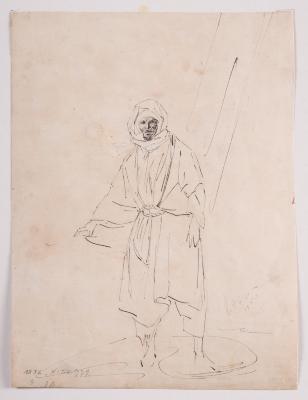
Kajetan Wincenty Kielisiński created numerous etchings and drawings devoted to folklore, life in Polish villages and towns, historical monuments, and landscapes. He was one of the first to develop bookplates in Poland. During his travels to various locations, he collected graphic materials for the publications "Polish Antiquities" and "Folk Costumes". In 1855, Poznań publisher Jan Konstanty Żupanski published "Kielisiński's Album", which collected the artist's scattered works. Kielisiński's graphic works, drawings, sketchbooks, and correspondence were kept in the Kórnik Library of the Polish Academy of Sciences, as well as in national museums (Kraków, Poznań, Warsaw) and renowned libraries (Jagiellonian University, Ossolineum, Warsaw University). The picture shows a young or middle-aged man and woman standing next to each other. The figures are standing upright, facing the viewer. The man is wearing a tall hat with a branch attached, a long coat or kaftan, narrow trousers, a wide belt, and Postoly (traditional Ukrainian shoes) or light boots. In his left hand, at belt level, he holds a bundle of flowers or tree branches, and in his right hand, which is lowered to his side, he has a kind of whip. His head is turned towards the woman, and his gaze is clearly directed at her. The woman is dressed in a jacket and a long, floor-length skirt, wearing light shoes, a wreath of plants or flowers with woven ribbons on her head, and a scarf draped over her shoulders. She also holds a twig in her arms, bent at the elbows and raised to chest level. Her head is turned towards the man, and her gaze is directed at him. The couple depicted is dressed in traditional 19th-century peasant clothing; they may be a married couple participating in a ritual ceremony. This is evidenced by the festive nature of their clothing, the decoration of the man's headdress and the woman's wreath, and the attributes held in their hands. Both have calm expressions, and the man is smiling slightly. There is no background in the image, only a thin line marking the surface on which the people are standing. The artist has focused on the characters, who should be viewed as generalised images without any distinct individualisation. Its artistic significance lies in the accurate and detailed reproduction of folk attire, making it a valuable source for research and study of traditional culture. From an aesthetic point of view, we are dealing with a realistic drawing, with a special emphasis on its documentary nature.
Legal regulation
Borys Voznytskyi Lviv National Art Gallery