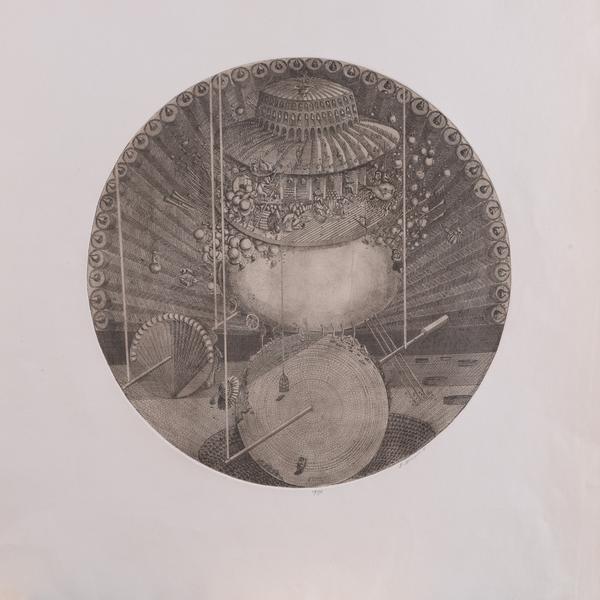
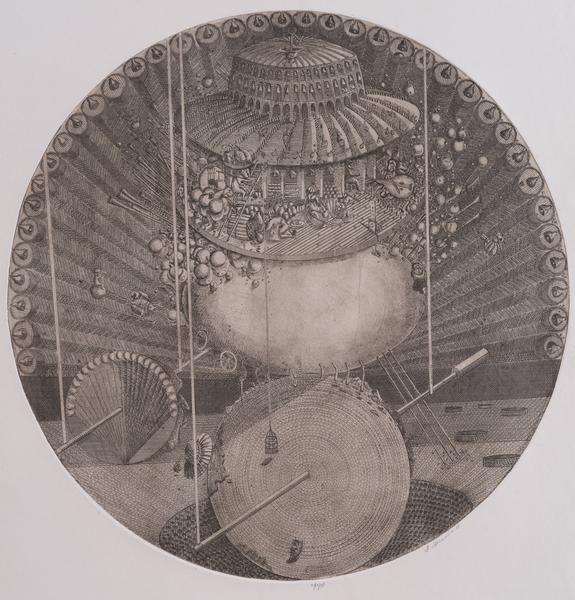
Laputa ІІ (Sheet 2 from the Graphic Cycle "Jonathan Swift's Kingdom of Absurdity")
Alexander Aksinin


Basic information
- ID
- Г-IV-3640
- Author
- Alexander Aksinin
- Name
- Laputa ІІ (Sheet 2 from the Graphic Cycle "Jonathan Swift's Kingdom of Absurdity")
- Date of creation
- 1978
- Technique
- etching
- Material
- imprint on paper
- Dimensions (height x width, cm)
- 29.5 x 29
Additionally
- Type
- printmaking
- Provenance
- Purchased and kept in permanent storage,1983
Information about author
Object description
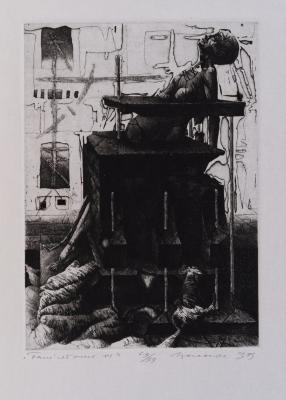
Alexander Aksinin's legacy of graphic works contains a series of etchings based on some literary works, one of which is Jonathan Swift's "Gulliver's Travels" (1977–1978). In this series (as in others, such as Lewis Carroll's "Alice in Wonderland"), Aksinin often turned the texts into part of an image. The artist's creative world is characterised by a condensed intellectual atmosphere full of "codes of aesthetic information". The art critic Mykhailo Sokolov noted that the artist introduced into his works a subject line, which was to symbolically reproduce not a separate part of the text but to give the image of the text as a whole, as well as to serve as a sign and matrix of an illustrated verbal work.
The work is the second sheet of 11 etchings from the graphic cycle "Jonathan Swift's Kingdom of Absurdity" and one of the earliest works by the artist. The third chapter of the book "Gulliver's Travels" by Jonathan Swift, the Anglo-Irish satirist of the 17th–18th centuries, became the object of the author's allusion. The story follows the life of Lemuel Gulliver, the hero of "Gulliver's Travels", who lands on the flying island of Laputa, a magnetically levitated diamond-based disk. The island's inhabitants are mathematicians, astronomers, musicians, and engineers who are completely immersed in themselves and distracted from everyday life. To return the Laputans to reality, their servants occasionally use a bag full of peas or pebbles connected to a long stick to hit their masters' ears or eyes to rouse them out of their deep thoughts. Aksinin depicts a fantastic island as a complex structure on hinges, needles, and wheels. People are shown upstairs; in particular, one person is climbing a ladder and carrying a fried chicken on a tray placed on their head; someone is playing the double-bass depicted in the form of a split pear, while someone is sitting in a boat, which serves as a bath. All these characters surround a round building with a top in the form of a hat, on the walls of which one can find miniature inscriptions, namely USA, Lagado, and Laputa. Lagado is the name of the islanders' academy. Long poles with bells at the top diverge from the building in the form of a fan. The same bells are in the niches of its walls. Below and next to it are numerous images of pipes and sacks of peas. In the lower part of the composition, there are only mechanisms, among which single objects seem to be lost. In this work, the artist imitates the compositional completeness and symbolic basic principles of Hieronymus Bosch, the Dutch artist of the 15th–16th centuries.
The work is the second sheet of 11 etchings from the graphic cycle "Jonathan Swift's Kingdom of Absurdity" and one of the earliest works by the artist. The third chapter of the book "Gulliver's Travels" by Jonathan Swift, the Anglo-Irish satirist of the 17th–18th centuries, became the object of the author's allusion. The story follows the life of Lemuel Gulliver, the hero of "Gulliver's Travels", who lands on the flying island of Laputa, a magnetically levitated diamond-based disk. The island's inhabitants are mathematicians, astronomers, musicians, and engineers who are completely immersed in themselves and distracted from everyday life. To return the Laputans to reality, their servants occasionally use a bag full of peas or pebbles connected to a long stick to hit their masters' ears or eyes to rouse them out of their deep thoughts. Aksinin depicts a fantastic island as a complex structure on hinges, needles, and wheels. People are shown upstairs; in particular, one person is climbing a ladder and carrying a fried chicken on a tray placed on their head; someone is playing the double-bass depicted in the form of a split pear, while someone is sitting in a boat, which serves as a bath. All these characters surround a round building with a top in the form of a hat, on the walls of which one can find miniature inscriptions, namely USA, Lagado, and Laputa. Lagado is the name of the islanders' academy. Long poles with bells at the top diverge from the building in the form of a fan. The same bells are in the niches of its walls. Below and next to it are numerous images of pipes and sacks of peas. In the lower part of the composition, there are only mechanisms, among which single objects seem to be lost. In this work, the artist imitates the compositional completeness and symbolic basic principles of Hieronymus Bosch, the Dutch artist of the 15th–16th centuries.
Inscriptions
At the bottom right under the imprint, there is an author's inscription "A. Aksinin – 78"
Legal regulation
Borys Voznytskyi Lviv National Art Gallery