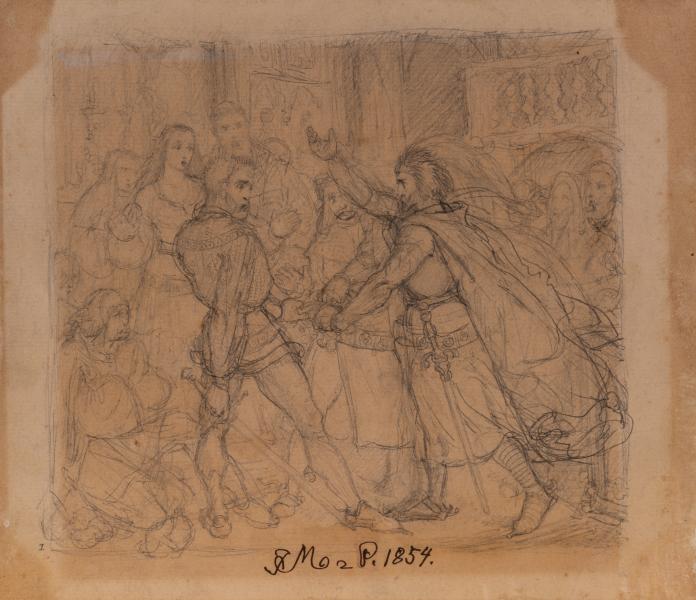
Scene from Adam Mickiewicz's Ballad "Lilies" (1820)
Jan Matejko




Basic information
- ID
- Г-V-76
- Author
- Jan Matejko
- Name
- Scene from Adam Mickiewicz's Ballad "Lilies" (1820)
- Date of creation
- 1854
- Country
- Poland Austro-Hungarian Empire
- Technique
- drawing
- Material
- paper pencil
- Dimensions (height x width, cm)
- 15.4 x 16.2
Additionally
- Type
- graphic art
- Genre
- narrative art
- Provenance
- Collection of Lviv City Gallery
Information about author
Object description
Adam Mickiewicz (1798–1855) wrote the ballad "Lilies" (1820) based on the Polish mediaeval folk song "Pani zabiła Pana" ("The Lady Killed the Lord"). The sketch by Jan Matejko illustrates the final scene of the ballad, where the ghost of Lord – the husband killed by his wife – appears in the church on the wedding day to take his unfaithful wife and her two suitors, who are his brothers, with him to the afterlife. Three male figures in mediaeval attire are at the centre of the dynamic, multi-figure composition, each holding a sword. Two of them (the brothers of the murdered Lord) are startled by the appearance of the third figure, who is a ghost. To the left behind them is a frightened young woman, the main character of the poem (the Lady). The ghostly man (depicted on the right in a cloak) is enraged by what is happening. He raises his right hand upwards and angrily speaks to the brothers and his wife, the murderer. The depicted scene is a moment before everything will be buried under the ruins of the church.
Inscriptions
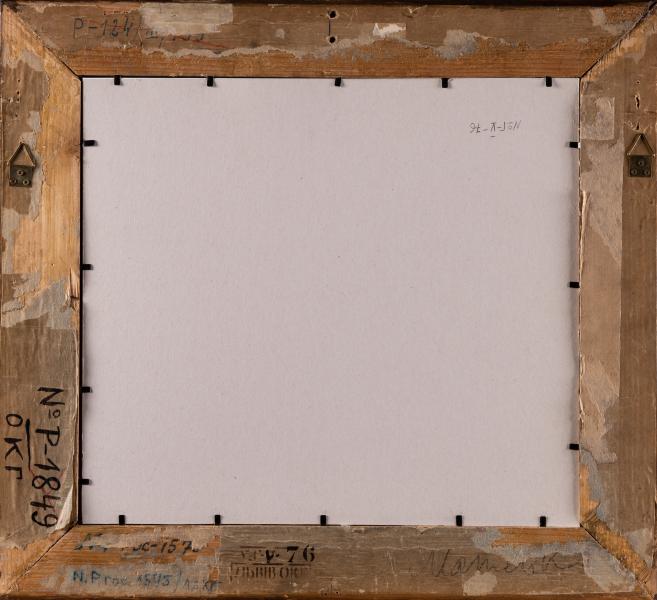
In the centre at the bottom of the sheet, the artist's signature in Indian ink: "J. M. z P. 1854". On the reverse side, the inscription reads: "Szkic kompozycyjny wedle poematu Mickiewicza 'Lilije' 'Mąż zamordowany zjawia się w kościele po niewierną żona'".
Legal regulation
Borys Voznytskyi Lviv National Art Gallery