Carolers
Vasyl Poliovyi


Basic information
- ID
- Ж-6992
- Author
- Vasyl Poliovyi
- Name
- Carolers
- Date of creation
- 1968
- Country
- the USSR
- Culture
- Ukrainian art of the Soviet period
- Technique
- original technique
- Material
- plywood mixed media
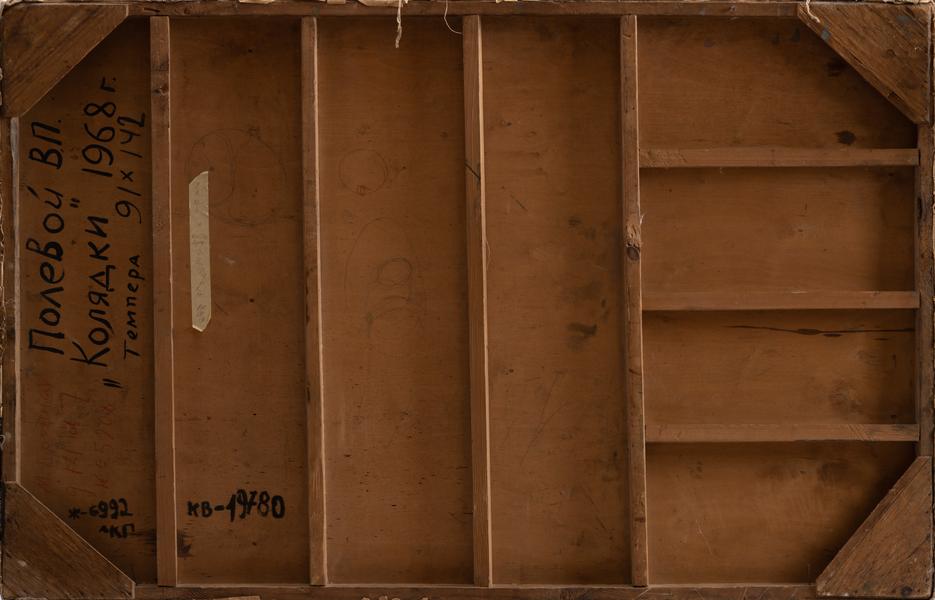
- Dimensions (height x width, cm)
- 91 x 142
Additionally
- Type
- painting
- Genre
- symbolic art
- Plot
- Allegory
- Provenance
- Handed over to the museum from Vasyl Poliovyi
Information about author
Object description
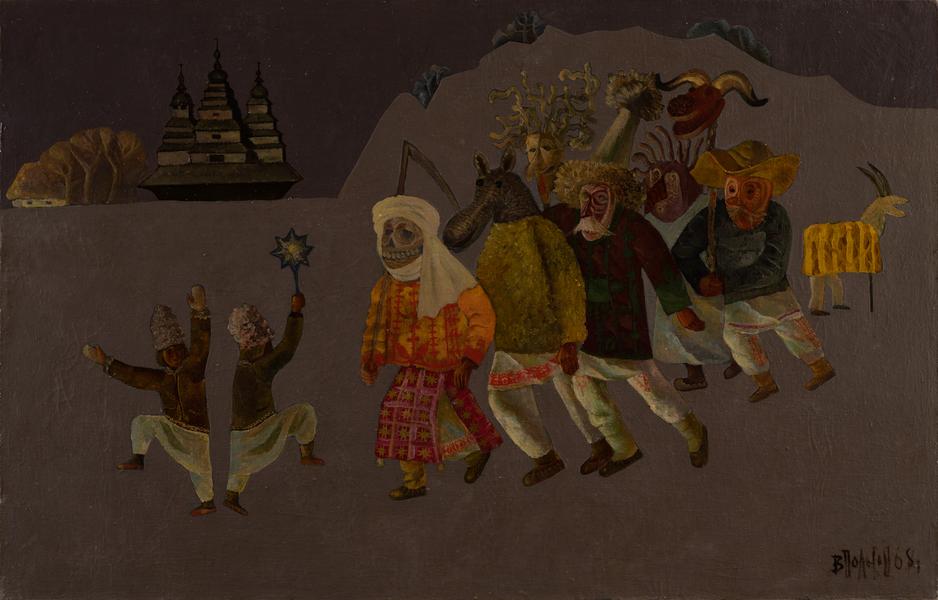
The easel work is dedicated to ethnographic folk events of the winter cycle, namely at the time of Christmas. The composition is balanced, and the colour palette is mixed with textural and tonal contrasts. Notably, there are signs of several significant adjustments to the composition, including repainting the ground and background. The space where the nativity scene participants are depicted consists of two massive achromatic planes without tonal gradations. In the bottom left corner along the horizon line is a stylised triple-domed wooden church (of ethnographic regions in the Carpathians, possibly the Boiko region, such as in the village of Yabluniv in the Turka district). It is set against the background of several trees and a small, low-roofed house with an organic vegetative covering, likely "thatched straw". The central part of the painting features a group of eight participants of the nativity scene against a light achromatic spot that represents the ground. The procession begins with "zvizdari" (carolers) – two children dressed in traditional winter attire. They are wearing tall light-grey fur hats, short beige coats, light-coloured gloves, light trousers, likely made of linen fabric, and postoly – traditional leather boots. The boy on the right is holding the Star of Bethlehem. They are followed by adults. The first one is Death with a scythe, dressed in festive women's clothing (a white headdress – namitka, an elaborately embroidered red cape, a long, richly embroidered shirt, two floral patterned aprons – zapaskas, and leather postoly boots). The head of the Death character corresponds to classical iconography – a human skeletal head without skin, muscles or connective tissues. Next is a man in a reversed fur coat, a knee-long red embroidered shirt, light-coloured woven trousers, and leather boots. The man wears an animal mask on his head, resembling a predator with a distinctly elongated snout, small ears, and grey-brown fur. A masked man with a red-painted face and a large white moustache is right behind him. This character is in a tall, narrow, cone-shaped headdress, trimmed with fur at the bottom with a large, spherical tassel at the top. He wears a purple coat with rich green embroidery, a knee-length shirt underneath, linen trousers, and postoly with footwraps. Next to him on a stick is a grotesque mask with a long nose, a protruding tongue, small almond-shaped slits for eyes, and patchy hair, which resembles the classical iconography of the Gorgon Medusa. This person is followed by a man holding a staff topped with a goat's head with gilded (?) horns and a red-painted face. He is wearing a greenish outer garment, underneath which is a knee-long shirt with red embroidery on the bottom, linen trousers, and postoly with footwraps. He wears a mask with round eyes, a prominent nose, and a large, curled, light-coloured moustache. His head is adorned with a crested headdress resembling a traditional male straw hat – bryl, but made of soft yellow-ochre material. Behind this character is a man dressed in a long light (white?) chlamys that reaches his ankles, revealing postoly with footwraps underneath. On his head is a purple trapezoid-shaped mask with a grotesquely huge nose, small round eyes, and a mouth. The head is enriched with serpent-like forms, reminiscent of the previously mentioned iconography of the Gorgon Medusa. The procession is completed by a man dressed as a goat, leaning on a stick, whose body is covered with bright yellow cloth from the goat mask to the knees. Overall, the group creates an impression of festivity and vibrancy without being excessively flamboyant. This enhances the mystical tone of the imagery and creates a unique atmosphere for the Great Event, which is the prerequisite for the festivities. According to the recollections of the artist's sister, Liudmyla Poliova (Ledford), one of the significant events during Vasyl Poliovyi's family visit to the Carpathians was the opportunity to see a Christmas nativity scene. Later, according to the artist's sister, he continued to explore this theme, even residing in the United States. Vasyl Poliovyi's work on the same theme, titled "Riadzheni" (1965) (riadzheni – participants in the folk Christmas festivities with games and songs, mainly carols), is preserved in the collection of the Khmelnytskyi Regional Art Museum. However, the colouring and compositional approach differs entirely from the one in the Gallery's collection.
Legal regulation
Borys Voznytskyi Lviv National Art Gallery