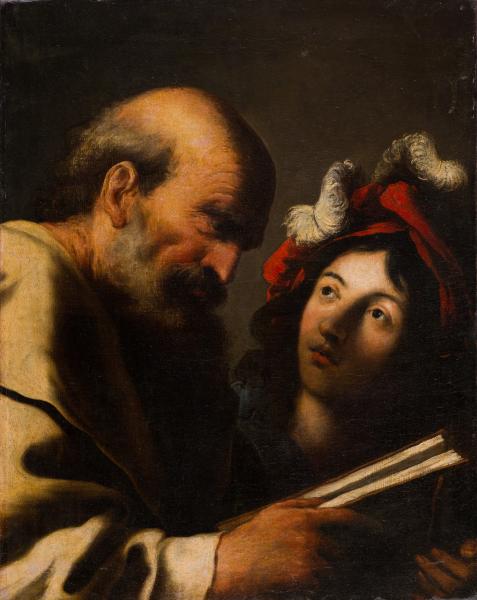
Youth and Old Age
Pietro della Vecchia


Basic information
- ID
- Ж-823
- Author
- Pietro della Vecchia
- Name
- Youth and Old Age
- Date of creation
- c.1640s – 1670s
- Technique
- oil painting
- Material
- canvas oil
- Dimensions (height x width, cm)
- 75 x 59
Additionally
- Type
- painting
- Genre
- genre art symbolic art
- Plot
- Youth and old age
- Provenance
- Collection of Wiktor Baworowski
- Exposition
- Potocki Palace
Information about author
Object description
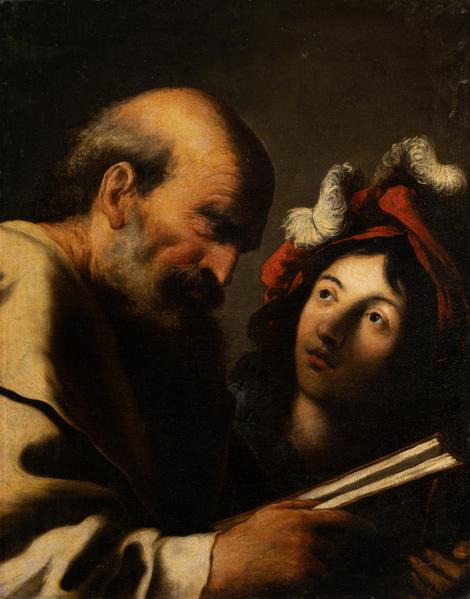
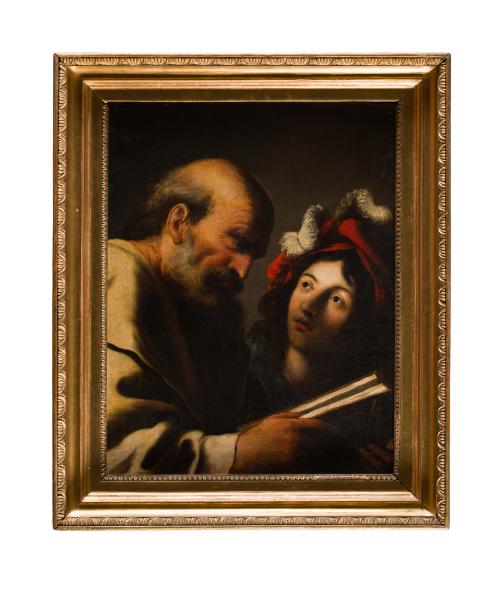
The "Youth and Old Age" painting came to the Gallery's collection from the collection of Count Wiktor Baworowski. Despite the numerous copies of the work, the Lviv composition was likely created by Pietro della Vecchia himself as part of the "The Philosopher and His Disciples" series, one of the paintings of which belongs to the Bavarian art collection. The work is distinguished by plastic integrity. The influences of Caravaggism are indicated by the use of chiaroscuro and tenebroso techniques, as well as an "open" artistic vision that gives an everyday motif a semantic and artistic value. The symbolic interpretation of the work is interesting: the compositional closure ensured by the intersection of the older man's gaze directed at the book and the young man's gaze directed at him is perceived as an expression of the student and teacher's spiritual closeness. The image of the book "unlocks" the composition's chronotope into the infinite of the world's meanings. The viewer's involvement in the circle of "initiates" is provided by the approach of the figures to the border of the intra-picture space and their location at the level of the perceivers. The image of a young man in a Renaissance beret indicates the "historicizing" tendencies in Pietro della Vecchia's work. The timelessness of the older man's clothes lends symbolism and symbolic depth to his figure. The canvas colouring is unique as it accentuates and "manifests" the darkness of shadows, brown-red colours, and golden-white flashes of light among prevailing red.
Legal regulation
Borys Voznytskyi Lviv National Art Gallery