Christ
unknown folk sculptor


Basic information
- ID
- С-I-1855
- Author
- unknown folk sculptor
- Name
- Christ
- Date of creation
- 19th c.
- Country
- Ukraine
- Technique
- carving
- Material
- wood
- Dimensions (height x width x depth, cm)
- 72.7 x 37.8 x 16.6
Additionally
- Type
- sculpture
- Genre
- religious
- Plot
- Ascension of Christ
- Provenance
- Pereviatychi village, Chervonohrad district, Lviv region
Information about author
Object description
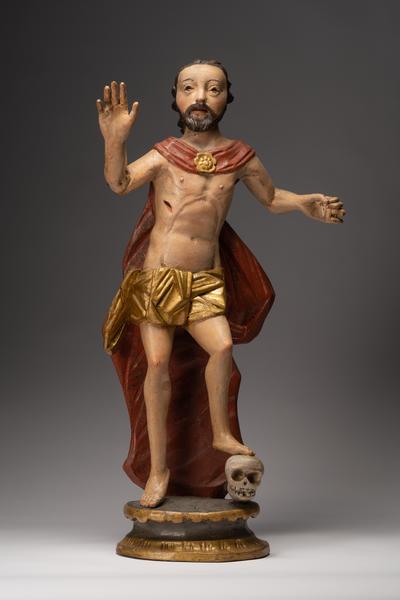
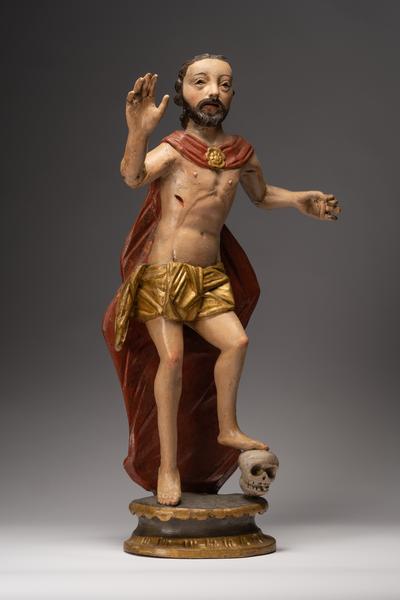
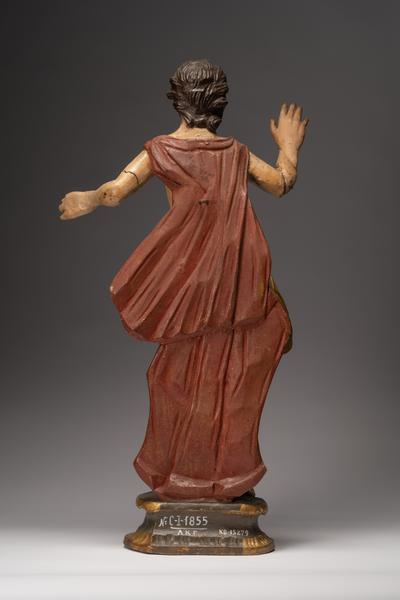
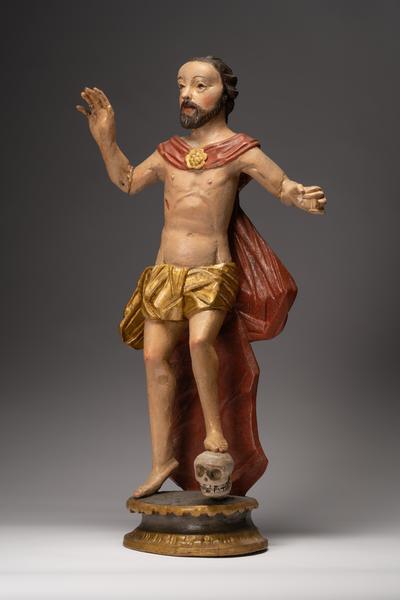
The Ascension of Christ is one of the twelve feasts reflecting important events that happened forty days after the crucifixion of Christ. In many churches, the sculptural image of the Ascension is installed on the tetrapod during the Easter holidays, where it remains until the religious feast of the Ascension of the Lord. The tradition follows Western iconography by illustrating the events described in the apocryphal Gospel of Luke. The canonical sculpture of Christ from the village of Pereviatychi demonstrates a full-length figure on a round stand; his right hand is depicted in a blessing gesture, and the position of the left one indicates that it was holding a banner. The left leg of the Almighty stands on the skull, symbolizing victory over death. His rounded oval face, with a high forehead, half-open mouth framed by a small neat beard, and clearly defined eyes, shows an expression full of contemplation and detachment. The shoulders of Christ are covered with a long red cape, fastened on the chest with decorative ornaments, and a short gold loincloth wraps around the hips, shaped by a group of diagonal lines that form triangular planes. The work was performed in a static manner typical for folk masters and with non-observance of anatomical body proportions. Polychrome plays an essential role in creating the Resurrection image and enhances the sculpture's emotionality.
Legal regulation
Borys Voznytskyi Lviv National Art Gallery