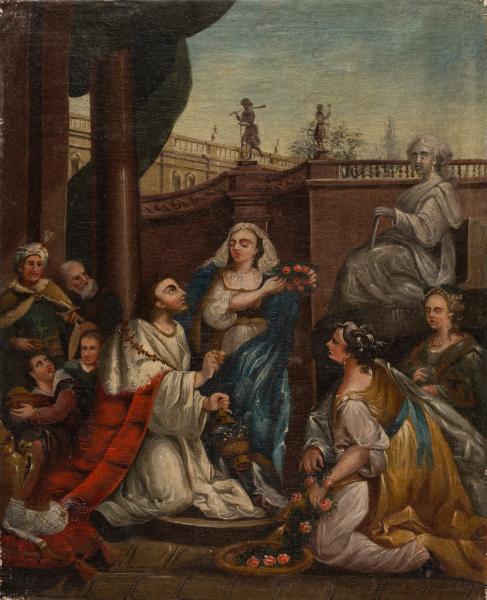
Idolatry of King Solomon (after Jacopo Amigoni)
Katarzina Kopalska


Basic information
- ID
- Ж-4873
- Author
- Katarzina Kopalska
- Name
- Idolatry of King Solomon (after Jacopo Amigoni)
- Date of creation
- 1876
- Technique
- oil painting
- Material
- canvas oil
- Dimensions (height x width, cm)
- 64 x 52
Additionally
- Type
- painting
- Genre
- religious
- Plot
- Idolatry of King Solomon
- Provenance
- Vasyl Stefanyk Scientific Library of Ukraine in Lviv
Information about author
Object description
The work by the amateur artist is indirectly a simplified painted copy of a graphic piece by the Italian artist Jacopo Amigoni (engraver Francesco Bartolozzi, 1748–1754). From the eponymous etching by Jacopo Amigoni (1675/82–1752), his contemporaries and followers repeatedly created painted copies. The most notable among them are the following: the work by the Dutch painter Rienk Keijert (1709–1775), created in 1757; the work by an unknown master of the Tuscan School from the late 18th century; the painting by the Czech artist Vaclav Bernard Ambrosi (1723–1806), created in 1800. All these works are compositionally identical, except for minor differences in the details of the characters' clothing and surroundings. One of these painted versions (or another less well-known one) served as a model for the artist to copy. The Old Testament episode "The Idolatry of King Solomon" recounts how the wise King Solomon, swayed by the counsel of his pagan wives, turned away from the true God and began to worship idols, for which he was punished. In the centre of the multi-figure, enclosed composition, against the backdrop of a high wall with a fence, King Solomon is depicted in white garments and a long red mantle with a white fur collar. He is kneeling before a statue of the goddess Astarte, placed on an altar. In the mythology of Semitic peoples, Astarte is the goddess of fertility, motherhood, and love. She is equivalent to the Greek goddess Aphrodite and the Roman goddess Venus. On either side of Solomon stand three of his pagan wives, dressed in elaborate attire. One holds a wreath of roses, another weaves a garland, while the third silently watches. Four servants gathered behind the king under the colonnade, observing the king and the women with surprise and disapproval. In the lower-left corner of the painting, a red cushion is depicted, upon which a white turban and a gold crown rest. At the top of the composition, above the wall, is a blue-grey sky. The painting is distinguished by its vibrant, rich colours and the artist's attention to fine details.
Inscriptions
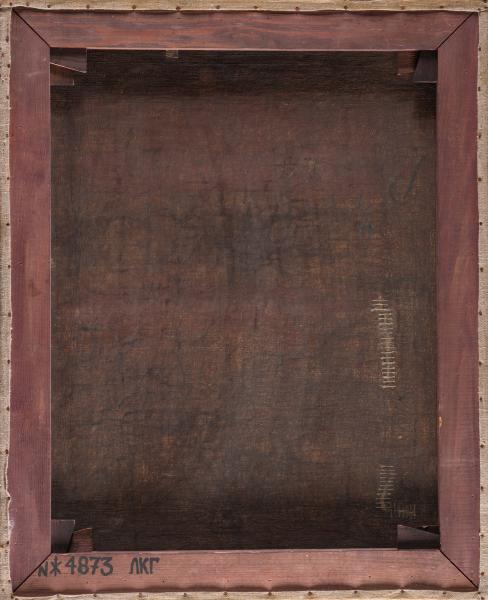
At the bottom of the composition, on a low round pedestal, there is an inscription (illegible). On the reverse, there is an inscription: "Katarzina Kopalska, 1876".
Legal regulation
Borys Voznytskyi Lviv National Art Gallery