Male Portrait
unknown


Basic information
- ID
- Ж-3938
- Author
- unknown
- Name
- Male Portrait
- Date of creation
- 1473
- Country
- Republic of Venice
- Technique
- oil painting
- Material
- wood oil
- Dimensions (height x width, cm)
- 26.7 x 21.5
Additionally
- Type
- painting
- Genre
- portraiture
- Plot
- Portrait
- Provenance
- Handed over to the Gallery in 1963
- Exposition
- Potocki Palace
Information about author
Object description
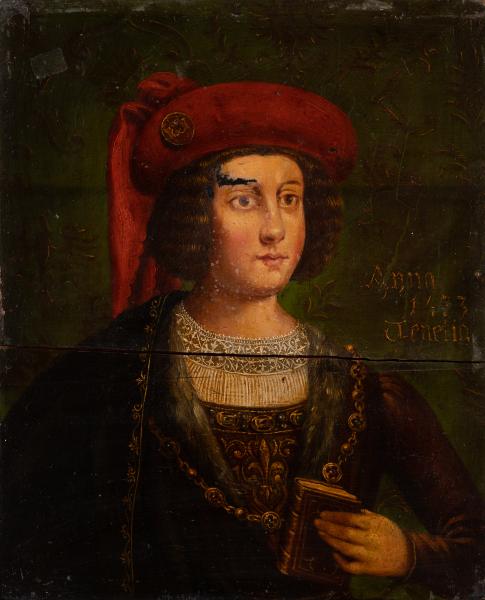
On the one hand, the Venetian School of Painting developed under the influence of strict Byzantine canons and, on the other, through the impact of Italian schools, primarily the Roman and Tuscan Schools. A characteristic feature of the Venetian School was the predominance and dominance of colour over form. It was in the 1470s that Venetian artists began to master the new technique of oil painting on wood and later on canvas. In Venice, this technique spread rapidly due to the durability of oil paints (compared to tempera) in conditions of constant humidity. One of the first to paint with oil paints was Giovanni Bellini (1430–1516), the founder of the Venetian School of Painting. The background of the painting is green, decorated with a golden animal and plant motif. The work is a bust-length portrait of a young man, depicted frontally with his face turned three-quarters to the right. The beardless young man with wavy dark hair is shown wearing a dark red beret adorned with a brooch on the left side and a trailing sash that falls down his back. His clothing is embroidered with gold and adorned with precious stones, trimmed with fur. A gold chain is depicted on his chest. A dark cloak is draped over his right shoulder. In his left hand, the young man holds a book.
Inscriptions
On the right side of the canvas, there is an inscription in the centre: “Anno 1473 Venetia” (In the year of our Lord 1473, Venice)
Legal regulation
Borys Voznytskyi Lviv National Art Gallery