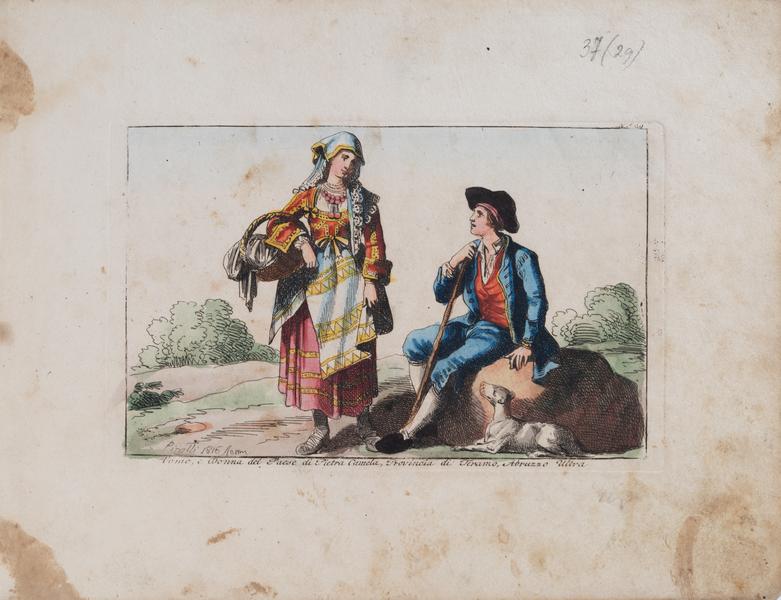
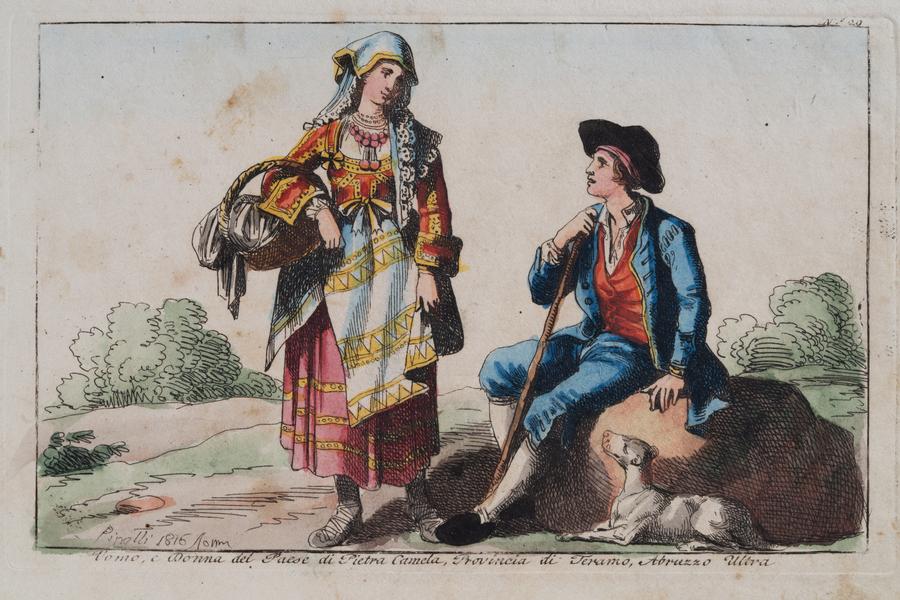
Man and Woman from the Village of Pietracamela in the Province of Teramo in Upper Abruzzo
Bartolomeo Pinelli


Basic information
- ID
- Г-IV-1733
- Author
- Bartolomeo Pinelli
- Name
- Man and Woman from the Village of Pietracamela in the Province of Teramo in Upper Abruzzo
- Date of creation
- 1816
- Technique
- etching watercolour
- Material
- paper
- Dimensions (height x width, cm)
- 10 x 16.2
Additionally
- Type
- graphic art
- Genre
- genre art
- Provenance
- Collection of Faina Tarashchanska (Lviv), 1966
Information about author
Object description
The composition is known from the album Raccolta di Cinquanta Costumi li più interesanti delle città, terre e paesi in provincia diverse del Regno di Napoli (Collection of Fifty Most Interesting Picturesque Costumes from Cities, Towns and Villages of Different Provinces of the Kingdom of Naples) published in Rome in 1816. The album's work was painted in other tones, not as intense and bright as in the so-called Lviv version. In the foreground, one can see two figures: a young man sitting on a rock with a dog next to him and a young girl in traditional festive clothing carrying a basket with an Easter cake to the church. As she passes the young man, he and his dog are looking at her with admiration. The girl is dressed in a yellow and red dress with peculiar cuffs, a long burgundy skirt with an apron with geometric patterns put over it. A headscarf is on her head; on her feet are light ciocia shoes. The necklace made of red coral resembles elements of the Ukrainian national dress. The young man is also dressed festively; in particular, he wears a blue camisole, a red jacket, narrow trousers, and knee socks. Black shoes are on his feet; on his head, there is a pink Neapolitan houve and a black hat. The action is taking place on top of a mountain pass, so the background of the composition is only a cloudless sky. In 1830, the figure of a woman from Pietracamela by B. Pinelli was replicated in lithography by the Neapolitan artist Gaetano Dura (1805–1878).
Inscriptions
In the lower left corner, there is the author's signature Pinelli written in italics, and the date 1816, followed by an illegible inscription of the place of performance, Roma. In the centre of the engraving, under the image, is the work's title: Uomo, e Donna del Paese di Pietra Camela, Provincia di Teramo, Abruzzo Ultra. The number "29" is in the upper right corner above the plate.
Legal regulation
Borys Voznytskyi Lviv National Art Gallery