Ruins of a Roman Sanctuary
unknown


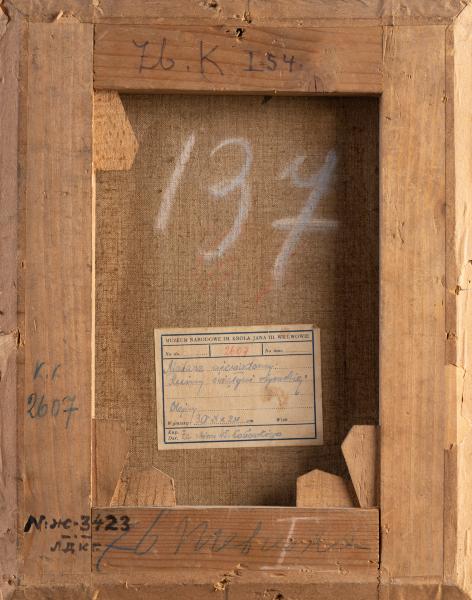
Basic information
- ID
- Ж-3423
- Author
- unknown
- Name
- Ruins of a Roman Sanctuary
- Date of creation
- 18th c.
- Technique
- oil painting
- Material
- canvas oil
- Dimensions (height x width, cm)
- 30.8 x 24
Additionally
- Type
- painting
- Genre
- architectural landscape
- Plot
- Architecture
- Provenance
- Lviv Historical Museum
- Exposition
- Potocki Palace
Information about author
Object description
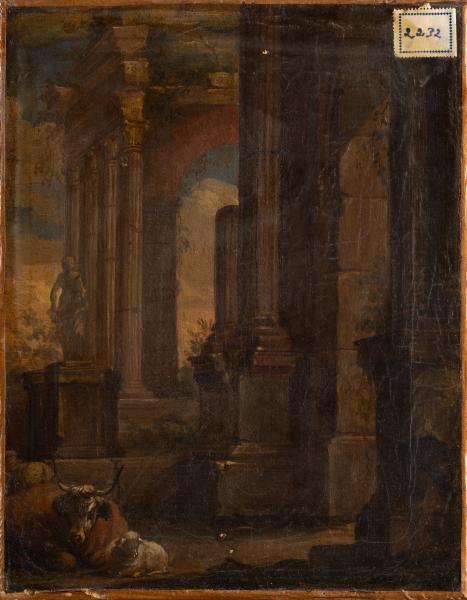
An architectural landscape by an unknown artist represents the genre of capriccio, which was exceptionally popular in the 17th–18th centuries. It is an exquisite architectural fantasy in which majestic antique ruins are poetically romanticised and harmoniously combined with pastoral motifs.
The heyday of capriccio (Italian: capriccio – a whim, a caprice) occurred in the 18th century. A whole pleiad of prominent European artists worked within this genre, including Francesco Zuccarelli, Giovanni Paolo Panini, Canaletto, Antonio Joli, Jean Lemaire, Paolo Anesi, Viviano Codazzi, Gennaro Greco, Hendrik Frans van Lint, Hubert Robert, and Francesco Guardi.
The composition of the work is built on a play of scales and deep perspective. The palette of the painting is executed in a warm, almost monochrome range, dominated by shades of ochre, terracotta, and brown.
The greater part of the canvas is occupied by the monumental ruins of an ancient Roman sanctuary – massive columns and fragments of crumbling walls. In places, they are overgrown with grass and shrubs, symbolising the implacability of time and the indifference of nature to former human greatness. To the left, deep within the space, an antique statue rises on a high pedestal – a female figure with a jug. The background for the composition is provided by an evening sky with light white clouds.
In the lower left corner, staffage is depicted – figures of domestic animals. An ox and a sheep rest gracefully on the ground. Their presence amidst the ruins of a once grand temple creates a contrast, characteristic of capriccio, between the majestic past and the mundane present.
The heyday of capriccio (Italian: capriccio – a whim, a caprice) occurred in the 18th century. A whole pleiad of prominent European artists worked within this genre, including Francesco Zuccarelli, Giovanni Paolo Panini, Canaletto, Antonio Joli, Jean Lemaire, Paolo Anesi, Viviano Codazzi, Gennaro Greco, Hendrik Frans van Lint, Hubert Robert, and Francesco Guardi.
The composition of the work is built on a play of scales and deep perspective. The palette of the painting is executed in a warm, almost monochrome range, dominated by shades of ochre, terracotta, and brown.
The greater part of the canvas is occupied by the monumental ruins of an ancient Roman sanctuary – massive columns and fragments of crumbling walls. In places, they are overgrown with grass and shrubs, symbolising the implacability of time and the indifference of nature to former human greatness. To the left, deep within the space, an antique statue rises on a high pedestal – a female figure with a jug. The background for the composition is provided by an evening sky with light white clouds.
In the lower left corner, staffage is depicted – figures of domestic animals. An ox and a sheep rest gracefully on the ground. Their presence amidst the ruins of a once grand temple creates a contrast, characteristic of capriccio, between the majestic past and the mundane present.
Legal regulation
Borys Voznytskyi Lviv National Art Gallery