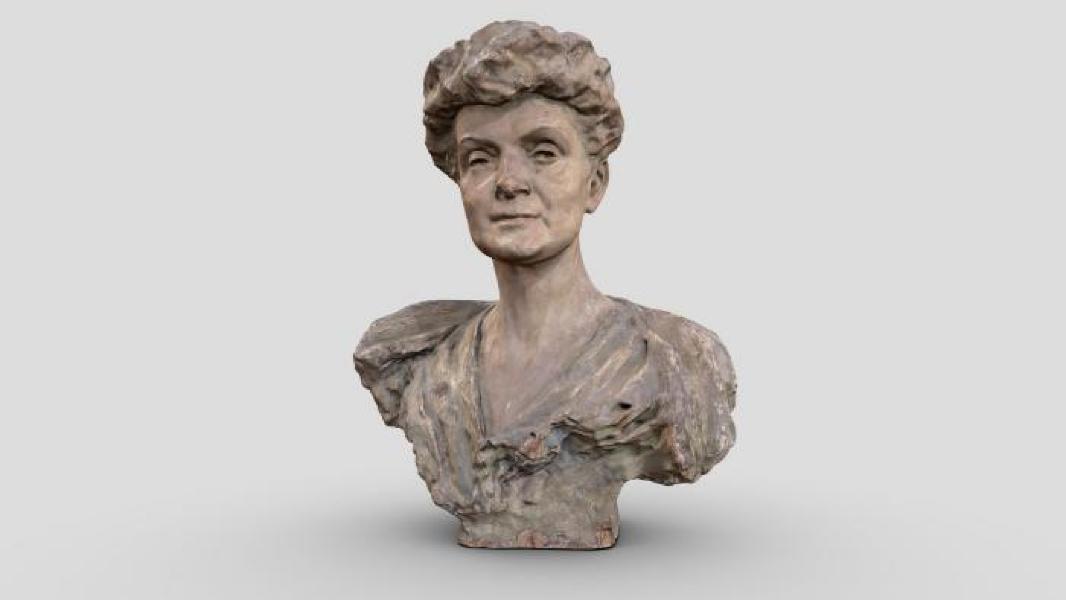
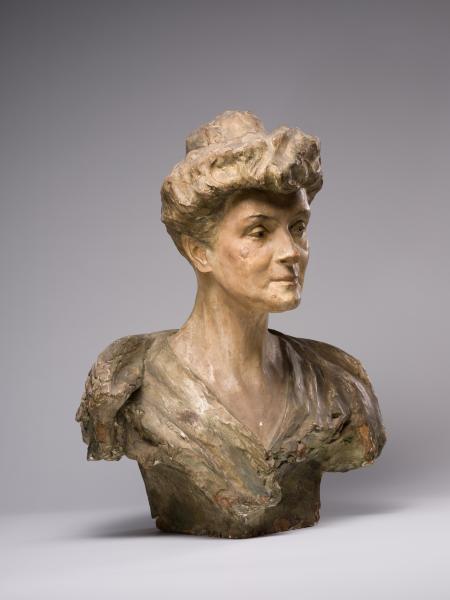
Bust of a Woman
Luna Drexler


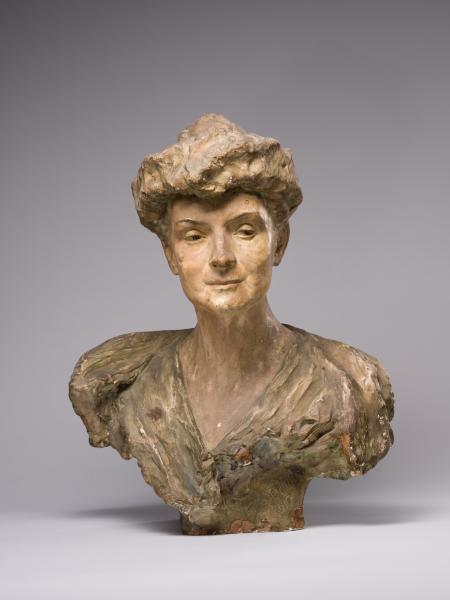
Basic information
- ID
- С-I-402
- Author
- Luna Drexler
- Name
- Bust of a Woman
- Date of creation
- 1907
- Country
- Austro-Hungarian Empire
- Culture
- Contemporary times
- Technique
- moulding polychromy
- Material
- plaster polychrome vernix
- Dimensions (height x width x depth, cm)
- 54 x 45 x 26
Additionally
- Type
- sculpture 3D
- Genre
- portraiture
- Plot
- Portrait bust
- Provenance
- Collection of Leon Pininski State Collection of Art in Warsaw (branch in Lviv)
Information about author
Object description
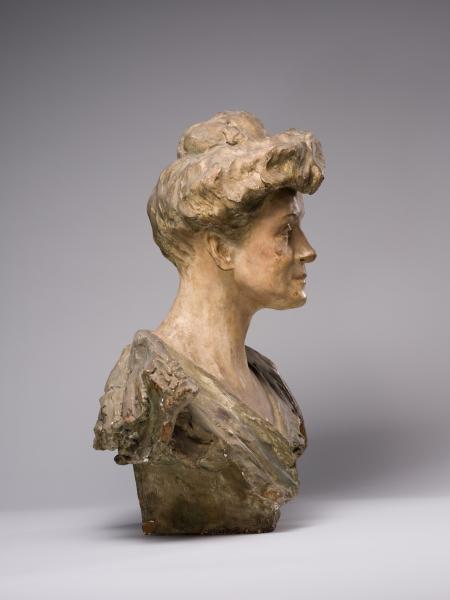
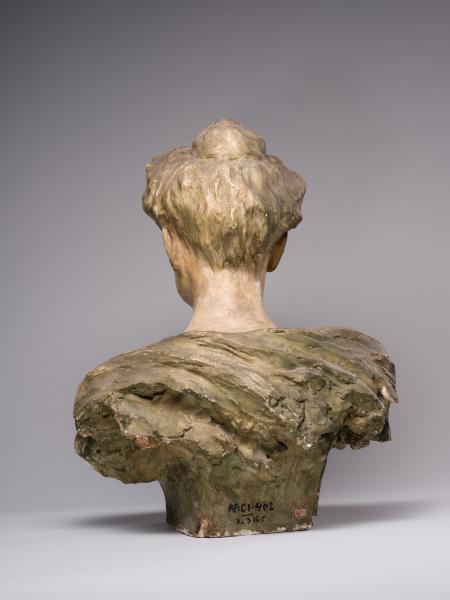
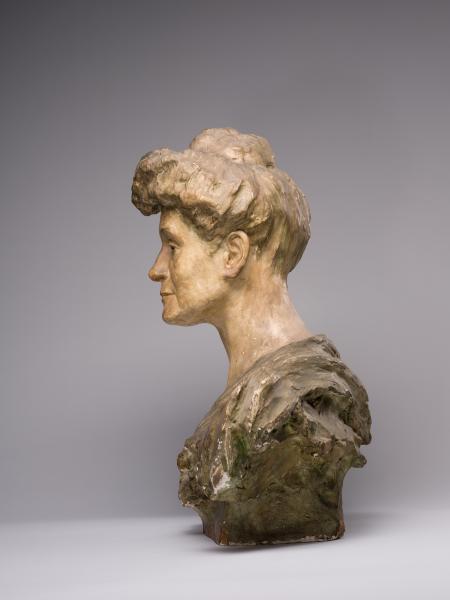
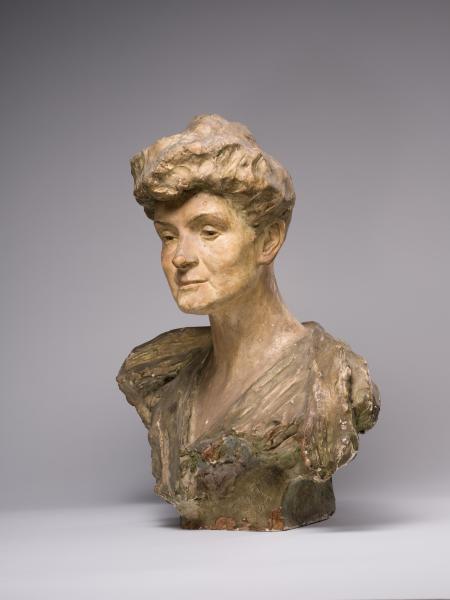
"Bust of a Woman" is one of the many female images in Luna Amalia Drexler's work, which combines refinement and conformity with inner strength, self-sufficiency, and self-confidence. The worldview and ideological basis of the portrait was the affirmation of women as full-fledged subjects of social and cultural life, characteristic of the turn of the 19th and 20th centuries, which was reflected institutionally in the feminist movement, including in Eastern Galicia. Feminism manifested itself in various ways, including the organisation of cultural and charitable associations, creative unions and specialised publications, aiming to establish women as a full-fledged subject of action, thought, will, and creativity. The early 1890s saw the emergence of a movement for the extension of women's educational rights, one of the achievements of which was the admission of women to universities as "extraordinary attendees" (from 1897). On 20 June 1906, the first Ukrainian girls' gymnasium of the classical type of the Basilian Sisters was opened in Lviv and operated until 1939. Its pedagogical concept was characterised by the development of emancipation ideas and the motivation of women to improve their educational level further. The development of feminism in Galicia was evidenced by women's participation in the region's political life: in electoral campaigns and in the activities of local authorities. A specific feature of the Galician women's movement was its differentiation into national branches, which interacted in the cultural field. The peculiarity of the figurative solution of "Bust of a Woman", inspired by the feminist worldview, is the reflection of the intellectual type, the movement of thought, inner consolidation, and intense spiritual life. What attracts attention is the revealing of the distinctive, essential through momentary facial expressions, a glance of the eyes, and a turn of the head. The representation is characterised by "communicativeness", modelling the situation of an imaginary dialogue involving a potential interlocutor-viewer in the semantic and emotional space of the work. It is interesting to see the nuances of the subject's character and emotional state in a round view of the work. The portrait belongs to the early period of Luna Amalia Drexler's work, as evidenced by the Secessionist and Impressionist styles, the former reflected in the whimsical silhouette and hairstyle, the latter in the free sketch-like modelling of the outfit and the shimmering play of light and shadow. The artist's inherent synthesis of sculptural and painterly means of expression is evident in the cool green tint of the elements of the sculptural forms. The image features combine sophisticated stylisation, decorativeness, and the age and physiognomic authenticity of the person portrayed.
Inscriptions
Signature and date: "DREXLERÓWNA / 07 II"; sticker on the back: "4173".
Legal regulation
Borys Voznytskyi Lviv National Art Gallery