Bust of a Girl

Stanislaw Kazimierz Ostrowski
Basic information
ID
С-I-1966
Author
Stanislaw Kazimierz Ostrowski
Name
Bust of a Girl
Date of creation
1909
Country
Austro-Hungarian Empire
Culture
Contemporary times
Technique
moulding polychrome
Material
plaster
Dimensions (height x width x depth, cm)
40 x 48 x 27.4
Additionally
Information about author
Author
Stanislaw Kazimierz Ostrowski
Artist's lifetime
1879–1947
Country
Austro-Hungarian Empire, Poland, France, the USA
Biography
Stanislaw Kazimierz Ostrowski (8.05.1879, Warsaw – 13.05.1947, New York) was a sculptor from Lviv, the son of the famous sculptor Kazimierz Witold Ostrowski. He was born in Warsaw. After his father's death, he moved to Lviv, where he was brought up by his grandfather Jozef. After graduating from the Franz Josef I Gymnasium in 1894–1895, he studied at the Art and Industrial School in the Drawing, Modelling and Decorative Painting Department. In 1895–1897 and 1899–1900, he studied sculpture at the Krakow Academy of Fine Arts under Alfred Daun and Konstanty Laszczka. Thanks to scholarships from the Lviv Magistrate and the Regional Department, he continued his studies in 1898–1899 in Rome and Florence at the studio of Augusto Rivalta. Between 1899 and 1901, he lived in Warsaw, where he co-founded the literary and artistic journal "Chimera". In 1899, he exhibited his first works – portrait plates and busts – in Lviv. In 1901, he married the famous Polish poet Bronislawa Edmunda Brzezicka. During his time in Warsaw, he created numerous portraits of artists and writers, some of which were inspired by the Italian Renaissance. In 1902–1905, he lived in Lviv, where he opened a studio, first in the European Hotel and later in the house of Jan Gwalbert Pawlikowski at 5 Third of May Street (now Sichovykh Striltsiv Street). In December 1902, he organised his first solo exhibition in Lviv, where he exhibited 13 plaster panels and portrait medallions in bronze-coloured plaster. Critics praised the young sculptor's work, noting its modernist, Secessionist style. "He is a modernist to the core," wrote Z. Sarnetskyi in the "Lvivska Gazeta" (1903), "he looks deeply into the depths of the portrayed person". In 1903, S. Ostrowski taught sculpture at the private school of the artist Stanislaw Batowski-Kaczor in Lviv. He worked in the field of portrait sculpture. In March 1904, the artist participated in the Lviv exhibition "Group of Four". In the spring of 1905, he exhibited new works in the Lviv Society of Fine Arts Admirers Salon. In the autumn of 1905 – early 1906, the artist held his second solo exhibition in Lviv. The sculptor's works of 1903–1906 are marked by the influence of A. Rodin, Symbolism, and Secession. Asymmetry, compositional abbreviations, verticalism, expressiveness of silhouettes and tectonicity characterise them. In many works, we can see a synthesis of the artistic means of expression of painting and sculpture, polychromy, the effect of the "non finito", the affectation of movement, sharp depressions and surface protrusions. Some of the sculptures exhibited at Ostrowski's personal exhibition in 1905–1906 show the transition from Secession to early Expressionism. The sculptor's work in the field of monumental plasticity is marked by the competition project of the new fountain of the Virgin Mary at the beginning of the Hetman's Vale (now Svobody Avenue) and the tombstone of Piotr Chmielowski in the Lychakiv cemetery. In May 1906, Ostrowski moved from Lviv to Munich. From 1906 to 1913, he lived in Paris, where in 1910 he founded the Society of Polish Artists. From 1913, he worked in Warsaw. In 1938–1939, he lived in Italy, and since 1941, he lived in New York. He died in New York in 1945.
Object description
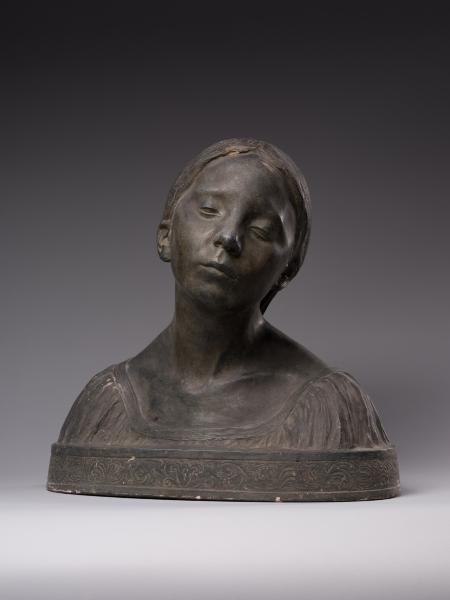
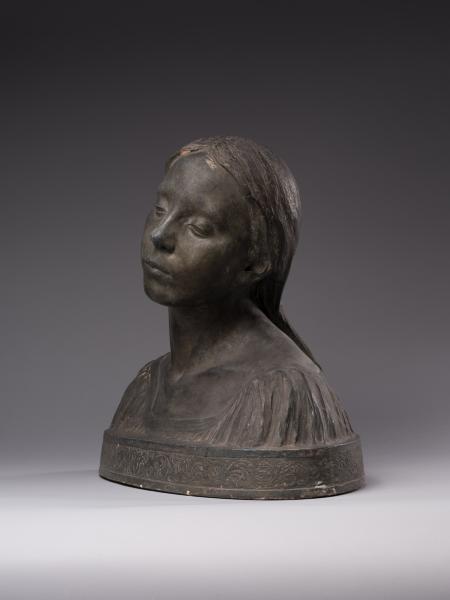
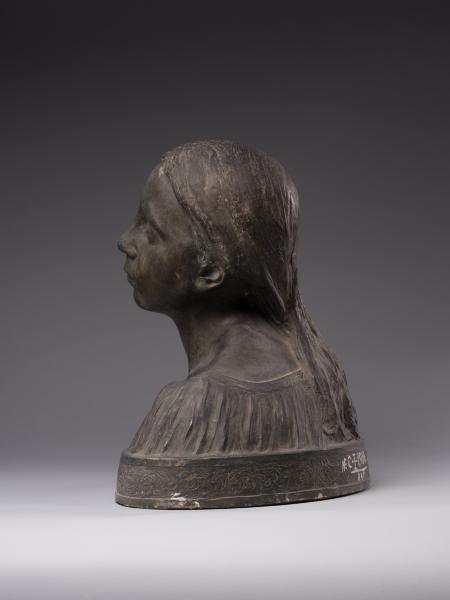
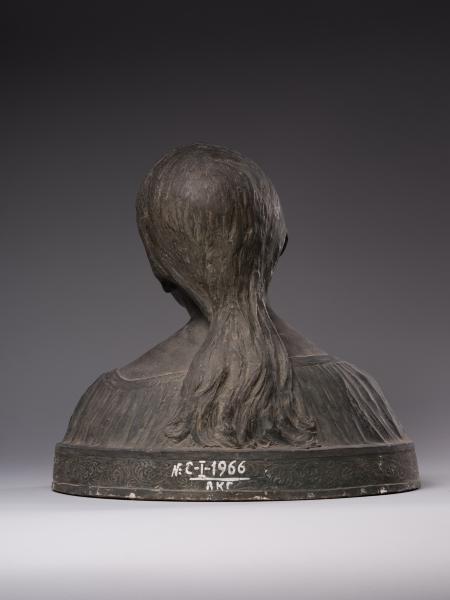
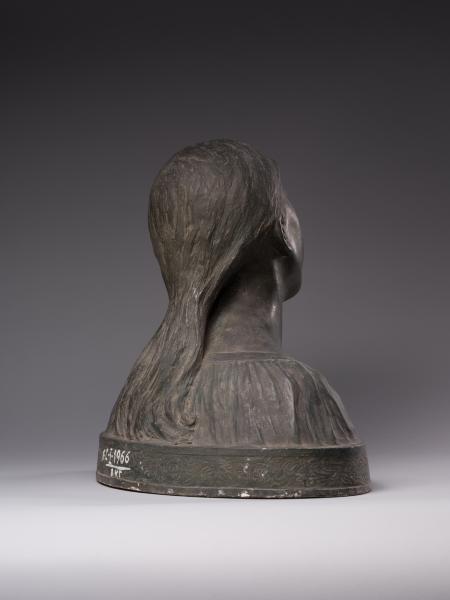
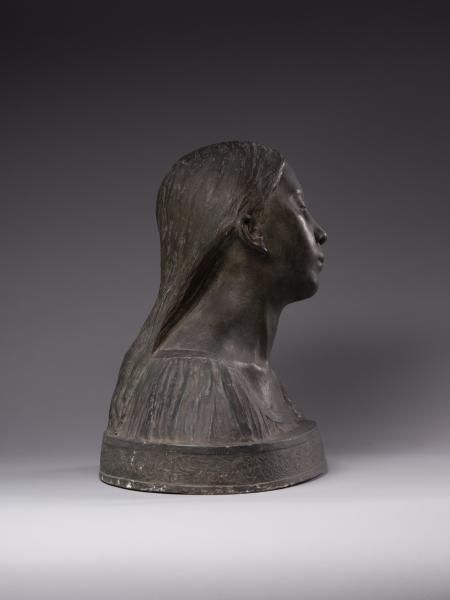
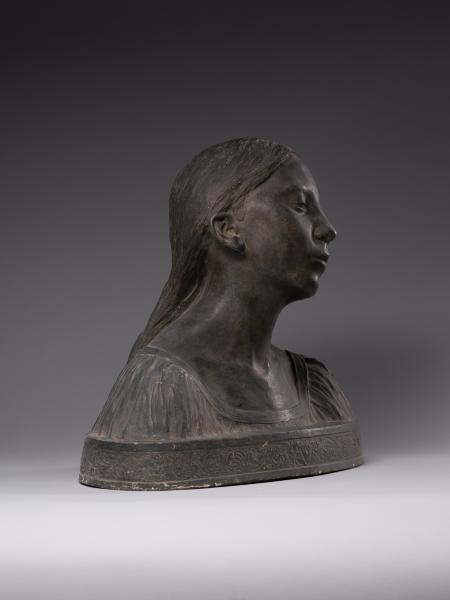
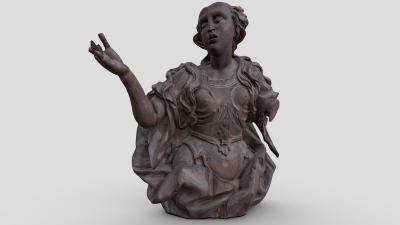
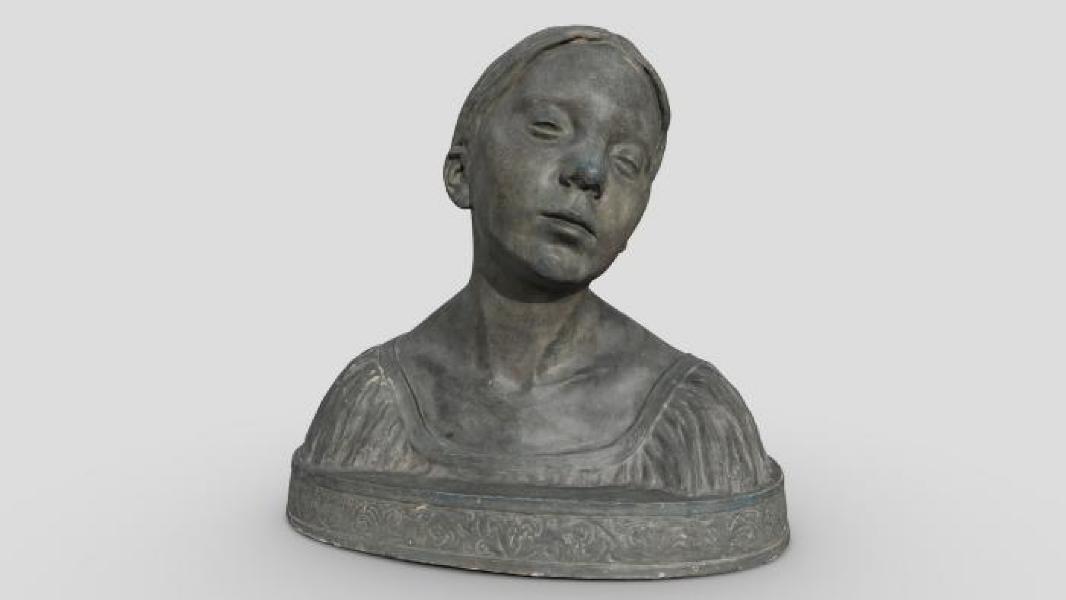
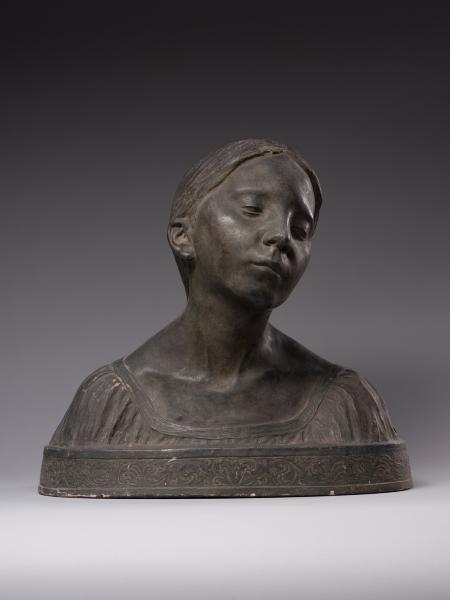
The "Bust of a Girl" (1909), from the collection of Borys Voznytskyi Lviv National Art Gallery, belongs to the artist's mature Paris period. The portrait is marked by melancholy, dreaminess, and thoughtfulness, reflected in the face with closed eyes, fluid lines, and a languidly tilted head. The peculiarity of the work is the synthesis of the Neo-Renaissance style, expressed in the perfect modelling of volumes, clear tectonics, type, neckline and ornaments, and the emotional exaltation of the Secession, asymmetry, the refinement of the silhouette, the decorative treatment of the hair and the fabric of the dress. The work is related to the aesthetics of Symbolism through a combination of lyricism and pacified anxiety, understatement and the perception of the visual image as a link between the "world of ideas and the world of things" (E. Cassirer), the material and the spiritual, the manifest and the hidden, the known and the unknowable levels of existence.
Inscriptions
Signed and dated on the back: "Ostrow / 1909".
Legal regulation
Borys Voznytskyi Lviv National Art Gallery