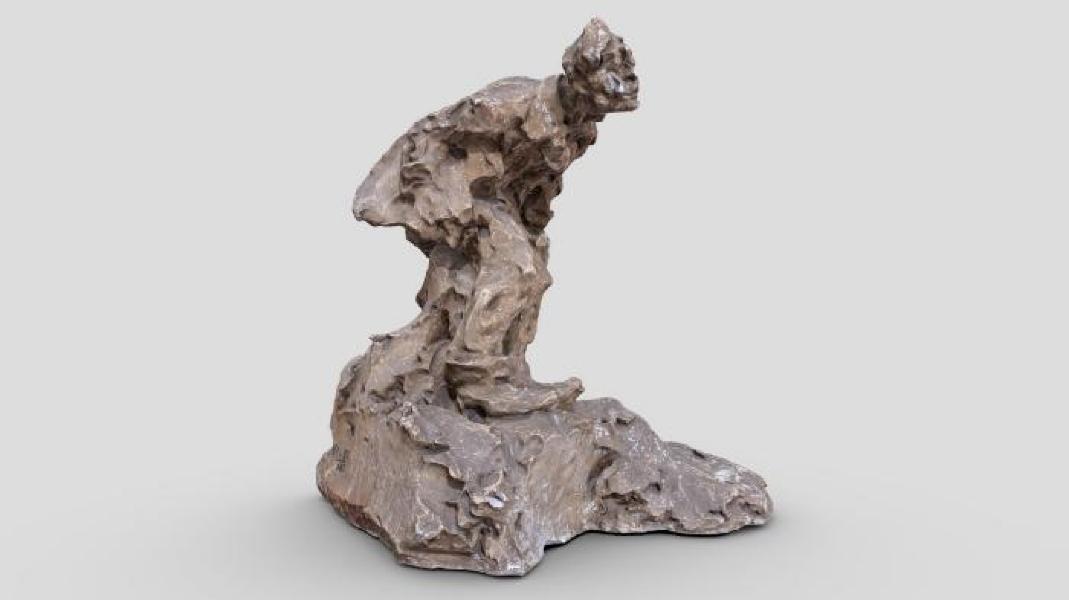
Painter (Male Figure)

Zygmunt Kurczynski
Basic information
ID
С-I-1012
Author
Zygmunt Kurczynski
Name
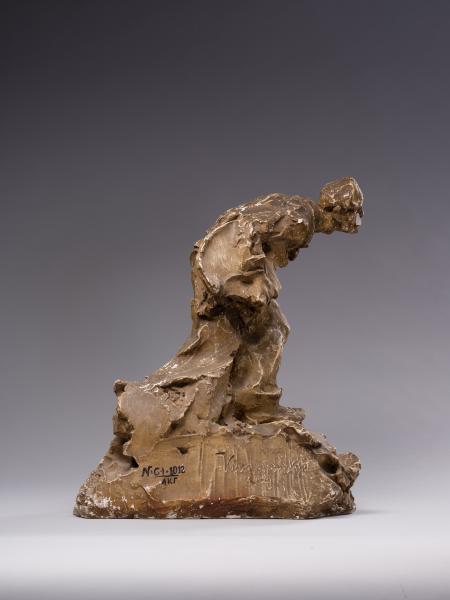
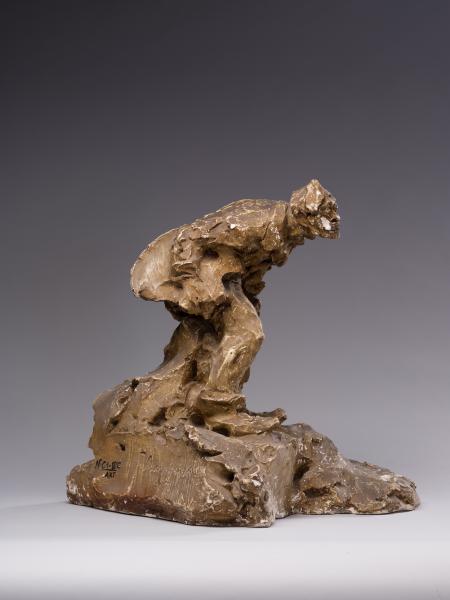
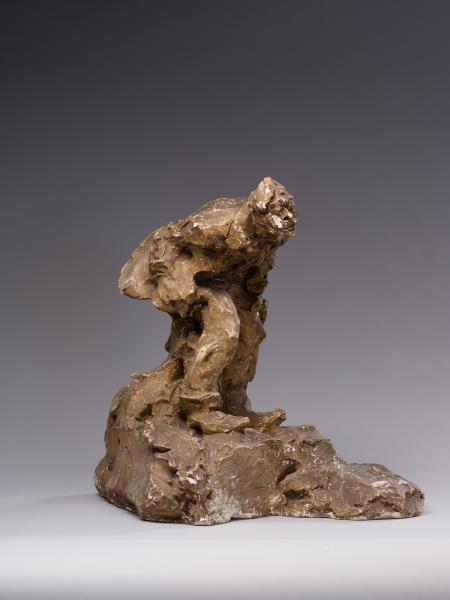
Painter (Male Figure)
Date of creation
1909
Country
Austro-Hungarian Empire
Culture
Contemporary times
Technique
moulding polychrome
Material
plaster
Dimensions (height x width x depth, cm)
44 x 41 x 38
Additionally
Information about author
Author
Zygmunt Kurczynski
Artist's lifetime
1886–1953/54 (?)
Country
Austro-Hungarian Empire, Poland, the Ukrainian SSR,
Biography
Zygmunt Kurczynski (2 April 1886, Lviv – 11 March 1953 (1954 /?/), Wroclaw) was a Polish sculptor and graphic artist. He was born in Lviv in the family of a tailor, Stanislaw Kurczynski, who had a workshop at 8 Krakivska Street. During his childhood and youth, he lived in poverty. From 1901 to 1905, he studied at the Lviv Art and Industrial School under T. Wisniowski and J. Beltowski. From 1905 to 1908, he continued his studies at the Krakow Academy of Fine Arts under K. Laszczka, who considered him one of the best students and saw an outstanding professional future for him. He was awarded a silver medal at the Academy for the "Drunken Faun" sculpture. After graduating, he went to Munich. In 1908, he spent several months in Paris, where he studied with P. Troubetzkoy and worked as a stonemason in the studio of A. Rodin. He developed his artistic style based on a synthesis of inspiration from Impressionism, Secession, Symbolism, and Greek Archaism. Returning to Lviv in 1908, he set up a studio in the Palace of Arts in Stryiskyi Park and received numerous commissions and recognition. Over the next decade, he created over 200 sculptures of various genres and forms in tinted plaster, marble, tin and bronze. Z. Kurczynski's creative development reached its peak in 1915–1918. The development of the sculptor's artistic style after 1918 is marked by a transition from Secessionist pictorial and graphic decorativeness and symbolic imagery to the stylisation of the archaic in the spirit of E.A. Bourdelle, neoclassical and neo-Baroque forms. Monumental and decorative sculptures, which adorned numerous buildings built in Lviv in 1908–1914, formed an essential part of the artist's work. Their artistic solutions were characterised by skilfully adapting to the architectural structures, strengthening the frontality, neutralising volumes, and emphasising contours. In 1919–1939, Z. Kurczynski taught drawing and sculpture at the Art and Industrial School and the St. Jadwiga Gymnasium. In the 1920s, he worked as a painter and graphic artist. He was elected to the town council. In 1924, he became vice-president of the Union of Artists of Eastern Malopolska. As an art critic, he collaborated with the Polish magazines "New Age", "Morning and Evening Newspaper", and "Lviv Courier". From 1944 to 1945, he was a member of the Lviv branch of the Union of Artists of Ukraine. In 1946, he moved to Wroclaw, where he taught at the Polytechnic from 1947 to 1948.
Object description
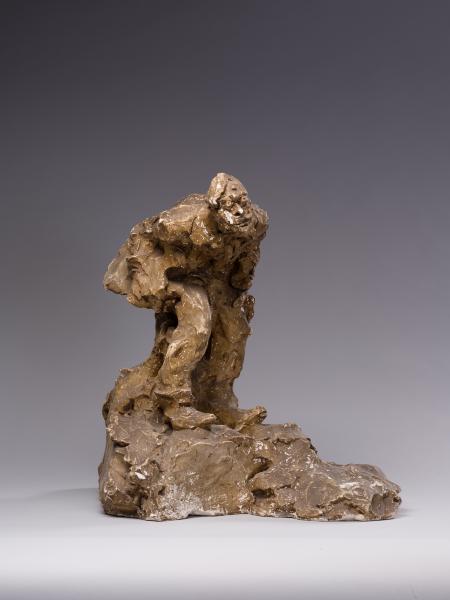
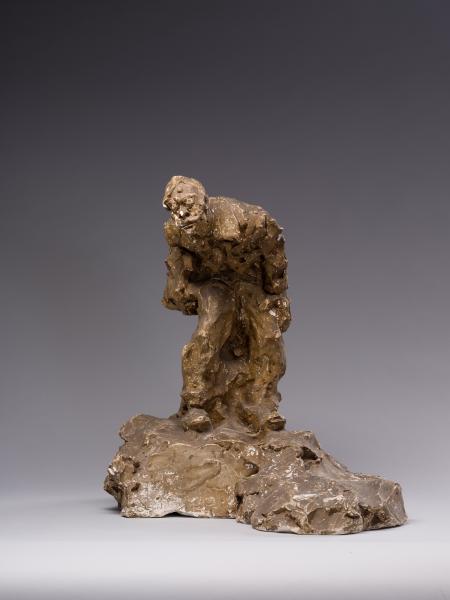
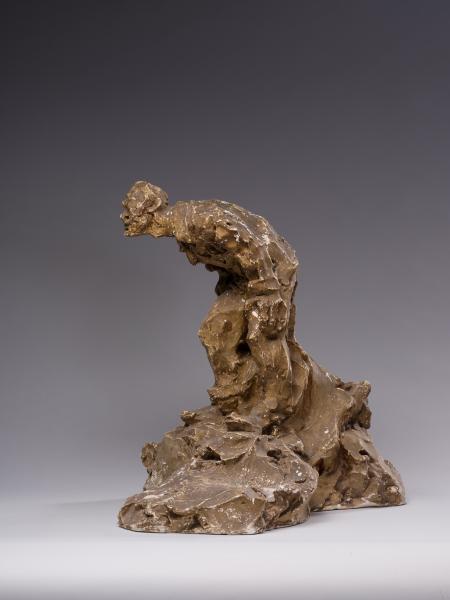
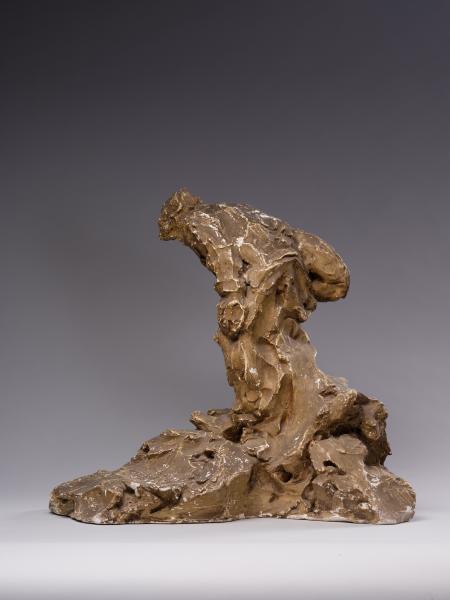
The sculpture "Painter" (1909) was created after Z. Kurczynski's return to Lviv in 1908, during the most prominent period of the artist's activity. Marked by professional maturity, it was full of shaping experiments and testing the possibilities of various artistic systems, including Expressionist plastics and imagery. Small in size, with a dynamic, almost churned-up surface tinted with brownish-brown paint, the work demonstrates the possibilities of "sculpturalism", a synthesis of different art forms. Resembling a shapeless mass from which emerges the clumsy, bent figure of a man with a palette, barely walking on an uneven surface, it is perceived as a caricature, an artistic experiment, an ironic paraphrase of sublime Symbolist imagery. The peculiarity of the figure is its knotted expressive texture, which seems to preserve the impulsive touches of the artist's fingers. According to M. Olszewski's remarks on other early Expressionist works by Z. Kurczynski, exhibited at the " Exhibition of Three" in 1911, the sculptor "pulled" clay and plaster "in a jerky, staccato manner". A similar shaping combined with geometric volumes is inherent in the sculpture "Musician" from 1910. The dematerialisation of the sculptural mass and the emotional expression through the texture of the sculpture's surface resonate with A. Rodin's late work. The use of a "disturbed" texture can be seen in the master's monumental and decorative compositions, particularly in the statues on the pediment of the building of the Trieste Insurance Company at 3 Kopernyka Street. "Painter" is one of nine easel paintings by the sculptor preserved in Lviv today, eight of which are in museum collections and one in a private collection.
Inscriptions
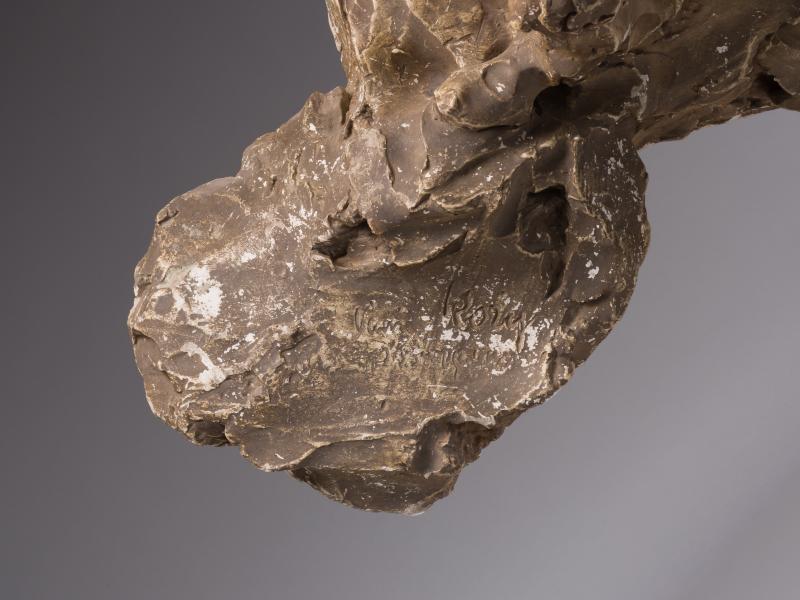
Signed and dated on the back: "Kurczyński / 909".
Legal regulation
Borys Voznytskyi Lviv National Art Gallery