The Punishment of Marsyas
Guglielmo della Porta


Basic information
- ID
- С-II-676
- Author
- Guglielmo della Porta
- Name
- The Punishment of Marsyas
- Date of creation
- 16th – early 17th c.
- Country
- Italy
- Technique
- moulding
- Material
- bronze
- Dimensions (diameter, cm)
- 12.3
Additionally
Information about author
Object description
A round version of an octagonal plaque, part of a series of original plaques that were popular in Europe throughout the 16th and early 17th centuries. The work is based on the mythological story of the satyr Marsyas, who dared to challenge the god Apollo to a contest of musical instruments. Apollo won, but for his insolence, he ordered Marsyas’ skin to be flayed and hung on a tree. The composition of the plaque emphasises the central vertical line, where the satyr is hanging from a tree. Below is a figure with a knife, which the executioner will use to flay the satyr’s skin. On either side of the tree are figures of various ancient characters – Hercules, Mercury, and King Midas, who acted as judge in the duel between the Olympic god and the satyr. An octagonal version of the work is kept in the Metropolitan Museum of Art in New York.
Inscriptions
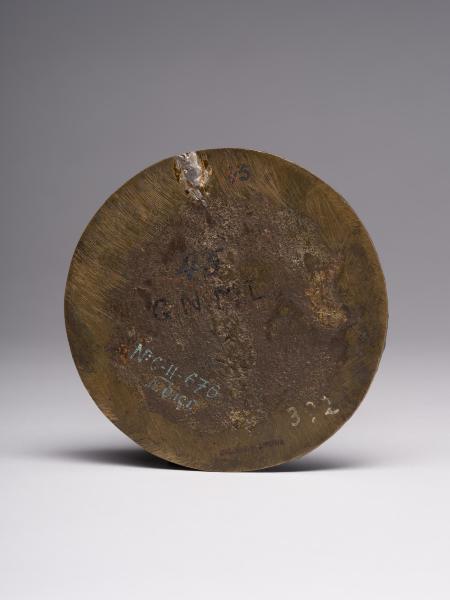
On the reverse side are inscriptions: "45"; "45.G.N.M.L."; "392"; "№ С-ІІ-676 Львів ОКГ"; "№ С-ІІ-676 / Львів ОКГ"; mark "Gal. Nar. m. Lwowa".
Legal regulation
Borys Voznytskyi Lviv National Art Gallery