Drawings of Literary Characters
Yulian Zaiats


Basic information
- ID
- Ф-З-Арх-ЛГМ-7/11
- Author
- Yulian Zaiats
- Name
- Drawings of Literary Characters
- Date of creation
- 12.06.1962
- Country
- the Ukrainian SSR
- Technique
- drawing
- Material
- paper pencil Indian ink
- Dimensions (height x width, cm)
- 20.4 x 28.5
Additionally
- Type
- graphic art
- Genre
- symbolic art
- Provenance
- Received from Nina Zaiats
Information about author
Object description
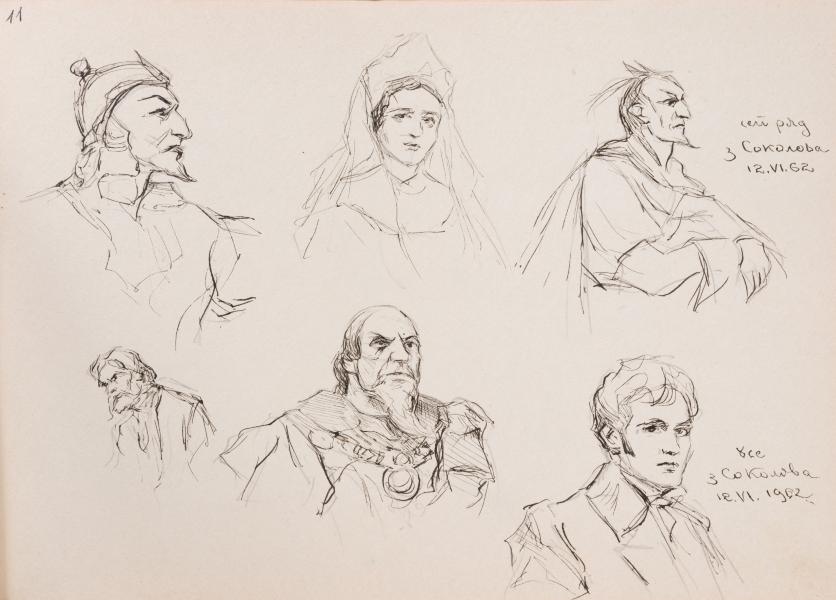
The sheet contains a series of copies of works by the artist Sokolov, who worked in the genres of portraiture and historical imagery. The first row presents three separate figures in different angles and costumes, painted in Sokolov's characteristic manner, but reinterpreted through the technical language of the copyist. The first image is a full-length profile portrait of a man in 17th-century attire. Particular attention is paid to the shape of the headdress and the expressiveness of the silhouette, which is distinguished by its clear lines and concise modelling of volume. The second image is a full-length portrait of a female in profile. The head is adorned with a kokoshnik, which emphasises the ethnographic and theatrical nature of the image. The model's face is presented symmetrically, which gives it a static quality, emphasising its traditional archetypal nature. The third character is a half-length portrait of a man in profile, likely of noble status, as indicated by the details of his costume. The lines of the shoulders, the folds of the clothing, and the details of the headdress are drawn with attention to the source material. The second row features a series of bust-length male portraits, painted in a concise manner yet still conveying psychological expressiveness. The first portrait is of an elderly man, probably a peasant or a minor townsman. His facial features are marked by pronounced wrinkles, and the shape of his head is depicted schematically, with an emphasis on facial expression rather than portrait identity. The second type is a figure in rich clothing with an authoritative posture. This is probably the image of a voivode or boyar, as evidenced by the clothing, the massiveness of the figure, and the emphatically serious expression on the face. The third image is a younger man in 19th-century fashionable outerwear. The figure has romantic features, possibly based on portraits of noble youth or officials of the era. The stylisation of the clothing and hairstyle gives the work the characteristics of a literary interpretation. Overall, the work is a valuable example of educational and research copying of historical portrait models, focusing not only on the technical reproduction of external features but also on the study of the type system, psychological characteristics, and costume richness from sources of classical graphics.
Inscriptions
On the right side are the inscriptions: "This row is from Sokolov"; "12.VI.62"; "All from Sokolov"; "12.VI.62".
Legal regulation
Borys Voznytskyi Lviv National Art Gallery