Drawings of Literary Characters

Yulian Zaiats

  • Drawings of Literary Characters 2
  • Drawings of Literary Characters 3
Basic information
ID
Ф-З-Арх-ЛГМ-7/17
Author
Yulian Zaiats
Name
Drawings of Literary Characters
Date of creation
02.08.1962– 04.08.1962
Country
the Ukrainian SSR
Technique
drawing
Material
paper pencil Indian ink
Dimensions (height x width, cm)
20.4 x 28.5
Additionally
Information about author
Author
Yulian Zaiats
Artist's lifetime
1880–1971
Country
Austro-Hungarian Empire, the Second Polish Republic, the USSR
Biography
Yulian Zaiats (May 30, 1880, Bohutyn, Austro-Hungarian Empire, now Pomoriany district, Lviv region – September 2, 1971, Lviv, Ukrainian SSR) was a Ukrainian artist, lawyer, scholar, bibliographer, and cultural figure. According to some sources, he was the son of a Greek Catholic priest.

He initially studied at a gymnasium in Lviv (graduating with honours in 1899). The artist then enrolled in the law faculty of Lviv University, but for political reasons transferred to the Jagiellonian University in Krakow (1901). At the same time, he enrolled in the Kraków Academy of Fine Arts, where he studied under Leon Jan Wyczółkowski (11 April 1852 – 27 December 1936). According to researcher Oleh Kupchynskyi, he was actively involved in research work. In 1902, he submitted his scientific work, "Usus fructus nominis", to the historical and philosophical section of the Shevchenko Scientific Society, which was published in the "Journal of Law and Economics." It should be noted that, based on the results of this work, Julian Zayats defended his doctoral dissertation in 1907. He then worked as a lawyer in the State Treasury Prosecutor's Office (Lviv). In addition, in 1909 and 1912, he improved his legal qualifications in Berlin, where he prepared a scientific work entitled "Jus iurandum in litem." According to researcher Oleh Kupchynskyi, he attended lectures at the Berlin Academy of Arts by the renowned German painter and graphic artist of Jewish origin, Max Liebermann (July 20, 1847–February 8, 1935). However, during this period, the artist did not teach regularly at this institution and was only appointed to the Senate of the Berlin Academy of Arts in 1912.

It should be noted that after World War I, Yulian Zaiats worked as an employee of a private law firm in Komarne (now the centre of the Komarne municipal community in the Lviv region), and later as a lawyer in Lviv. Yulian Zaiats also taught Roman law at the Ukrainian Secret University and was a permanent legal advisor to Metropolitan Andrei Sheptytskyi. He joined the Legal Commission of the Shevchenko Scientific Society and became a member of one of the key parties in the region at that time, the Ukrainian National Democratic Union. During the Second Polish Republic (1918–1939), Yulian Zaiats authored appeals to the League of Nations and the Vatican regarding the violent measures against Ukrainians within the framework of military-police terror, the so-called “Polish pacification”, initiated by the leader of this state entity, Jozef Pilsudski. At the same time, in the 1920s, he was invited to work at the Lviv branch of the Financial Prosecutor's Office of the Polish State Treasury. Later, before the annexation of the western Ukrainian lands to the Ukrainian SSR, he was a judge of the Supreme Administrative Tribunal of Poland in Warsaw (1939). From 1941, he was president of the Court of Appeal (Lviv).

After the end of the Nazi occupation, he was arrested as a person who could have been involved in the crimes of the occupiers. At the request of the intelligentsia (according to documents from the archives of the Security Service of Ukraine, first published in the works of scholars Mykola Kobyletskyi and Lesia Trepak), in particular, Metropolitan Andrei Sheptytskyi, and the head of the National Museum, Ilarion Svientsitskyi, the criminal case against Yulian Zaiats was closed. In 1945, he began teaching at Lviv State University, and from 1946, he worked as a bibliographer at the Scientific Library of the V. Stefanyk Academy of Sciences of the Ukrainian SSR. In 1951, the artist failed to pass the certification due to a lack of professional qualifications, but with the permission of the Certification Commission, he held the position of librarian from 1953 until his retirement.

During his time as a bibliographer, Yulian Zaiats produced a number of bibliographic works: “Materials for the Bibliography of M. Voznyak” (1946), “Bibliography of the works of M. P. Drahomanov” (1947, co-authored), “Bibliography of the history of the city of Lviv” (parts 1–2, 1948) – however, none of them were ever published. He was into collecting art and old books, and did some painting and drawing. Participated in art exhibitions in Lviv (1929–1932, 1934, 1935, 1937, 1943; National Museum and Ukrainian Society of Art Lovers), in Warsaw (Polish Society of Art Lovers in the “Zachęta” Salon), and other cities. Among his well-known works are “Lady in Blue”, “Daughter”, “Self-Portrait”, “Boy”, “Church in Krasne”, “Church in Kryvchytsi”, Flowers”, and “The Kaminka River”, which were highly praised in the press and exhibition catalogues of the time.

Additionally, he possessed a distinctive vocal talent and a powerful tenor voice. According to researcher Oleh Kupchynskyi, he graduated from the Lviv Conservatory (class of Nestor Nyzhankivsky). However, from 1928, Nestor Nyzhankivsky (August 31, 1893–April 10, 1940) taught at the Mykola Lysenko Higher Music Institute in Lviv. Also, according to Oleh Kupchynskyi, Yulian Zaiats performed solo concerts in Lviv, Warsaw, and other cities and participated in annual holiday programs for Shevchenko Days in Galicia. Between 1920 and 1926, he served as the leader of the “Muse” singing society. As for the artist's legacy, thanks to the efforts of Ilarion Svientsitskyi, a significant collection of his works is housed in the Andrei Sheptytskyi National Museum in Lviv, and some works are in the art department of the Lviv Library of the Vasyl Stefanyk National Academy of Sciences. According to researchers Mykola Kobyletskyi and Lesia Trepak, twenty works by Yulian Zaiats were purchased by the State Tretyakov Gallery in Moscow.

An important part of Yulian Zaiats' creative legacy is a series of graphic works currently stored in the Archive of Artists and Cultural Figures of the Borys Voznytskyi Lviv National Art Gallery, which provide valuable insights into the specifics of the educational process as well as the priorities in more conservative artistic circles focused on developing a realistic visual language through careful study of nature and the creative work of artists of past eras, especially those who practised the faithful reproduction of people and the world around them.
Object description
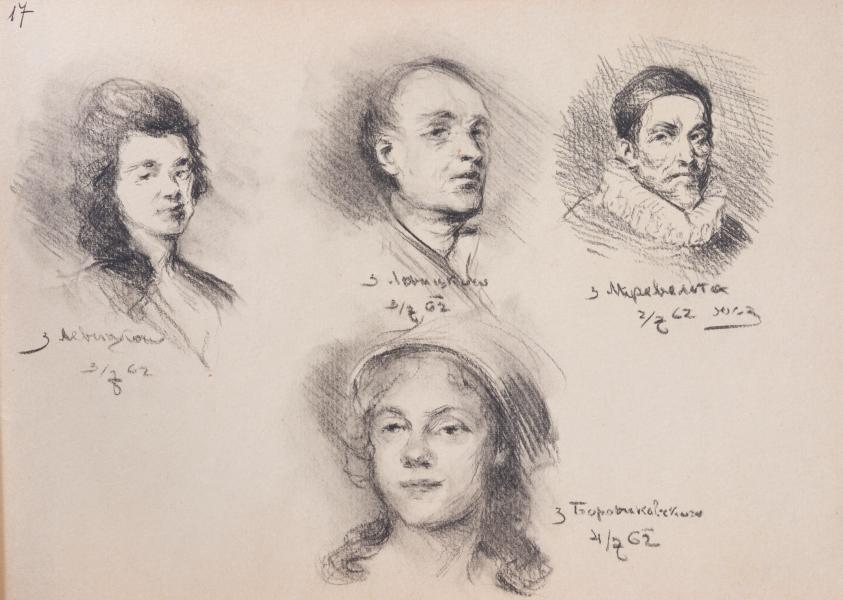
A series of pencil drawings based on the works of renowned European and Ukrainian portrait painters of the 18th and early 19th centuries, demonstrating a focused study of the stylistic and compositional decisions of three famous artists: Dmytro Levytskyi, Michiel Jansz. van Mierevelt, and Volodymyr Borovykovskyi. The author of these drawings clearly not only practised copying, but also conducted in-depth stylistic and plastic research, probably with the aim of further using the motifs in his own artistic practice. The first drawing on the sheet depicts a woman with a high neckline and luxurious hairstyle, stylistically similar to Dmytro Levytskyi's formal female portraits. The figure is depicted in profile, with a slight turn of the shoulders, which gives the image a sense of dynamism. The lines are soft and careful, skilfully reproducing the volume of the body and the delicacy of the facial features. The hairstyle is pulled up high, structured, and conveyed with particular attention to the plasticity of the strands, characteristic of the fashion of the second half of the 18th century. This drawing is not so much a direct copy as a careful stylisation that captures the spirit and visual rhythm of D. Levytskyi, his ability to combine solemnity with psychological warmth. The second portrait, depicting Denis Diderot, also refers to the work of Levytskyi. The author of the drawing reproduces the composition characteristic of Levytskyi: a half-turn, soft modelling of the face, and light chiaroscuro sculpting of shapes. The attention to the gaze indicates an attempt to penetrate the depth of the psychological characterisation of the subject. At the same time, the simplicity and restraint of the lines preserve the freedom and delicacy of the drawing. Of particular interest is the portrait of Johan van Oldenbarnevelt, a copy after a work by the Dutch artist Michiel Jansz van Mierevelt. The drawing reproduces the master's characteristic type of formal male portrait: a stern image, a solemn posture, and a dignified figure. The author carefully conveys the plasticly modelled facial features, sparse, restrained, yet confident lines that form the image of an elderly man with a short beard, wearing a headdress. Light and shadow are used judiciously, without excessive contrast, as a means of defining volume rather than dramatisation. The last portrait in the series is that of Kateryna Arsenieva, based on the work of the same name by Volodymyr Borovykovskyi. The author recreates the face and part of the shoulder girdle of a young woman, focusing on the soft outline of the silhouette, the gentle expression of the face, and the slightly raised eyebrows, which give the gaze a slightly pensive character. The hairstyle and part of the headdress are rendered with decorative ease, in accordance with the aesthetics of sentimentalism characteristic of Borovykovskyi. Particular attention is paid to the face: subtle hatching and delicate play of half-shadows allow us to feel the inner world of the model, not ceremonial, but intimate and contemplative. Overall, this series of pencil drawings demonstrates the author's profound knowledge of the traditions of European and Ukrainian portrait art, as well as the purposefulness of his research method. Such drawings were obviously not mechanical copies, but rather exercises in mastering stylistic models, plastic techniques, and ways of interpreting the human image, which could serve as a basis for further individual artistic decisions.
Inscriptions
From left to right: "From Levytskyi"; "3/8 62"; "From Levytskyi"; "3/8 62"; "From Mierevelt"; "2/8 62"; Yulian Zaiats' signature; "From Borovykovskyi"; "4/8 62".
Portrayed person
The name of the person portrayed
Denis Diderot (05.10.1713–31.07.1784), Johan van Oldenbarnevelt, Kateryna Arsenieva (1778–?)
Legal regulation
Borys Voznytskyi Lviv National Art Gallery