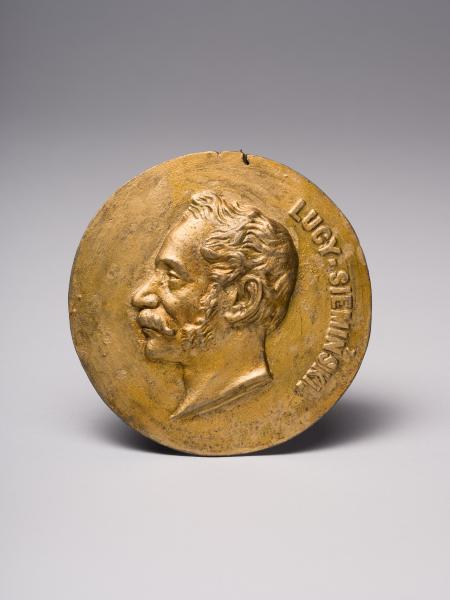
Medal “Lucjan Siemienski"
unknown


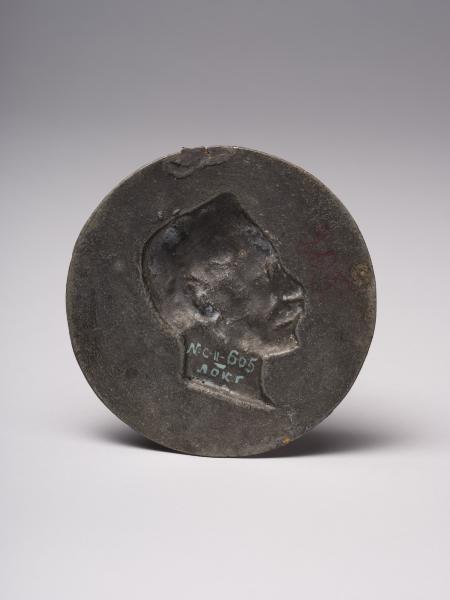
Basic information
- ID
- С-II-605
- Author
- unknown
- Name
- Medal “Lucjan Siemienski"
- Country
- Kingdom of Poland (?)
- Culture
- Modern times
- Technique
- moulding
- Material
- lead gilt
- Dimensions (diameter, cm)
- 12
Additionally
- Type
- sculpture (relief)
- Genre
- portraiture
- Plot
- Portrait
- Provenance
- the Dzieduszycki collection
Information about author
Object description
Lucjan Hipolit Siemieński (August 13, 1807 – November 27, 1877) was a Polish poet, writer, publicist, literary critic, translator, and participant in the November Uprising. He came from a noble family. He was educated at the Piarist Gymnasium in Lublin and the Gymnasium in Odesa. He took part in the November Uprising, was wounded, and was taken prisoner. After returning to Galicia, he joined the “Union of Twenty-One” – a secret organisation created in 1832 in Lviv by wealthy nobles and intellectuals of noble origin. He was friends with Seweryn Goszczyński (1801–1876) and belonged to the literary group Ziewonja (1832–1838), which advocated the creation of national literature by imitating the folk art of the Slavic peoples. In 1828, he made his debut in the “Wanda” magazine with the poem “The Wanderer“. He later wrote numerous poems inspired by Polish and Ukrainian folklore, biographical stories, and works on history and literature. In 1833, he translated fragments of “The Tale of Igor's Campaign“, poems by Michelangelo (in the compilation “Poezye Michała-Anioła Buonarrotego”), works by Horace, and Ukrainian folk songs. In 1838, he emigrated to France, where he joined the Polish Democratic Society. That same year, together with August Bielowski (1806–1876), he published translations of Ukrainian folk songs in the compilation “Thoughts”. In 1842, he published “Evenings under the Linden Tree, or the History of the Polish Nation, as Told by Grzegorz from Racławice” in Poznań, a popular account of Polish history. In 1848, he participated in the Slavic Congress in Prague. He settled in Krakow, where he was in contact with conservative circles that had formed around the publications of “Czas” and “Przegląd Polski”. In 1849–1852, he was the editor-in-chief, and in 1856–1860, the editor of the literary supplement of the newspaper “Czas”. In 1849–1850, he lectured on world literature at the Jagiellonian University. He was a co-founder and member of the Polish Academy of Sciences. In 1873, under the pseudonym “Odysseus the Slav”, he translated Homer's Odyssey into Polish. The artist died on November 27, 1877, in Krakow. He was buried in the Rakowicki Cemetery. In 1881, the ashes of Lucjan Hipolit Siemieński were transferred to the Tomb of Great Poles.
Inscriptions
"LUCY SIEMINSKI".
Portrayed person
- The name of the person portrayed
- Lucjan Hipolit Siemienski
- Lifetime of the person portrayed
- 13.08.1807–27.11.1877
Legal regulation
Borys Voznytskyi Lviv National Art Gallery