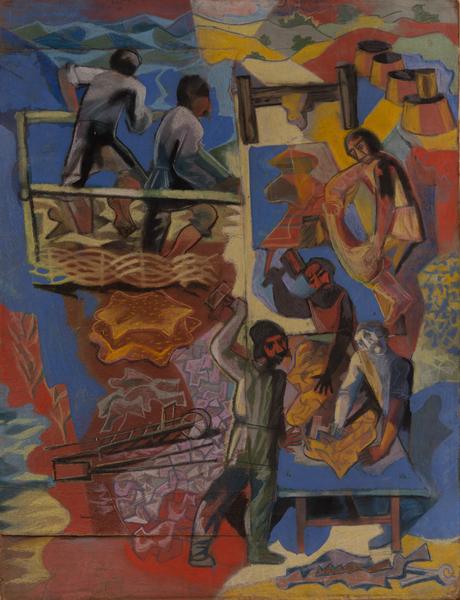
Sketch for a Mural on the Territory of the Lviv State Leather Enterprise (until 1976, the Svitanok Leather Company)
Vasyl Poliovyi


Basic information
- ID
- Г-II-331
- Author
- Vasyl Poliovyi
- Name
- Sketch for a Mural on the Territory of the Lviv State Leather Enterprise (until 1976, the Svitanok Leather Company)
- Date of creation
- 1970s (?)
- Country
- the USSR
- Culture
- Ukrainian art of the Soviet period
- Technique
- mixed technique
- Material
- cardboard pastel tempera (?)
- Dimensions (height x width, cm)
- 109.5 x 84
Additionally
- Type
- graphic art
- Genre
- symbolic art
- Plot
- Allegory
- Provenance
- Handed over to the museum from Vasyl Poliovyi
Information about author
Object description
The work is a sketch from a series of mural projects at the Lviv State Leather Enterprise (mural "History of Leather Production" for the institution's club, 1980). As in other sketches, the author visualises scenes from different stages of leather preparation (including soaking and stretching) at different periods in a synchronous stylistic form. In this sketch, the artist depicts the processing of raw materials in the early modern leather production process. Accurately determining the specific chronological period in which the events occur is challenging because the tools used by craftsmen were universal and widely used over the centuries. The characters' attire is equally conventional. The author combined several stages of production into one image and placed the characters in a stylised hilly landscape. Essentially, we are looking at a simultaneous narrative of how rawhide is transformed into material for various household items, ranging from clothing to interior elements such as cordovan leather wallpaper or book bindings. Leather has been an indispensable material for centuries due to the stability of its production processes, which have mainly been complicated by mechanisation and new chemicals for its processing (mainly tanning, which is still often carried out using the same vegetable-based substances used centuries ago). It is significant that a rather ordinary story, which can be seen, for example, in professional textbooks on the production of leather goods, is presented by Vasyl Poliovyi as complex in terms of colour and stylisation, referring to the practices of European modernism of the early twentieth century. Both in the group of two craftsmen performing the technological process in the left part of the work and in the group of four artisans working at the tables, there is an expressive dynamism and a vibrant colour scheme (contrasting combinations of green and red, ultramarine and yellow-ochre shades), which contribute to active observation. The artist's decorative language creates a certain illustrative detachment.
Legal regulation
Borys Voznytskyi Lviv National Art Gallery