Beach
Vasyl Poliovyi


Basic information
- ID
- Ж-6996
- Author
- Vasyl Poliovyi
- Name
- Beach
- Date of creation
- 1964
- Country
- the USSR
- Culture
- Ukrainian art of the Soviet period
- Technique
- original technique
- Material
- cardboard mixed media
- Dimensions (height x width, cm)
- 79 x 99.5
Additionally
- Type
- painting
- Genre
- genre art
- Provenance
- Handed over to the museum from Vasyl Poliovyi
Information about author
Object description
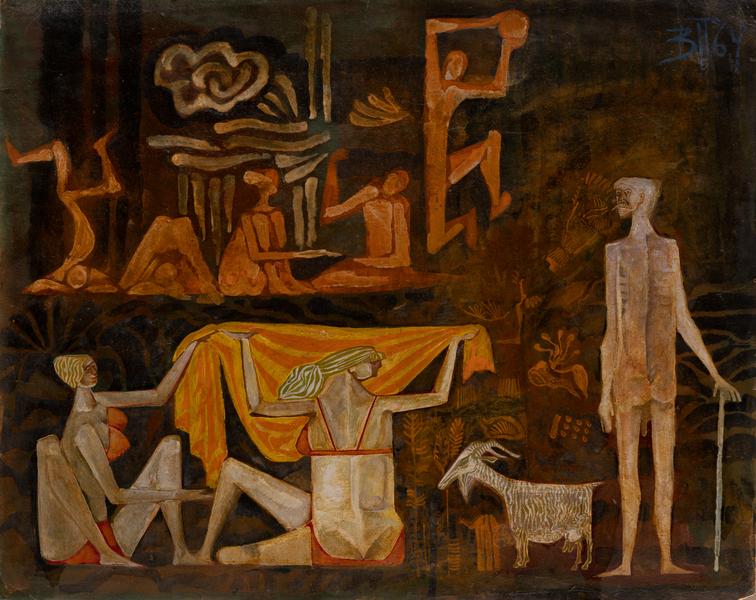
The work demonstrates some of the author's most interesting findings regarding composition interpretation and experiments with techniques, making the piece dynamic and nuanced. The colour palette is warm, dominated by earthy and ochre tones. The stylisation approach transforms the landscape background into a generalised decorative form with subtle allusions to vegetation and water. This interpretation of figures and the environment refers to archaic artistic practices, particularly primitive art, such as cave paintings. A group of five people in the background are performing gymnastic movements. The interpretation of their bodies, the colour and tone of their faces resemble characters from sites such as Serra da Capivara or South Sulawesi. The man on the far right uses sports equipment, possibly a ball or a shot. The man next to him is demonstrating the muscles of his right shoulder with a caricature grotesque gesture to the woman sitting next to him. The decorative light ochre stripes enhance this atmosphere. However, what is happening in the foreground makes the narrative somewhat ironic. On the left, in profile, there is an almost caricatured figure of a woman in a red swimsuit sitting next to a lady with a massive torso, slender limbs, and long light (bleached?) hair, also in a similar red swimsuit. She is holding a bright orange-yellow fabric (possibly a blanket), carefully examining a slender figure of a nude man standing in the lower right corner of the painting. This character of undetermined age has a long moustache and a cone-shaped headdress; he is holding a staff in his hands. Next to him, on the left side, there is a goat depicted in profile. The figure of the man is rendered grotesquely airy through the use of white glaze, which creates the impression of transparency and immateriality of his body. There is a visual contact between him and the women at the bottom of the artwork, but it is difficult to interpret it correctly.
Legal regulation
Borys Voznytskyi Lviv National Art Gallery