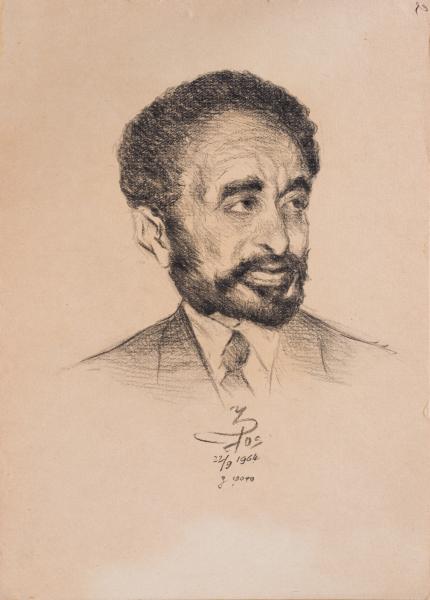
Portrait Drawing of a Man with a Beard
Yulian Zaiats


Basic information
- ID
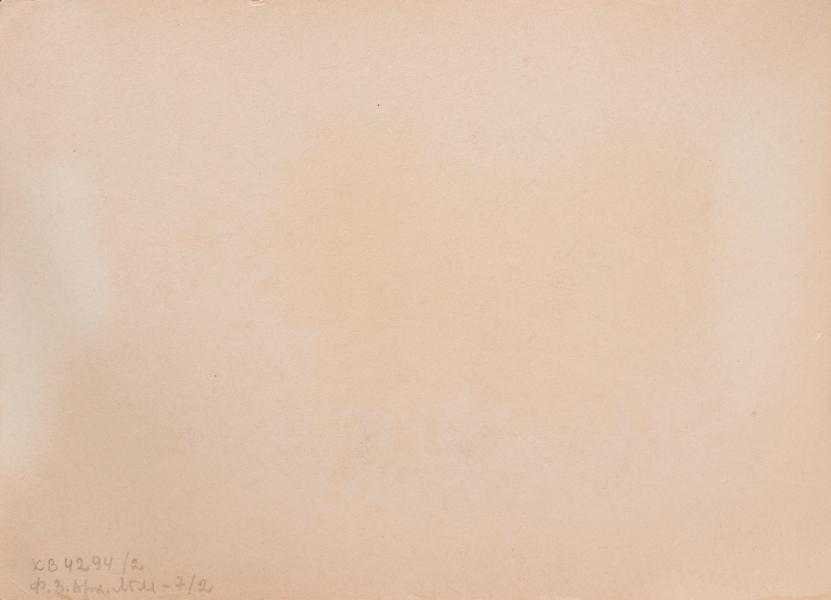
- Ф-З-Арх-ЛГМ-7/2
- Author
- Yulian Zaiats
- Name
- Portrait Drawing of a Man with a Beard
- Date of creation
- 22.09.1964
- Country
- the Ukrainian SSR
- Technique
- drawing
- Material
- paper pencil
- Dimensions (height x width, cm)
- 28.5 x 20.4
Additionally
- Type
- graphic art
- Genre
- portraiture
- Plot
- Portrait
- Provenance
- Received from Nina Zaiats
Information about author
Object description
The sheet features a close-up image of a male figure, drawn in graphite pencil, which is an interpretation of a well-known photograph of Emperor Haile Selassie I of Ethiopia. The work belongs to the mature period of the artist's career, when drawing was used not as an educational exercise, but as an autonomous form of visual research. Compositionally, the head is positioned at a right angle, creating a dynamic perspective and accentuating the facial features. The drawing is distinguished by its restraint in expressive means and, at the same time, a high degree of analytical elaboration of forms. The line is confident, plastic, with a distinct modulating rhythm; in some areas, it intensifies to a deeper tone, while in others, it barely touches the surface of the paper, hinting at the form without weighing it down. The volume is modelled not by large-scale hatching, but through the precise placement of accents: in the area of the eyes, nose, jawline, and cheekbones. Particular attention is paid to the facial expression, which is focused and inwardly collected, conveying dignity and self-control, as befits the historical image of Selassie as a statesman. Despite using a photographic source, the artist does not strive for a mechanical copy; instead, we see an interpretation of the image through the prism of the author's intonation and plastic generalisation. This transforms the fixation of a specific person into a symbolic figure, not devoid of portrait specificity, and preserves its essential features. The drawing is distinguished by its balanced composition and balanced rhythm of strokes. The clothing is conveyed in a generalised manner, without unnecessary detail, which allows the viewer to focus on the face as the main expressive element of the image. The absence of a background enhances the effect of the figure being "written out" against a neutral background, a typical technique in graphic portrait studies. This sheet is an example of purposeful graphic observation of a complex personality, in which technical restraint does not hinder the achievement of a profound psychological resonance. The artist demonstrates a confident mastery of academic drawing techniques while maintaining an individual style that is analytical and attentive to form, but devoid of dry schematism.
Inscriptions
In the centre, below the images: Yulian Zaiats' signature, "22/9 64", "from a photo".
Portrayed person
- The name of the person portrayed
- Haile Selassie I
- Lifetime of the person portrayed
- 23.07.1892–27.08.1975
Legal regulation
Borys Voznytskyi Lviv National Art Gallery