Academy of Lagado (Sheet 3 from the Graphic Cycle "Jonathan Swift's Kingdom of Absurdity")
Alexander Aksinin


Basic information
- ID
- Г-IV-3641
- Author
- Alexander Aksinin
- Name
- Academy of Lagado (Sheet 3 from the Graphic Cycle "Jonathan Swift's Kingdom of Absurdity")
- Date of creation
- 1978
- Technique
- etching
- Material
- imprint on paper
- Dimensions (height x width, cm)
- 29.5 x 29
Additionally
- Type
- printmaking
- Provenance
- Purchased and kept in permanent storage,1983
Information about author
Object description
Alexander Aksinin's legacy of graphic works contains a series of etchings based on some literary works, one of which is Jonathan Swift's "Gulliver's Travels" (1977–1978). In this series (as in others, such as Lewis Carroll's "Alice in Wonderland"), Aksinin often turned the texts into part of an image. The artist's creative world is characterised by a condensed intellectual atmosphere full of "codes of aesthetic information". The art critic Mykhailo Sokolov noted that the artist introduced into his works a subject line, which was to symbolically reproduce not a separate part of the text but to give the image of the text as a whole, as well as to serve as a sign and matrix of an illustrated verbal work.
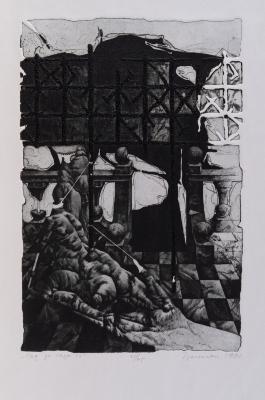
The work is the third sheet of 11 etchings from the graphic cycle "Jonathan Swift's Kingdom of Absurdity" and one of the earliest works by the artist. The third chapter of the book "Gulliver's Travels" written by Jonathan Swift, the Anglo-Irish satirist of the 17th–18th centuries, became the object of the author's allusion. Lemuel Gulliver, the hero of "Gulliver's Travels", was landed by pirates on the island of Balnibarbi, which the king of the flying island of Laputa ruled. In Lagado, the capital of Balnibarbi, the king had invested a great fortune on building an Academy of Projectors so that it shall contribute to the nation's development through research; however, the projectors' experiments and bizarre inventions are pointless, and ambitious "researchers" just dwell in their unreal world. Alexander Aksinin's composition is arranged in a circle-sphere, which looks like a pumpkin in this engraving. At the top, the fruit's rind is presented as an ocean space in which three sailboats were lost, referring to the fact that the hero came to the island on a ship. The peduncle resembles the curved Leaning Tower of Pisa topped with a hat (an allusion to poorly built houses in Lagado).
In the middle of the pumpkin is a vertically cut slice with its cavity forming the compositional emphasis in the work. A miniature character, sitting on the edge of the ocean surface, lowers down a fishing rod with a bucket filled with some substance into the cavity; the shadow of the bucket reflects in the form of an oval on the surface of a cutout slice. Empty bowls fly down diagonally below. This mass of bowls falls, starting from the left side of the sphere, where the dishes are depicted against the background of a cross-section of the pumpkin. In the cross-sections on the left, bizarre cooking processes occur, as evidenced by the meat-minced spiral-type serpentines (distillation of human excretion), coming out from the taps at the top. However, they bear little resemblance to edible substances. Empty pots, knives, and forks scattered on shelves in cross-sections, as well as mice consuming food from the feeder below also testify to some cooking processes. In the far left cross-section, one can see a figure of a man dressed as a nobleman; it is none other than Gulliver, the hero of the novel. The author may associate Gulliver with himself, for the artist's signature A. AKSININ–77 is depicted at the bottom, in the cavity of the cutout slice, next to the sharp-pointed spikes of the pumpkin rind. The phantasmagoric process continues in the pumpkin cross-section shown to the right of the cutout slice. That's where the mass of bowls is flying towards, eventually interspersing with masks and fragments of figures, generally reminiscent of human images, who are seriously engaged in their "research".
The artist "projects" the novel by Jonathan Swift onto the realities of his time, disguising specific nuances in the abyss of intellectual satire of the Anglo-Irish novelist. In this work, the artist imitates the compositional completeness and symbolic basic principles of Hieronymus Bosch, the Dutch artist of the 15th–16th centuries.
The work is the third sheet of 11 etchings from the graphic cycle "Jonathan Swift's Kingdom of Absurdity" and one of the earliest works by the artist. The third chapter of the book "Gulliver's Travels" written by Jonathan Swift, the Anglo-Irish satirist of the 17th–18th centuries, became the object of the author's allusion. Lemuel Gulliver, the hero of "Gulliver's Travels", was landed by pirates on the island of Balnibarbi, which the king of the flying island of Laputa ruled. In Lagado, the capital of Balnibarbi, the king had invested a great fortune on building an Academy of Projectors so that it shall contribute to the nation's development through research; however, the projectors' experiments and bizarre inventions are pointless, and ambitious "researchers" just dwell in their unreal world. Alexander Aksinin's composition is arranged in a circle-sphere, which looks like a pumpkin in this engraving. At the top, the fruit's rind is presented as an ocean space in which three sailboats were lost, referring to the fact that the hero came to the island on a ship. The peduncle resembles the curved Leaning Tower of Pisa topped with a hat (an allusion to poorly built houses in Lagado).
In the middle of the pumpkin is a vertically cut slice with its cavity forming the compositional emphasis in the work. A miniature character, sitting on the edge of the ocean surface, lowers down a fishing rod with a bucket filled with some substance into the cavity; the shadow of the bucket reflects in the form of an oval on the surface of a cutout slice. Empty bowls fly down diagonally below. This mass of bowls falls, starting from the left side of the sphere, where the dishes are depicted against the background of a cross-section of the pumpkin. In the cross-sections on the left, bizarre cooking processes occur, as evidenced by the meat-minced spiral-type serpentines (distillation of human excretion), coming out from the taps at the top. However, they bear little resemblance to edible substances. Empty pots, knives, and forks scattered on shelves in cross-sections, as well as mice consuming food from the feeder below also testify to some cooking processes. In the far left cross-section, one can see a figure of a man dressed as a nobleman; it is none other than Gulliver, the hero of the novel. The author may associate Gulliver with himself, for the artist's signature A. AKSININ–77 is depicted at the bottom, in the cavity of the cutout slice, next to the sharp-pointed spikes of the pumpkin rind. The phantasmagoric process continues in the pumpkin cross-section shown to the right of the cutout slice. That's where the mass of bowls is flying towards, eventually interspersing with masks and fragments of figures, generally reminiscent of human images, who are seriously engaged in their "research".
The artist "projects" the novel by Jonathan Swift onto the realities of his time, disguising specific nuances in the abyss of intellectual satire of the Anglo-Irish novelist. In this work, the artist imitates the compositional completeness and symbolic basic principles of Hieronymus Bosch, the Dutch artist of the 15th–16th centuries.
Inscriptions
At the bottom right under the imprint, there is an author's inscription "A. Aksinin – 78"
Legal regulation
Borys Voznytskyi Lviv National Art Gallery