Back

Nesterov

Margit Selska (Reich)

  • Nesterov 2
  • Nesterov 3
Basic information
ID
Ж-5877
Author
Margit Selska (Reich)
Name
Nesterov
Date of creation
1946
Country
the Ukrainian SSR
Culture
Contemporary times
Technique
oil painting
Material
canvas oil
Dimensions (height x width, cm)
57.5 x 48
Additionally
Information about author
Author
Margit Selska (Reich)
Author in the original
Margit Sielska (Reich)
Artist's lifetime
1900–1980
Country
Austro-Hungarian Empire, the Ukrainian SSR, now Ukraine
Biography
Margit Selska (Reich) (1900, Kolomyia – 1980, Lviv) was a Ukrainian artist, the wife of Roman Selskyi. She was born in Kolomyia to the family of engineer Isaac Reich. She attended the private Free Academy of Arts of Leonard Podhorodecki in Lviv (1918); her teacher was Feliks Wygrzywalski. In 1921, Margit Selska graduated from the State Industrial School in Lviv, then studied painting at the Krakow Academy of Arts (1921–1922) under Wojciech Weiss and Wladyslaw Jarocki, and from 1922 to 1923 at the Academy of Fine Arts in Vienna. In 1924, the artist moved to Paris, where she visited exhibitions of modern artists, became interested in cinema and photography, and studied at the Académie Moderne, a private art school of Fernand Léger and Amédée Ozenfant. The artist participated in the Salon des Indépendants (Paris, 1926). The following year she had her first solo exhibition in Lviv. She was a member of the artistic association "Artes" (1929–1935) and the Association of Independent Ukrainian Artists (1931–1939), participated in the activities of the "New Generation" (1932–1935) and the Lviv Professional Union of Plastic Artists (LZZAP, 1932–1939). During the Holocaust, Margit Selska was imprisoned in the Yaniv concentration camp, from which she managed to escape to Krakow with the help of friends. In 1943, the Selski couple returned to Lviv. In 1978, for the first time after the war, the artist presented her works in an exhibition at the Lviv Art Gallery. Margit Selska authorises numerous portraits, still lifes, and landscapes. Post-Impressionism, Cubism and Constructivism strongly influenced her oeuvre. Her works are characterised by a particular colouristic and compositional solution, especially her early works Hel (1932), Woman with a Cat (1960s), Crimea. Uiutne Village (1962), Carpathian Landscape (1965), Near the Sea (1964), Grape Harvest (1968), Old Ash Tree (1976), etc.
Object description
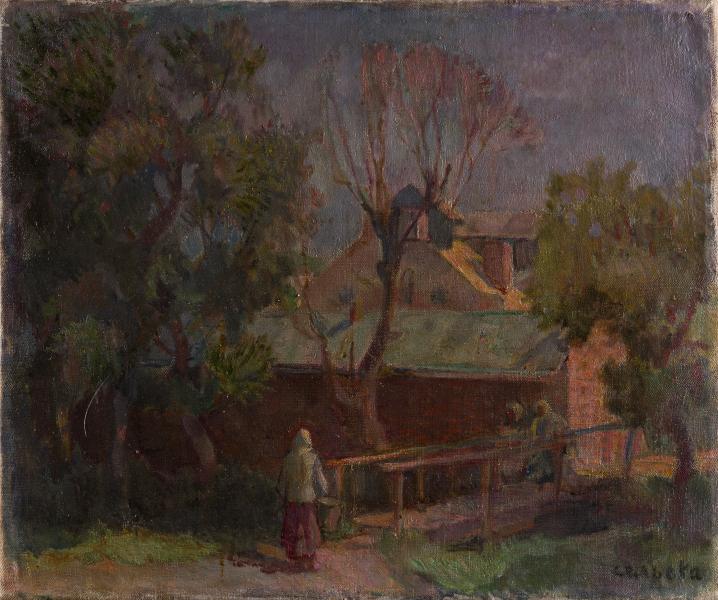
The landscape "Nesterov" (1946), depicting a corner of the town, now restored to its historical name of Zhovkva, shows M. Selska's attempts to preserve the freedom of form creation in the face of the imposition of social realist requirements. Thus, the three-dimensional and detailed reproduction of a one-storey building, trees, a bridge, a pair of travellers and a single female figure demonstrates compliance with mimetic principles. At the same time, the work confirms the preservation of the artist's own culture of colour expression, oriented towards the traditions of the Kapists and the French School of Painting at the turn of the 19th and 20th centuries. The dominance of colour in creating an evocative image can be seen in the unity of the picture with a golden tone, the richness of the texture, and the delicate play of warm and cold tones. An unintentional appeal to the archetypes and symbols of folk culture is perceived in the image of a bridge – a place of transition that in legends, fairy tales and beliefs symbolises overcoming obstacles, reaching a new state or status; it connects heterogeneous spaces, is one of the most important and dangerous parts of the journey.
Inscriptions
In the lower right corner is the inscription: "Selska".
Legal regulation
Borys Voznytskyi Lviv National Art Gallery