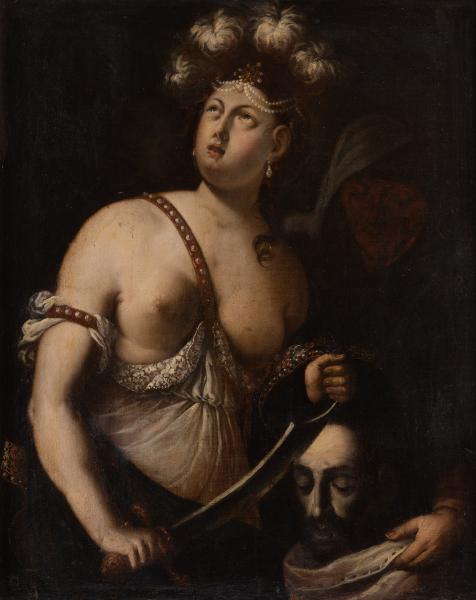
Judith with the Head of Holofernes
unknown (Italian School)


Basic information
- ID
- Ж-3029
- Author
- unknown (Italian School)
- Name
- Judith with the Head of Holofernes
- Date of creation
- 17th–18th c.
- Technique
- oil painting
- Material
- oil canvas
- Dimensions (height x width, cm)
- 96.5 x 77
Additionally
- Type
- painting
- Genre
- religious
- Plot
- Judith with the head of Holofernes
- Exposition
- Potocki Palace
Information about author
Object description
Сюжет «Юдиф з головою Олоферна» здобув значну популярність як символічний образ жіночої люті, хоробрості та опору. Це біблійна історія, відома в мистецтві протягом століть, зосереджена навколо Юдиф, красивої єврейки з міста Бетулія. Місто перебувало під облогою ассирійського полководця Олоферна. Юдиф вдала, що намагається втекти з міста, і передрекла полководцю перемогу. Для цього її запросили до намету в таборі за межами Бетулії. Поки Олоферн був у нетверезому стані, Юдиф відрубала йому голову та повернулася з нею в місто. Зображення сюжету історії про Юдиф різняться залежно від художників, їх передісторії та періоду, в якому було створено твір мистецтва. Її можуть зображати жорстокою, успішною, тривожною або спокусливою. Попри варіації, історія Юдиф століттями надихала не лише жінок, а й митців. Християнські художники підкреслювали побожність і молитву Юдиф, зображуючи її захисницею народу Божого. Багато хто змальовував її справжньою християнською жінкою, з покритою головою та волоссям, безстатевим тілом без прикрас, захопленим молитвою. З XVII століття північноєвропейські художники зображували Юдиф оголеною жінкою, яка отримувала задоволення від крові та насильства, своєї жіночої сексуальності. Однак південні художники, такі як Караваджо та Артемізія Джентілескі, відтворювали її під час відсікання голови Олоферна на знак перемоги Церкви над єрессю реформаторів. У центрі полотна розміщена постать напівоголеної Юдиф у вбранні танцівниці, з мечем у правій руці та головою Олоферна у лівій. Її нагота нагадує, для чого вона була в наметі – щоб спокусити Олоферна й убити його. Художник зобразив героїню в стані особливого задоволення, коли вона гордо тримає свій меч одразу після обезголовлення Олоферна. На задньому плані картини з темряви полотна видніється постать старшої жінки, служниці. Вона тримає напоготові мішок, щоб загорнути в нього голову. Служницю Юдиф зображали як молодою дівчиною, так і старшою жінкою. У Олоферна розтулений рот і заплющені очі, шкіра обличчя знекровлена – його здолали, він ніби відходить на задній план картини, поглинутий темрявою.
Inscriptions
The subject of "Judith with the Head of Holofernes" gained significant popularity as a symbolic image of female rage, bravery, and resistance. It is a biblical story, known in art for centuries, centred around Judith, a beautiful Jewish woman from the city of Bethulia. The city was under siege by the Assyrian general Holofernes. Judith pretended to be trying to escape from the city and foretold the general's victory. For this reason, she was invited to the tent in the camp outside Bethulia. While Holofernes was in a drunken state, Judith beheaded him and returned to the city with his head. Depictions of the story of Judith vary depending on the artists, their backgrounds, and the period in which the artwork was created. She may be portrayed as fierce, victorious, anxious, or seductive. Despite the variations, the story of Judith has inspired not only women but also artists for centuries. Christian artists emphasised Judith's piety and prayer, depicting her as the protector of God's people. Many portrayed her as a true Christian woman, with a covered head and hair, an androgynous body without adornments, absorbed in prayer. From the 17th century, Northern European artists depicted Judith as a naked woman who reveled in blood and violence, embracing her feminine sexuality. However, Southern artists, such as Caravaggio and Artemisia Gentileschi, portrayed her during the beheading of Holofernes as a symbol of the Church's victory over the heresy of the Reformers. At the centre of the canvas is the figure of a half-naked Judith dressed as a dancer, with a sword in her right hand and the head of Holofernes in her left. Her nudity serves as a reminder of why she was in the tent – to seduce Holofernes and kill him. The artist depicts the heroine in a state of particular satisfaction as she proudly holds her sword immediately after beheading Holofernes. In the background of the painting, the figure of an older woman, a maidservant, can be seen emerging from the darkness of the canvas. She holds a bag at the ready to wrap the head in it. The maidservant of Judith has been depicted both as a young girl and as an older woman. Holofernes has an open mouth and closed eyes, his facial skin drained of blood – he has been defeated, seemingly receding into the background of the painting, engulfed by darkness.
Legal regulation
Borys Voznytskyi Lviv National Art Gallery