Back

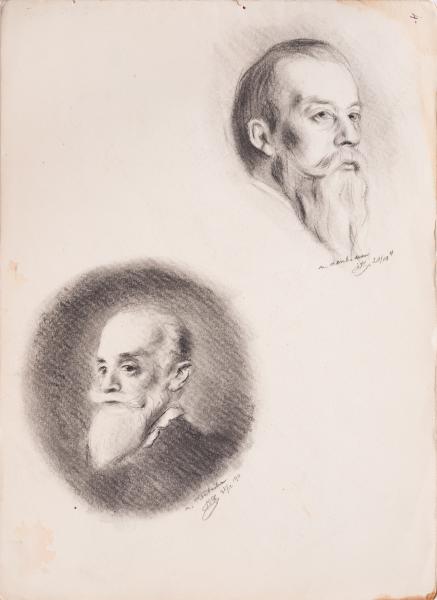
Drawing of Two Elderly Men's Heads

Yulian Zaiats

  • Drawing of Two Elderly Men's Heads 2
  • Drawing of Two Elderly Men's Heads 3
Basic information
ID
Ф-З-Арх-ЛГМ-5/4
Author
Yulian Zaiats
Name
Drawing of Two Elderly Men's Heads
Date of creation
1991
Country
German Empire (?)
Technique
drawing
Material
paper charcoal
Dimensions (height x width, cm)
29.9 x 21.8
Additionally
Information about author
Author
Yulian Zaiats
Artist's lifetime
1880–1971
Country
Austro-Hungarian Empire, the Second Polish Republic, the USSR
Biography
Yulian Zaiats (May 30, 1880, Bohutyn, Austro-Hungarian Empire, now Pomoriany district, Lviv region – September 2, 1971, Lviv, Ukrainian SSR) was a Ukrainian artist, lawyer, scholar, bibliographer, and cultural figure. According to some sources, he was the son of a Greek Catholic priest.

He initially studied at a gymnasium in Lviv (graduating with honours in 1899). The artist then enrolled in the law faculty of Lviv University, but for political reasons transferred to the Jagiellonian University in Krakow (1901). At the same time, he enrolled in the Kraków Academy of Fine Arts, where he studied under Leon Jan Wyczółkowski (11 April 1852 – 27 December 1936). According to researcher Oleh Kupchynskyi, he was actively involved in research work. In 1902, he submitted his scientific work, "Usus fructus nominis", to the historical and philosophical section of the Shevchenko Scientific Society, which was published in the "Journal of Law and Economics." It should be noted that, based on the results of this work, Julian Zayats defended his doctoral dissertation in 1907. He then worked as a lawyer in the State Treasury Prosecutor's Office (Lviv). In addition, in 1909 and 1912, he improved his legal qualifications in Berlin, where he prepared a scientific work entitled "Jus iurandum in litem." According to researcher Oleh Kupchynskyi, he attended lectures at the Berlin Academy of Arts by the renowned German painter and graphic artist of Jewish origin, Max Liebermann (July 20, 1847–February 8, 1935). However, during this period, the artist did not teach regularly at this institution and was only appointed to the Senate of the Berlin Academy of Arts in 1912.

It should be noted that after World War I, Yulian Zaiats worked as an employee of a private law firm in Komarne (now the centre of the Komarne municipal community in the Lviv region), and later as a lawyer in Lviv. Yulian Zaiats also taught Roman law at the Ukrainian Secret University and was a permanent legal advisor to Metropolitan Andrei Sheptytskyi. He joined the Legal Commission of the Shevchenko Scientific Society and became a member of one of the key parties in the region at that time, the Ukrainian National Democratic Union. During the Second Polish Republic (1918–1939), Yulian Zaiats authored appeals to the League of Nations and the Vatican regarding the violent measures against Ukrainians within the framework of military-police terror, the so-called “Polish pacification”, initiated by the leader of this state entity, Jozef Pilsudski. At the same time, in the 1920s, he was invited to work at the Lviv branch of the Financial Prosecutor's Office of the Polish State Treasury. Later, before the annexation of the western Ukrainian lands to the Ukrainian SSR, he was a judge of the Supreme Administrative Tribunal of Poland in Warsaw (1939). From 1941, he was president of the Court of Appeal (Lviv).

After the end of the Nazi occupation, he was arrested as a person who could have been involved in the crimes of the occupiers. At the request of the intelligentsia (according to documents from the archives of the Security Service of Ukraine, first published in the works of scholars Mykola Kobyletskyi and Lesia Trepak), in particular, Metropolitan Andrei Sheptytskyi, and the head of the National Museum, Ilarion Svientsitskyi, the criminal case against Yulian Zaiats was closed. In 1945, he began teaching at Lviv State University, and from 1946, he worked as a bibliographer at the Scientific Library of the V. Stefanyk Academy of Sciences of the Ukrainian SSR. In 1951, the artist failed to pass the certification due to a lack of professional qualifications, but with the permission of the Certification Commission, he held the position of librarian from 1953 until his retirement.

During his time as a bibliographer, Yulian Zaiats produced a number of bibliographic works: “Materials for the Bibliography of M. Voznyak” (1946), “Bibliography of the works of M. P. Drahomanov” (1947, co-authored), “Bibliography of the history of the city of Lviv” (parts 1–2, 1948) – however, none of them were ever published. He was into collecting art and old books, and did some painting and drawing. Participated in art exhibitions in Lviv (1929–1932, 1934, 1935, 1937, 1943; National Museum and Ukrainian Society of Art Lovers), in Warsaw (Polish Society of Art Lovers in the “Zachęta” Salon), and other cities. Among his well-known works are “Lady in Blue”, “Daughter”, “Self-Portrait”, “Boy”, “Church in Krasne”, “Church in Kryvchytsi”, Flowers”, and “The Kaminka River”, which were highly praised in the press and exhibition catalogues of the time.

Additionally, he possessed a distinctive vocal talent and a powerful tenor voice. According to researcher Oleh Kupchynskyi, he graduated from the Lviv Conservatory (class of Nestor Nyzhankivsky). However, from 1928, Nestor Nyzhankivsky (August 31, 1893–April 10, 1940) taught at the Mykola Lysenko Higher Music Institute in Lviv. Also, according to Oleh Kupchynskyi, Yulian Zaiats performed solo concerts in Lviv, Warsaw, and other cities and participated in annual holiday programs for Shevchenko Days in Galicia. Between 1920 and 1926, he served as the leader of the “Muse” singing society. As for the artist's legacy, thanks to the efforts of Ilarion Svientsitskyi, a significant collection of his works is housed in the Andrei Sheptytskyi National Museum in Lviv, and some works are in the art department of the Lviv Library of the Vasyl Stefanyk National Academy of Sciences. According to researchers Mykola Kobyletskyi and Lesia Trepak, twenty works by Yulian Zaiats were purchased by the State Tretyakov Gallery in Moscow.

An important part of Yulian Zaiats' creative legacy is a series of graphic works currently stored in the Archive of Artists and Cultural Figures of the Borys Voznytskyi Lviv National Art Gallery, which provide valuable insights into the specifics of the educational process as well as the priorities in more conservative artistic circles focused on developing a realistic visual language through careful study of nature and the creative work of artists of past eras, especially those who practised the faithful reproduction of people and the world around them.
Object description
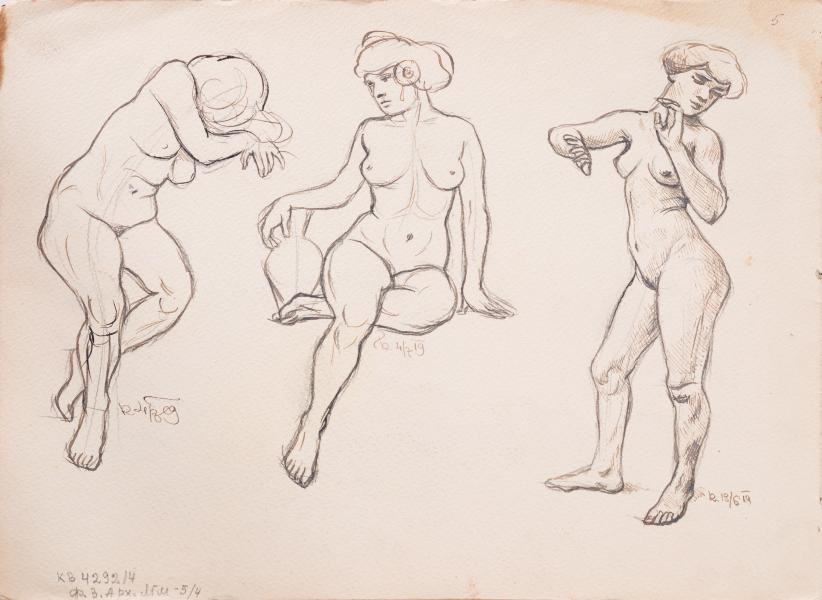
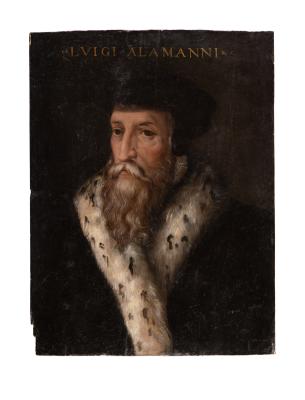
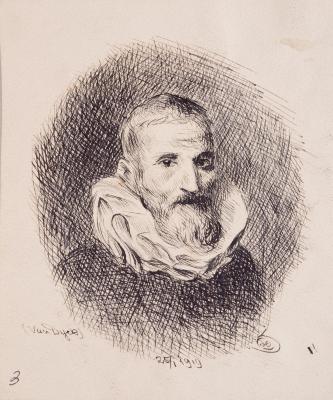
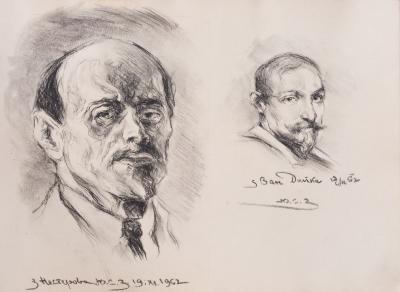
On the front of the image are two oval portraits of men. As in other cases with copies by Yulian Zaiats, here we see signatures indicating the author of the original (unfortunately, they are quite illegible, which makes identification impossible). These copies are a good example of how the author demonstrated mastery of figurative and spatial thinking, as well as an understanding of characteristic types. The style of the originals suggests that they are the work of an academic artist who carefully studied the painting of the old masters. The upper portrait is presented in a right-hand turn, with a slight tilt of the head and a characteristic long beard. The subject's gaze is directed to the side, and Yulian Zaiats emphasised his deep eyes, cheekbones, and forehead. The lower portrait is more tonally refined, with a rich background that creates an oval vignette around the head. The lower portrait also depicts an elderly man with a long beard, but with a different facial type, which indicates the distinct individualisation of images characteristic of classical European portraits. In both cases, the light and shadow modelling is based on the principles of academic drawing, with a single light source, tonal transitions, and soft hatching that form volume and reveal the plasticity of the facial features. Particular attention is paid to the eyes, nose, cheekbones, and beard—the main emotional and psychological elements of the image. In the lower sketch, the artist uses contrasting tonal darkening of the background to enhance the depth and highlight the silhouette of the head. Overall, this graphic work demonstrates Yulian Zaiats' ability to work with historical models and carefully reproduce the individual features of the characters depicted. Therefore, it can be said that this side of the sheet is an example of a high-level training exercise and, at the same time, a record of academic teaching methods focused on the careful study of the heritage of European portrait painting. On the reverse side of the sheet are three sketches of a nude female figure, executed academically in ink (sepia) and pencil. The drawings are examples of a training exercise designed to study anatomy, movement, and the expressive plasticity of the body. The composition is structured as a series of successive poses of the model, with each figure occupying a separate place in space. On the left is a woman in a bent, almost crouched position with her head bowed; the central figure is sitting, leaning on a vase (?); on the right is a figure in a dynamic turn, with her arm raised, creating a sense of dance movement. All the poses capture the character of the gesture, the weight of the body, and the tension or relaxation of the muscles, which indicates deep observation of nature. The style of drawing is simplified, yet it maintains precise proportions and plasticity. The lines are confident and contoured, sometimes with an emphasis on points of tension in the body or its curves. The absence of light and shadow is compensated for by the rhythm of the lines and the expressiveness of the silhouette. This manner is characteristic of quick study sketches, which served as exercises in feeling movement, space, and anatomical structure. The images are stylised, particularly in the interpretation of hairstyles, which brings them closer to the aesthetics of the first third of the 20th century. Despite their educational purpose, the drawings demonstrate the author's individual approach, attention to form, and psychological specificity. In addition, these sketches are of undoubted value as sources for studying the creative development of Yulian Zaiats in the context of the pedagogical practices of that time in the academic environment.
Inscriptions
The front bears the illegible signature of the author of the original image – "M. Lonb..."; the dates of execution are indicated under the portraits: "28/12 1911"; "20/10 11". On the reverse side, under each figure, there is Yulian Zaiats' signature and the dates (from left to right): "4/8 19"; "4/8 19"; "18/ 6 19".
Legal regulation
Borys Voznytskyi Lviv National Art Gallery