Altar Cross
unknown
Basic information
- ID
- C-I-881
- Author
- unknown
- Name
- Altar Cross
- Date of creation
- 18th c.
- Country
- Ukraine
- Technique
- carving polychrome
- Material
- wood
- Dimensions (height x width x depth, cm)
- 64 x 24.5 x 1.9
Additionally
- Type
- decorative and applied arts
- Genre
- religious
- Provenance
- Handed over by the Stryi Local Studies Museum, 1966
Information about author
Object description
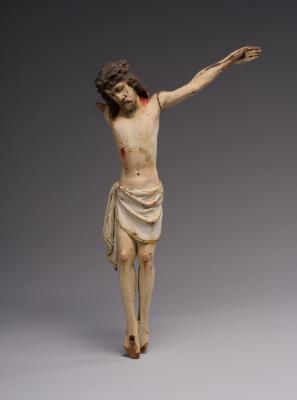
The altar features a wooden three-armed cross on a square relief base, which has a complex form with expanded ends carved in the shape of three-petalled terminations. The work belongs to the iconographic type of the blossoming cross. At the ends of each arm are placed rounded projections – decorative overlays or nails that emphasise the sacred purpose of the object and its connection with the Crucifixion on Calvary. On the front side of the central shaft and the middle crossbar, a faintly discernible polychrome depiction of the Crucified Christ is visible. The contours of the halo, the facial features, and the figure in a perizoma, the loincloth, may be distinguished, rendered in a manner characteristic of folk masters, where the graphic outline plays the principal role. The surface has lost a considerable part of its original painted layer and coating, yet traces of dark brown and golden-greenish tones remain, which once imparted solemnity to the work. The reverse side has also preserved remnants of a painted drawing with an iconographic depiction of the Baptism of Christ, where the central shaft features the graphic figure of Jesus, above whom is a dove, the symbol of the Holy Spirit.
Legal regulation
Borys Voznytskyi Lviv National Art Gallery