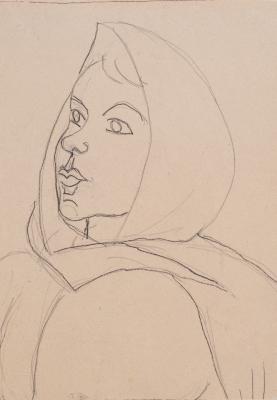
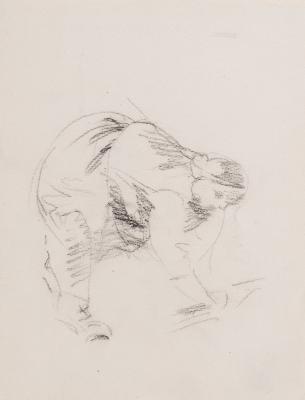
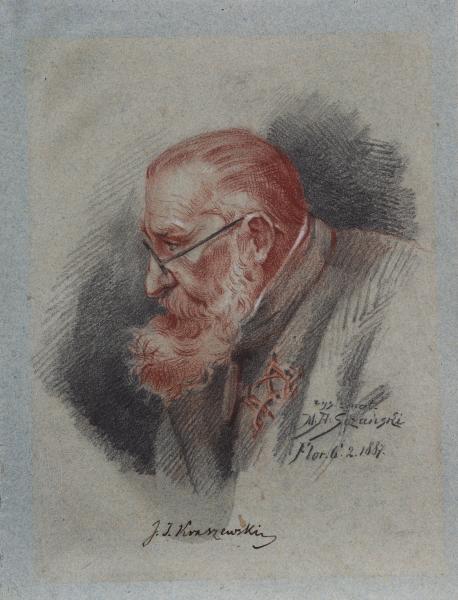
Portrait of Jozef Ignacy Kraszewski
Michal Sozanski


Basic information
- ID
- Г-V-348
- Author
- Michal Sozanski
- Name
- Portrait of Jozef Ignacy Kraszewski
- Date of creation
- 1887
- Country
- Italy
- Culture
- Modern times
- Technique
- drawing
- Material
- paper pencil chalk
- Dimensions (height x width, cm)
- 26 x 19.4
Additionally
- Type
- graphic art
- Genre
- portraiture
- Plot
- Portrait
- Provenance
- the Dzieduszycki collection
Information about author
Object description
Józef Ignacy Kraszewski (28 July 1812 – 19 March 1887) – Polish writer, publicist, publisher, artist, historian, philosopher, encyclopaedist, public and political figure – was born in Warsaw into a noble family bearing the Jastrzębiec coat of arms. His parents, Jan Kraszewski and Zofia, née Malska, lived in the Grodno region on the Dolge estate near Pruzhany. Józef Ignacy was the eldest of five children in the family. His youngest brother, Kajetan (1827–1896), was a writer, author of short stories and novellas, while Lucian was an artist and photographer, one of the pioneers of Polish artistic photography. In 1822–1826, Józef Ignacy Kraszewski studied at a school in Biała Podlaska, then known as the Biała Academy. In 1826–1827, he studied at a school in Lublin, and in 1827–1829, he studied at a gymnasium in Świsłocz. In September 1829, he began studying at the medical department of Vilnius University, but soon transferred to the literary department. He was actively involved in student life and anti-government circles. On 3 December 1830, he was arrested along with a group of young people. He remained in prison until March 1832. Subsequently, the young man was exiled to Vilnius, where he began historical research, which later resulted in the four-volume work "Wilno od początków jego do roku 1750" (Vilnius from its beginnings to 1750) (1840–1842). During this period, he also wrote several novellas. On 10 June 1838, Józef Ignacy Kraszewski married Zofia Woronicz, the niece of Roman Catholic priest Jan Paweł Woroniczówna (1757–1829). In 1841–1851, he edited the Vilnius-based Ateneum, and in 1851, he became a contributor to" Gazeta Warszawska" (Warsaw newspaper). In 1853, he settled in Zhytomyr, where he held the positions of curator of Polish schools, director of the Zhytomyr Theatre (from 1856), director of the Noble Club, and president of the Charitable Society. From 1860 to 1887, he was an honorary member of the Poznań Society of Friends of Science. At the same time, he gained popularity as a writer. In 1866, he settled in Krakow and soon moved to Austria. In 1868, he founded his own printing house in Dresden. From 1873, he devoted himself exclusively to literary work. During his stay in Dresden, he visited Galicia several times. In 1882, he founded the "Macierz Polska" publishing house in Lviv. Between 1876 and 1887, he wrote 29 novels in 76 volumes, which formed the "Dzieje Polski" cycle, an artistic description of the history of Poland and the Grand Duchy of Lithuania from ancient times. In 1883, Józef Ignacy Kraszewski was arrested in Berlin on charges of espionage for France and sentenced to three and a half years in prison in Magdeburg Fortress, but due to lung disease, he was released on bail in 1885. J. I. Kraszewski's productivity and fruitful work impressed his contemporaries. His literary legacy includes about 600 volumes of novels, short stories, poetic and dramatic works, ethnographic and folkloric works, and journalistic and literary-critical articles. As an artist and graphic designer, he was a student of Bonaventura Dombrowski (1807–1862); he painted watercolour landscapes and portraits and was a master of etching. He died on 19 March 1887 in Geneva and was buried in Krakow.
Inscriptions
"J. I. Kraszewski / M. A. Sozański / Flor. 6.2.1887".
Portrayed person
- The name of the person portrayed
- Jozef Ignacy Kraszewski
- Lifetime of the person portrayed
- 28.07.1812–19.03.1887
Legal regulation
Borys Voznytskyi Lviv National Art Gallery