Cain
Luca Giordano




Basic information
- ID
- Ж-1606
- Author
- Luca Giordano
- Name
- Cain
- Date of creation
- c.1650s
- Technique
- oil painting
- Material
- canvas oil
- Dimensions (height x width, cm)
- 110 x 165
Additionally
- Type
- painting
- Genre
- religious
- Plot
- Cain
- Provenance
- the Lubomirski collection
- Exposition
- Potocki Palace
Information about author
Object description
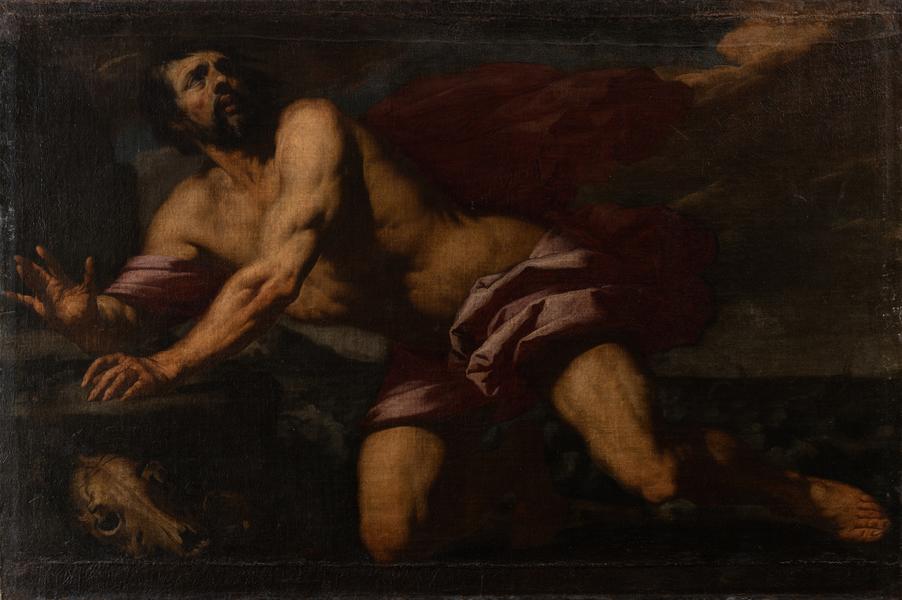
In the painting from the Gallery's collection, Luca Giordano created an artistic interpretation of the image of Cain, the son of the first human couple, Adam and Eve, and the brother of Abel. According to the Old Testament legend, Cain was a farmer, and Abel was engaged in cattle breeding. As is stated in the Book 4 of Genesis, Cain killed Abel out of jealousy because God accepted his brother's gift of animals but not his own of the fruits. The ethical comprehension of the New Testament's plot led to the interpretation of the images of Cain and Abel as personifications of faith and unbelief, evil (Jews 11.4; 1 John 3.12; Jude 11) and good (Matthew 23.35; Jews 11. 4) life paths. Presumably, Luca Giordano's attention was primarily drawn to the plot of "Curse of Cain", represented by the scenes of "Cain Accepts the Curse of God" and "Cain Flees from the Face of God". According to traditional iconography, the fratricide was depicted gesturing, with empty hands, as in the mosaic of the Palatine Chapel or the fresco of the monastery in Decani (Kosovo), or with the murder weapon hidden behind his back, as in the mosaic of the Cathedral in Montreal. It is possible that the artist interpreted the plot of "God Gives a Sign to Cain", in which rays stream from God's right hand, illuminating the criminal's face. In the Lviv work by Luca Giordano, the drama of the event is reproduced by the location of the figure along the "passive diagonal" of the horizontally elongated format, broken contours, expressiveness of drapery, and a combination of rich umber, green, and crimson tones. Fear and embarrassment of the fratricide are emphasized by the lack of a foothold in the posture of his stout clumsy figure, impulsively raised right hand, and despairing gaze of sunken eyes. The impression is enhanced by the sharp contrasts of light and shadow (chiaroscuro), characteristic of Caravaggism and the artist's teacher Jose de Ribera, and the highlighting of a brightly lit figure on a shining black background (tenebroso). The universalization of the murder of Abel by Cain to the scale of absolute evil is visualised by the interpretation of time and space as the world as a whole, which is emphasised by the lowered horizon line and the crimson-grey background, similar to the grandiose tectonic shifts. A skull in the lower left corner of the canvas symbolises both physical and spiritual death.
Legal regulation
Borys Voznytskyi Lviv National Art Gallery