Hagar in the Desert
Sebastiano Ricci


Basic information
- ID
- Ж-1858
- Author
- Sebastiano Ricci
- Name
- Hagar in the Desert
- Date of creation
- c.1690
- Technique
- oil painting
- Material
- canvas oil
- Dimensions (height x width, cm)
- 137 x 104.4
Additionally
- Type
- painting
- Genre
- religious mythological painting
- Plot
- Hagar in the desert
- Provenance
- Collection of Leon Pininski
- Exposition
- Potocki Palace
Information about author
Object description
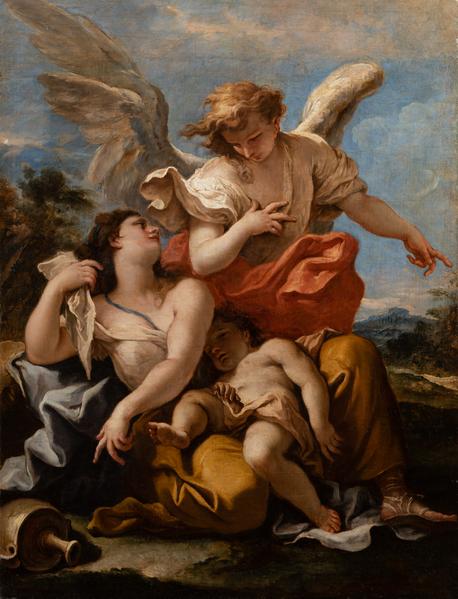
The "Hagar in the Desert" painting from the collection of Borys Voznytskyi Lviv National Art Gallery was inspired by the plot from the Holy Scriptures (Genesis 16. 1–16; 21. 9–21), the Jewish Torah (Book of Bereishit), and the Koran. Thus, according to the Old Testament legend, Abraham's barren wife, Sarah, gave her husband, the enslaved Egyptian Hagar, as a concubine to procreate. So, Hagar gave birth to Abraham's son, Ishmael. Fourteen years later, God sent Sarah her son Isaac, and she persuaded Abraham that the concubine with the child needed to be banished. Hagar desired to return to Egypt but got lost in the desert. When the water ran out, she wept in despair, preparing to die. God had mercy on her and sent the angel Gabriel, who guided the woman to the spring. Finally, Hagar and her son, who became the progenitor of the Arabs, settled in the desert of Paran. The Gallery's work is composed with rationally modelled dynamism and the coordination of figures in sharp baroque aspects with format diagonals. Of great importance are rhythmic echoes. The "active" diagonal line formed by Hagar's left hand and the angel's right hand resonates with Hagar's right hand, parallel to the diagonal. Meanwhile, the diagonal outlined by Hagar's tilted head and left shoulder and Ishmael's left hand resonates with the angel's left hand, parallel to the "passive" diagonal line. The location in the upper and lower segments of the intersection of the diagonals of the angel and baby Ishmael is symbolic. In the first case, it gives the impression of dominance in the composition, while in the second one – of maternal and angelic protection. The expression is enhanced by multidirectional movements deep into the picture space and towards the viewer, forming a "spatial baroque zigzag". The radiant range of silver-pearl, ash-blue, pink, and lilac colours, dominated by golden ochre (Hagar's robes) and red (the drapery wrapping the angel), indicates a close connection with Venetian art. The landscape background, as if "infused" with coolness and moisture, is painted with almost watercolour purity and lightness.
Legal regulation
Borys Voznytskyi Lviv National Art Gallery