Calvary
Wolfgang Krodel the Elder


Basic information
- ID
- Ж-1941
- Author
- Wolfgang Krodel the Elder
- Name
- Calvary
- Date of creation
- 1535
- Technique
- oil painting
- Material
- wood oil
- Dimensions (height x width, cm)
- 47 x 32.5
Additionally
- Type
- painting
- Genre
- religious
- Plot
- Calvary
- Provenance
- the Lubomirski collection
- Exposition
- Potocki Palace
Information about author
Object description
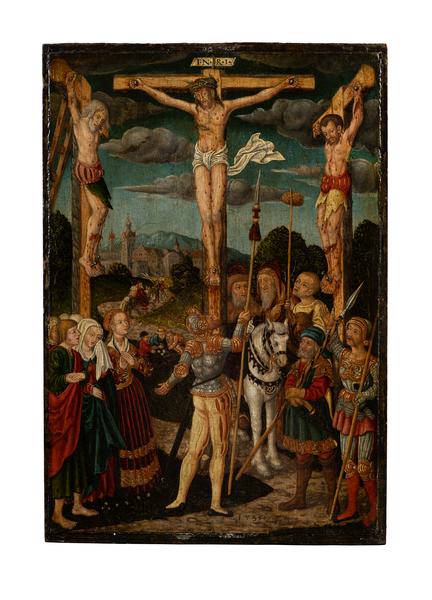
The most crucial scene of Christ's sacrifice in Christianity – the Crucifixion, described in the four Gospels, is one of the most common in European art and has a variety of iconography. It is one of the two main themes in medieval workshop painting, which young artists performed to get the title of guild master. It was repeatedly developed by Lucas Cranach the Elder, whose student from Wittenberg created the painting from the Borys Voznytskyi Lviv National Art Gallery collection. The Cavalry scene, depicted by Wolfgang Krodel the Elder, belongs to the iconographic type of "Crucifixion in the Crowd", popular in the late Middle Ages. The small painting depicts three crosses, with the side ones turned to the middle, rising above a group of people. The hands and feet of the crucified are nailed with large nails; there is blood on the mutilated legs of the robbers. The side of the Savior has already been pierced with a spear. Longinus, the Roman warrior, stands at the foot of the central cross. His head is raised, and he is frozen and enlightened by Christ's blood flowing down. On the right, with his hand raised, is a Roman centurion converted to Christianity. They are both dressed as Landsknechts. Standing on the left, Mary Magdalene draws the viewers' attention with her rich, bright red pleated clothes and fashionable hairstyle. Next to her are John the Evangelist and the Virgin Mary wiping her tears. The outfits of the men in the foreground and the Pharisees in the background, as well as the white horse in rich harness, create a colourful mosaic of rich red, green, bluish-grey, and ochre tones. The work's decorativeness is enhanced by parallel, horizontally grouped dark clouds pointed at the ends. A schematic panorama of the city of Jerusalem and a group of people heading towards it, as well as the men playing dice for Christ's clothes, create the thematic background in the depth of the work. The city outlines resemble Renaissance-style buildings typical of Europe. In general, the Passion of the Lord scene is presented as if the action took place in Germany in the early 16th century. It is deprived of iconographic elements developed in medieval Catholic Christology (for example, the swoon of the Virgin Mary according to the vision of St. Brigid) and is interpreted without the usual drama of the situation. The calm tone, accurate reproduction of events, and a keen interest in the setting and costumes are reminiscent of eyewitness accounts. The establishment of Protestantism caused those signs. Furthermore, through such details, the artist conveyed his shock at the cynicism and vanity of his time, brought about by the recent events of the peasant war and the defeat of the uprisings. Although Protestantism rejected the decoration of religious buildings with artistic works, a number of religious themes still found their place in the space of the post-Reformation church. These include the theme of the Crucifixion. Depicting scenes of Christ's martyrdom did not contradict the Protestant understanding of faith. According to Martin Luther, it reflected the idea of eternal salvation and was permeated with religious didactics. The heyday of the Renaissance in Germany occurred in the first half of the 16th century, a time of sharp class conflicts. New ideals and worldviews were directly reflected in fine arts. Albrecht Dürer, Lucas Cranach the Elder, and Hans Holbein the Younger were among the most prominent artists of the German Renaissance. Lucas Cranach the Elder maintained close ties with the humanists of his era. He instilled his commitment to progressive ideas in his students, including Wolfgang Krodel the Elder. His painting "Calvary" (1535) echoed the events of the tragic end of the Peasants' War of 1525. Departing from the traditional iconography, the author dressed the Roman legionaries in the costumes of his contemporaries – the Swiss Guard and Landsknechts – military mercenaries who brutally suppressed the uprising. "Calvary" is the only painting by Wolfgang Kroedel the Elder in Ukraine in which the biblical event is recreated according to the realities of that time.
Inscriptions
In the centre below is the signature-monogram "WK", date – 1535
Legal regulation
Borys Voznytskyi Lviv National Art Gallery