Sketch for the "Elements" Mural
Vasyl Poliovyi


Basic information
- ID
- Ж-8187
- Author
- Vasyl Poliovyi
- Name
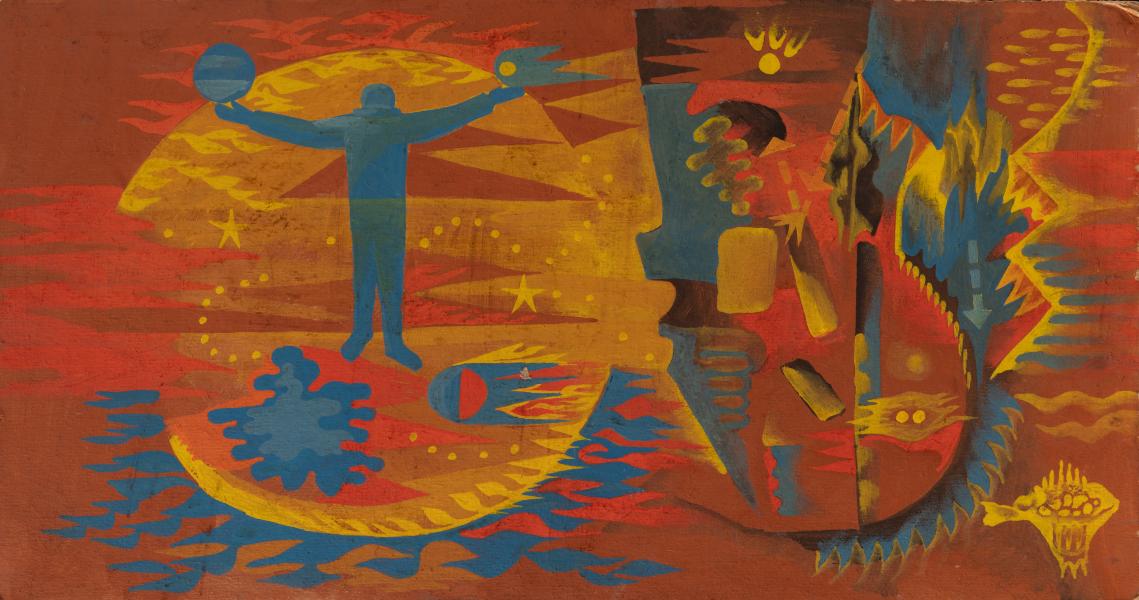
- Sketch for the "Elements" Mural
- Country
- the USSR
- Culture
- Ukrainian art of the Soviet period
- Technique
- mixed technique
- Material
- cardboard tempera
- Dimensions (height x width, cm)
- 24.5 x 45.5
Additionally
- Type
- painting
- Genre
- symbolic art
- Plot
- Allegory
- Provenance
- Handed over to the museum from Vasyl Poliovyi
Information about author
Object description
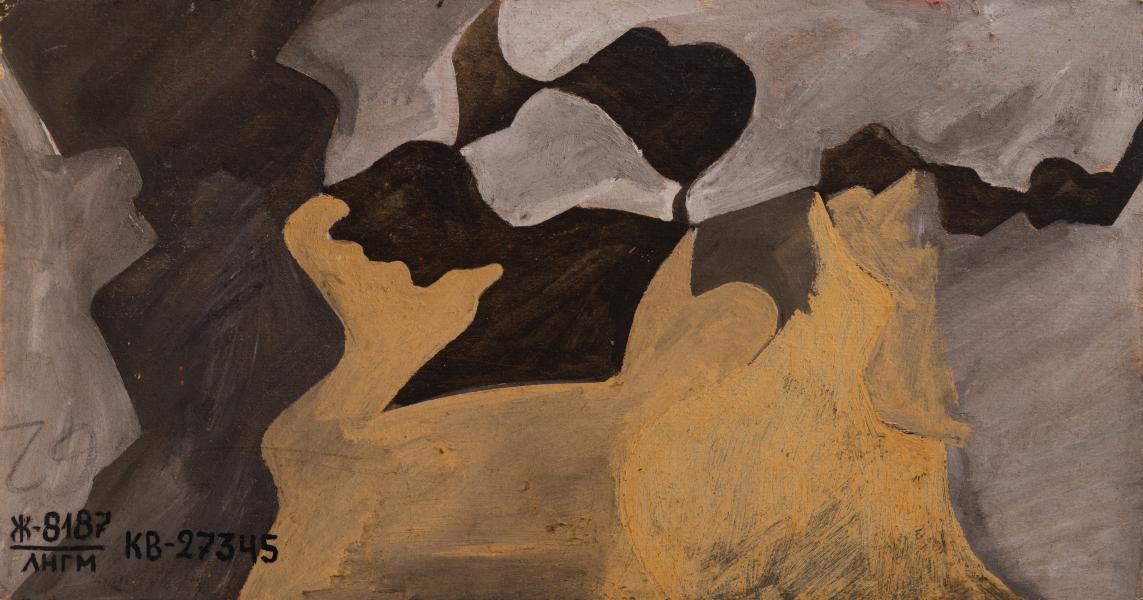
The sketch has an unmistakable resonance with the themes and imagery of Ж-8185. It is probably dedicated to studying both the upper atmosphere and the depths of space, which were among the key ideological blocks for the Soviet Union. The left part of the work depicts the general silhouette of a researcher holding stylised images of the celestial bodies (it should be noted that the formal approach is related to iconographic practices, in particular, the symbolic representation of the sun and moon from the Crucifixion scene). The figure itself seems to be standing on a starry road, which is probably a reference to a popular song with words by the Soviet poet and writer, and later dissident and political exile, Volodymyr Voinovych: "I believe, friends, caravans of rockets / Will hurry us forward from star to star / On the dusty paths of the planets / Our footprints will remain" (1960–1961). The pathos of the scene unfolding before the viewer is moderate but expressive, not political. In the right part of the composition is a scene with a group of objects, probably of extraterrestrial origin, whose fantastic shapes are difficult to identify. At the same time, it is worth noting that one of the most likely sources of inspiration for the author was the futuristic opera "Victory over the Sun" (1913) and the individual artistic practice of Mykhailo Matiushyn. The work's colour scheme is warm, dominated by ochres, with some cold areas accentuated by tonal contrasts. On the reverse side of the sketch is a fragment of an unidentified achromatic composition with black and grey gradients and a chromatic ochre and yellow detail. The formal solution is in keeping with modernist practice. Since the fragment is associated with the individual practice of Vasyl Poliovyi, we can assume his authorship. However, as this part does not contain any motifs suitable for identification, it is premature to offer an interpretation at this stage.
Legal regulation
Borys Voznytskyi Lviv National Art Gallery