Lamentation of Christ
unknown


Basic information
Additionally
- Type
- sculpture
- Genre
- religious
- Plot
- Lamentation of Christ
- Provenance
- Collection of Lviv City Gallery
- Exposition
- Potocki Palace
Information about author
Object description
The "Lamentation of Christ" scene is one of the concluding episodes of the Passion cycle, with the next one being the "Entombment". The iconography of this scene is vast and widespread across all Christian countries. The depicted events take place on Mount Golgotha on Good Friday after Jesus was taken down from the cross, often near its base. The sources describing the scene are the canonical Gospels, the apocryphal Gospel of Nicodemus, and the "Golden Legend" text. The scene depicts a crowd dispersing, with the seven closest individuals remaining with the deceased Savior: the Virgin Mary, John the Evangelist, Nicodemus, Joseph of Arimathea, Mary Magdalene, and the two sisters of the Virgin Mary, the daughters of Saint Anne from subsequent marriages – Mary Cleophas and Mary Salome. In various works of art, the number of figures may vary, but three figures remain constant: Jesus, the Virgin Mary, and John – the beloved disciple of Christ. Although Michelangelo, in his brilliant "Pietà" ("Our Lady of Piety"), depicted only two figures – the Virgin Mary and her dead Son in her lap.
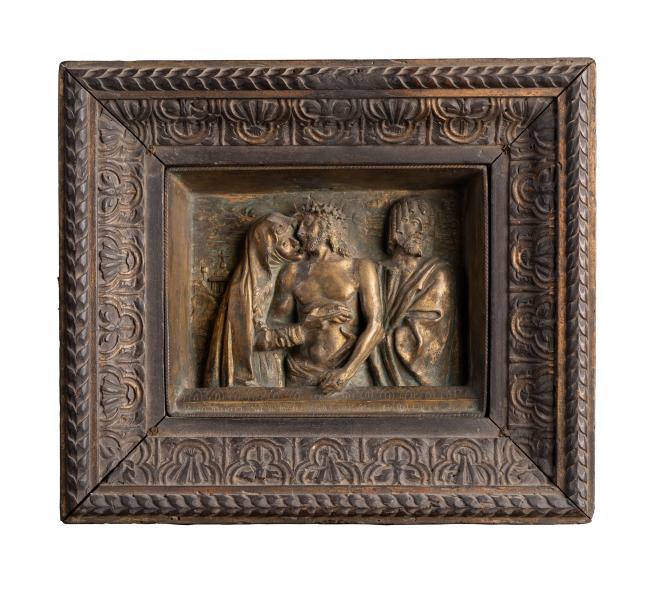
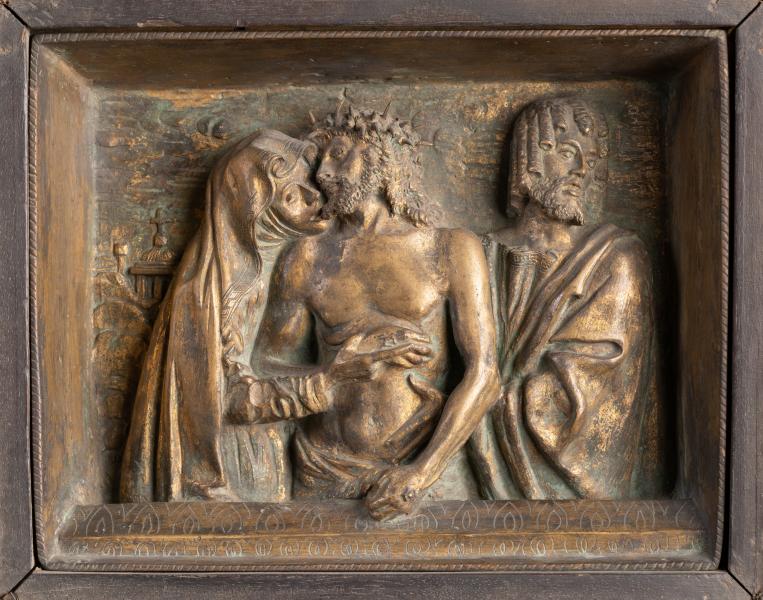
The bronze high relief from the Gallery collection represents the traditional variant, where three figures are depicted from the waist up. In the centre, the body of Jesus, removed from the cross and draped in a loincloth (perizoma), is presented frontally. His head, adorned with a large crown of thorns, is turned to the left towards the Virgin Mary, depicted in profile. A maphorion covers Mary's head and shoulders. Her lips opened in a mournful cry, and she gently touched the cheek of her dead son. With her right hand, she tenderly holds Christ's palm, marked by the nail wound. Jesus' left arm hangs unwillingly along his body. On his right side is depicted the wound inflicted by the lance of the Roman soldier Longinus. On the opposite side of the Savior, the artist placed the figure of John the Evangelist. With his hands, he supports Christ's body at the waist. The Apostle, overwhelmed with grief, turns his face away. Characteristic are the thick locks of hair that frame his face. The work was likely created in Northwestern Europe, possibly in Germany, where it was traditional to depict the crown of thorns as large and voluminous, sometimes disproportionately about the size of the head. In creating the high relief, the author was inspired by the "Pietà" (c. 1460, National Pinacoteca di Brera in Milan) by the Venetian artist Giovanni Bellini (1430–1516), who was a founder of the Venetian School of Painting.
The bronze high relief from the Gallery collection represents the traditional variant, where three figures are depicted from the waist up. In the centre, the body of Jesus, removed from the cross and draped in a loincloth (perizoma), is presented frontally. His head, adorned with a large crown of thorns, is turned to the left towards the Virgin Mary, depicted in profile. A maphorion covers Mary's head and shoulders. Her lips opened in a mournful cry, and she gently touched the cheek of her dead son. With her right hand, she tenderly holds Christ's palm, marked by the nail wound. Jesus' left arm hangs unwillingly along his body. On his right side is depicted the wound inflicted by the lance of the Roman soldier Longinus. On the opposite side of the Savior, the artist placed the figure of John the Evangelist. With his hands, he supports Christ's body at the waist. The Apostle, overwhelmed with grief, turns his face away. Characteristic are the thick locks of hair that frame his face. The work was likely created in Northwestern Europe, possibly in Germany, where it was traditional to depict the crown of thorns as large and voluminous, sometimes disproportionately about the size of the head. In creating the high relief, the author was inspired by the "Pietà" (c. 1460, National Pinacoteca di Brera in Milan) by the Venetian artist Giovanni Bellini (1430–1516), who was a founder of the Venetian School of Painting.
Legal regulation
Borys Voznytskyi Lviv National Art Gallery