Crucifixion
unknown folk sculptor


Basic information
- ID
- С-I-1607
- Author
- unknown folk sculptor
- Name
- Crucifixion
- Date of creation
- 19th c.
- Country
- Ukraine
- Technique
- carving polychromy
- Material
- wood
- Dimensions (height x width x depth, cm)
- 46 x 24 x 4.5
Additionally
- Type
- sculpture
- Genre
- religious
- Plot
- Crucifixion
- Provenance
- Sykhiv village, Stryi district, Lviv region
Information about author
Object description
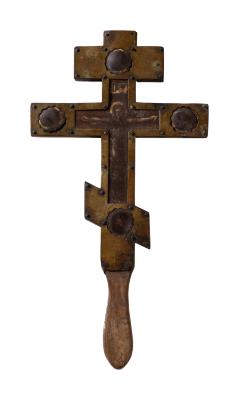
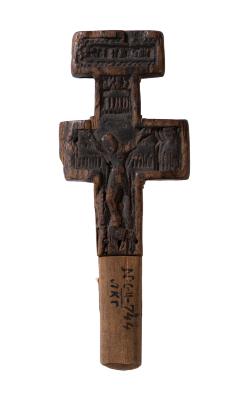
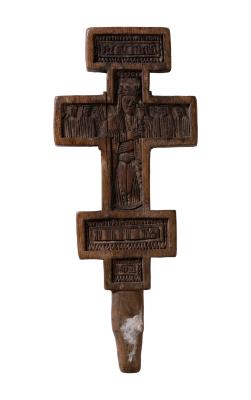
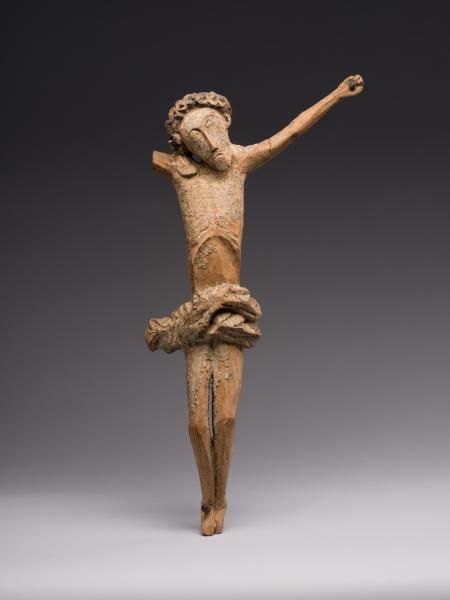
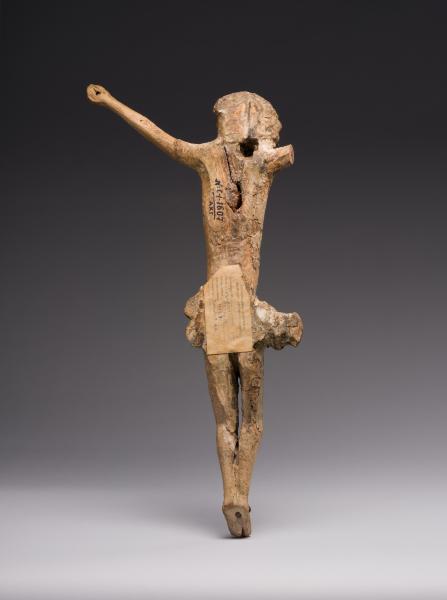
The carved wooden Crucifixion is rendered in a rather generalised manner, without fine detail, but with an emphasis on the main symbolic features. The slightly elongated figure of Christ is disproportionate, which is typical of many folk artworks. Thin arms and legs, narrow shoulders, a short neck, and a protruding chest are all presented in a generalised manner, without careful anatomical detail. The Saviour's head is tilted to the right and down, conveying the moment of death and humility, which is emphasised by his closed eyes. The characteristic crown of thorns is carved in a stylised manner, emphasising suffering. A decorative element in the sculptural image is the short perizoma on the hips, modelled with shallow relief folds. The overall image of the Crucifixion is dramatic and, at the same time, ascetic, devoid of excessive emotionality. Despite significant losses and damage, the work retains its artistic and historical value, as it reflects the religious worldview of a particular era. The Crucifixion is a striking example of a work where the symbolic representation of Christ is more important than realistic accuracy.
Legal regulation
Borys Voznytskyi Lviv National Art Gallery