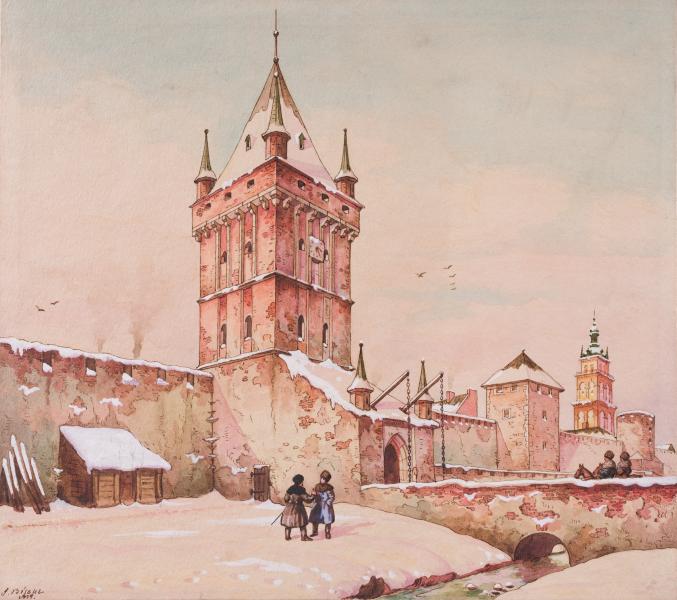
View of the Gate and Tower in Old Lviv

Gustav Bisanz

  • View of the Gate and Tower in Old Lviv 2
  • View of the Gate and Tower in Old Lviv 3
Basic information
ID
Г-I-427
Author
Gustav Bisanz
Name
View of the Gate and Tower in Old Lviv
Culture
Modern times
Technique
watercolour
Material
paper
Dimensions (height x width, cm)
24 x 27
Additionally
Information about author
Author
Gustav Bisanz
Artist's lifetime
1848–1925
Country
Austrian Empire, Austro-Hungarian Monarchy, the Second Polish Republic
Biography
Gustav Bisanz (30 August 1848 – 3 October 1925) was a Polish architect of German origin, twice rector and long-time dean of the Faculty of Architecture at the Imperial and Royal Higher Technical School in Lviv. (now Lviv Polytechnic National University). He was born into the German family of landowner Johann Bisanz on 30 August 1848 in the village of Kavchyi Kut (now Kuty, Stryi District, Lviv Region). After graduating from school, he studied at the Polytechnic University in Vienna. In 1868–1873, he continued his studies at the Imperial and Royal Higher Technical School in Lviv, in particular under the renowned architect Julian Zachariewicz (1837–1898). In 1872, while still a student, he became an assistant to Julian Zachariewicz in the Department of Construction. From 1872 to 1876, he participated in the design of the main building of the Lviv Polytechnic under the supervision of J. Zachariewicz. From 1876, he was the head of the newly created "Department of Architecture II2, later known as the "Department of Land Construction". From 1877 until his death, he was a member of the Polytechnic Society in Lviv. In 1878, he was promoted to associate professor, and in 1883, to full professor. In 1879, he visited Italy and Germany for educational purposes, and in 1882, he traveled to Belgium and France. From 1883 to 1898 and from 1901 to 1903, he was elected dean of the Faculty of Architecture. In 1888–1889 and 1898–1899, he served as rector of the Imperial and Royal Polytechnic School in Lviv (now Lviv Polytechnic National University). In 1889, he was a member of the editorial board on construction issues in "Czasopismo Techniczne" (Technical Journal) and "Allgemeine Bauzeitung" (General Construction Newspaper). In his architectural work, he drew on various historical styles, including Neo-Renaissance, Neo-Baroque, Neo-Gothic, and Neo-Romanesque. He designed many public and religious buildings, commercial establishments, and private residences. He was a frequent member of architectural competition juries. He is the author of the "Budownictwo" (Construction) textbook, which was widely used in Galicia until the 1920s. In 1903–1904, he supervised the construction of two wings of the Lviv Polytechnic. In 1910, Bisanz was one of the organisers of an exhibition of Polish architects in Lviv. From 8 to 11 September 1910, he participated in the Fifth Congress of Technicians in Lviv, where he read a paper entitled "On the Legislative Regulation of the Position of Architect in Austria". In 1912, he was elected second vice-president of the Circle of Polish Architects, an association that emerged within the Polytechnic Society. He died on 3 October 1925 and was buried in Lviv at the Lychakiv Cemetery.
Legal regulation
Borys Voznytskyi Lviv National Art Gallery