Collection of Ethnographic Drawings
Kajetan Kielisinski

Basic information
- ID
- Г-V-424_127
- Author
- Kajetan Kielisinski
- Name
- Collection of Ethnographic Drawings
- Country
- Kingdom of Poland
- Culture
- Modern times
- Technique
- drawing
- Material
- pencil
Additionally
- Type
- graphic art
- Genre
- genre art
- Provenance
- the Dzieduszycki collection
Information about author
Object description
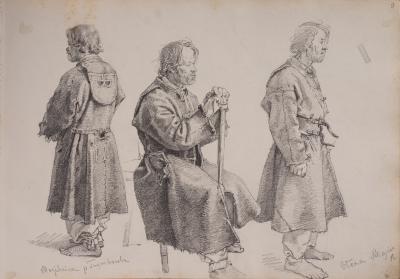
Kajetan Wincenty Kielisiński created numerous etchings and drawings devoted to folklore, life in Polish villages and towns, historical monuments, and landscapes. He was one of the first to develop bookplates in Poland. During his travels to various locations, he collected graphic materials for the publications "Polish Antiquities" and "Folk Costumes". In 1855, Poznań publisher Jan Konstanty Żupanski published "Kielisiński's Album", which collected the artist's scattered works. Kielisiński's graphic works, drawings, sketchbooks, and correspondence were kept in the Kórnik Library of the Polish Academy of Sciences, as well as in national museums (Kraków, Poznań, Warsaw) and renowned libraries (Jagiellonian University, Ossolineum, Warsaw University). The picture shows a young man or lad in traditional, probably Hutsul, clothing. The headdress is probably a mountain or Hutsul cap with a tassel, typical of the 17th–18th centuries. The young man's outer garment is a long kontusz or żupan, belted with numerous small details – straps, pouches, possibly weapons. He is wearing traditional boots. In his right hand, he holds a stick, indicating the combat or defensive function of the depicted character. His left arm is bent at the elbow and placed between the buttons under the żupan. The figure is presented in a confident, static pose, with a calm and open expression, his gaze directed ahead and slightly to the side. The young man is shown against the backdrop of a mountain village landscape – behind him are the outlines of peasant houses, trees, and a road between low hills. The drawing is done in pencil using a graphic technique. The manner of execution is quite detailed, with the author conveying the small details of the folk costume and its folds. The image has great ethnographic value, as it captures a person's clothing, appearance, and character from a specific historical era. The realistic style, graphic precision, and attention to detail attest to the work's high artistic level. Similar images were often used in folklore studies, in publications about folk life and the history of peasants or mountain peoples of the Carpathians.
Legal regulation
Borys Voznytskyi Lviv National Art Gallery