Collection of Ethnographic Drawings
Kajetan Kielisinski

Basic information
- ID
- Г-V-424_147
- Author
- Kajetan Kielisinski
- Name
- Collection of Ethnographic Drawings
- Country
- Kingdom of Poland
- Culture
- Modern times
- Technique
- drawing
- Material
- pencil
Additionally
- Type
- graphic art
- Genre
- genre art
- Provenance
- the Dzieduszycki collection
Information about author
Object description
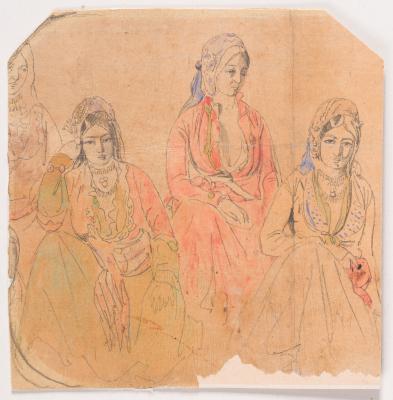
Kajetan Wincenty Kielisiński created numerous etchings and drawings devoted to folklore, life in Polish villages and towns, historical monuments, and landscapes. He was one of the first to develop bookplates in Poland. During his travels to various locations, he collected graphic materials for the publications "Polish Antiquities" and "Folk Costumes". In 1855, Poznań publisher Jan Konstanty Żupanski published "Kielisiński's Album", which collected the artist's scattered works. Kielisiński's graphic works, drawings, sketchbooks, and correspondence were kept in the Kórnik Library of the Polish Academy of Sciences, as well as in national museums (Kraków, Poznań, Warsaw) and renowned libraries (Jagiellonian University, Ossolineum, Warsaw University). The picture shows two people: a young woman standing in the foreground, facing the viewer, and behind her, what appears to be a servant, possibly a teenager. The woman is dressed in luxurious festive attire, typical of the nobility and aristocracy. The elegant, wide dress with a long train indicates a significant social event, such as a ball, a festive reception for guests, or another solemn occasion. The figure is depicted standing upright, holding an object in her left hand, such as a folded fan, while her right hand holds the gathered train of her crinoline dress. Her hair is neatly styled and gathered into a small ponytail at the top of her head. The neckline of the dress leaves the neck, upper shoulders, and chest exposed, emphasising beauty and elegance. The skirt falls in small folds; its lower part is decorated with floral ornamentation. The figure of the servant is shown to be significantly shorter, most likely a teenage boy of short stature. Only his upper body is visible, as the dress he is holding covers his silhouette. His hair is pulled back and neatly styled. The servant's gaze is directed at the young woman, who is looking straight ahead. Both characters are shown with calm expressions, with no obvious emotional displays. The background features a carefully paved stone floor and walls with superficially indicated interior details. The artist has accurately and carefully conveyed the subtle nuances and features of the characters' clothing. The clothing conveys a sense of wealth and status, indicating affluence and membership of the upper echelons of society. Thus, this drawing presents another historical costume portrait that captures the appearance and attire of a person from a particular era. The artistic value of the drawing lies in its documentary and ethnographic accuracy in depicting the historical costume: the author sought to capture the details of the clothing and social image, rather than the individual features of the person.
Legal regulation
Borys Voznytskyi Lviv National Art Gallery