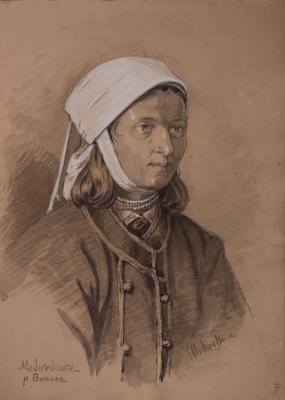
Collection of Ethnographic Drawings
Kajetan Kielisinski

Basic information
- ID
- Г-V-424_359
- Author
- Kajetan Kielisinski
- Name
- Collection of Ethnographic Drawings
- Country
- Kingdom of Poland
- Culture
- Modern times
- Technique
- drawing
- Material
- pencil
Additionally
- Type
- graphic art
- Genre
- history painting
- Provenance
- the Dzieduszycki collection
Information about author
Object description
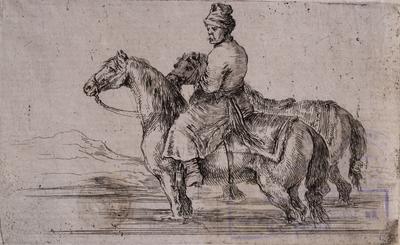
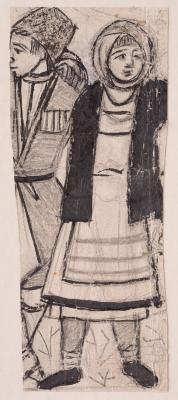
Kajetan Wincenty Kielisiński created numerous etchings and drawings devoted to folklore, life in Polish villages and towns, historical monuments, and landscapes. He was one of the first to develop bookplates in Poland. During his travels to various locations, he collected graphic materials for the publications "Polish Antiquities" and "Folk Costumes". In 1855, Poznań publisher Jan Konstanty Żupanski published "Kielisiński's Album", which collected the artist's scattered works. Kielisiński's graphic works, drawings, sketchbooks, and correspondence were kept in the Kórnik Library of the Polish Academy of Sciences, as well as in national museums (Kraków, Poznań, Warsaw) and renowned libraries (Jagiellonian University, Ossolineum, Warsaw University). The drawing depicts a hetman or a high-ranking representative of the Cossack or noble elite. The drawing is done in the style of contour graphics – thin, simple lines without shadows or hatching – which clearly show the figure's contours and clothing details. This type of image has an illustrative, almost heraldic character, typical of historical reconstruction. The man is depicted standing frontally with a slight turn of the body. In his right hand, he holds a large, massive, round mace with decorative elements, a symbol of hetman power, while his left hand rests on a sabre hanging from his belt. His clothing is typical of a representative of the higher Cossack or hetmanate of the 17th–18th centuries, clearly indicating status. On his head is a cap or turban-like headdress decorated with large ostrich feathers, a characteristic feature of hetmans or representatives of the Cossack elite. Such a headdress is not only an element of clothing but a symbol of dignity and military glory. A long cloak or kaftan, falling on the shoulders and trimmed with fur on the collar, indicates wealth and high status. The edges of the cloak are straight and unadorned, giving the figure a solemn and austere appearance. Under the cloak is a żupan with buttons or fasteners running vertically down the front. The waist is girded, indicating the presence of a belt with a sabre hidden by the clothing. The żupan fits tightly to the body and has a shorter hemline than the cloak. Soft shoes or boots without heels are worn. The figure looks solemn, calm, and majestic. The attire indicates status, power, and military dignity. Since there is no background or any details, all attention is focused on the figure and its appearance. The artistic significance lies in the accurate and detailed reproduction of historical costume, making it a valuable source for researching and studying traditional culture. From an aesthetic point of view, we are dealing with a realistic drawing, with a special emphasis on its documentary nature.
Legal regulation
Borys Voznytskyi Lviv National Art Gallery