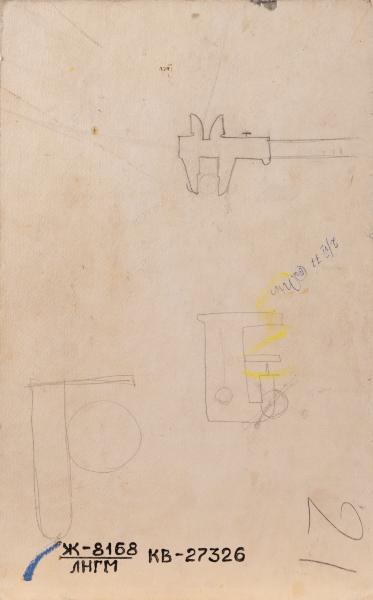
Sketch for the "Ruble" Mural
Vasyl Poliovyi


Basic information
- ID
- Ж-8168
- Author
- Vasyl Poliovyi
- Name
- Sketch for the "Ruble" Mural
- Date of creation
- 1977
- Country
- the USSR
- Culture
- Ukrainian art of the Soviet period
- Technique
- mixed technique
- Material
- paper cardboard tempera
- Dimensions (height x width, cm)
- 42 x 26.5
Additionally
- Type
- painting
- Genre
- symbolic art
- Plot
- Allegory
- Provenance
- Handed over to the museum from Vasyl Poliovyi
Information about author
Object description
The composition is in line with the practices of European modernism (primarily inspired by the still lifes of Cubists and Purists) and the individual searches of the Soviet avant-garde artists of the 1920s. The characteristic technique used by the author is typical of modernist practices. First of all, we are talking about the interpretive imitation of a collage of Cyrillic fonts through painting. The peculiarity of the author's use of a cold palette with some warm nuances is partly the result of the sources of the visual solution. Still, the delicate, subtly nuanced approach proves the author's interpretation. Combining the inscription "ruble" and using two typefaces for the number "3" is noteworthy. The latter is probably because the 1961 three-karbovanets banknote used two different fonts on the front and back sides, the same as those used by the author in this work. It is worth noting that three karbovanets (3 rubles or ''trioshka") had specific semantics in the Soviet context, which implies, in particular, the interpretation of the ritual of joint alcohol consumption during men's leisure time after work. For example, in a canteen for three people, a bottle of Moskovska vodka cost 2.87 karbovanets, a snack such as melted cheese "Miskyi" cost 11 kopeks, and a piece of bread cost 2 kopeks. It should be noted here that specialised establishments, such as the so-called "riumochni" (bars), were viewed negatively at that time due to frequent staff misconduct and inadequate quality of alcohol. At the level of everyday perception, they were seen as places for people with an addiction. At the same time, in the context of the Soviet domestic culture of consumption "for three", one of the essential priorities was the possibility of informal communication, often getting to know each other. The third person was taken for the company since it was considered abusive to consume such amounts of alcohol for two people. Of course, this interpretation may have a different dimension in a particular case, as it has not been possible to establish the meaning of other numbers, such as 60, 31, 47, and 54.
Legal regulation
Borys Voznytskyi Lviv National Art Gallery