Sketch for the "Ruthenian Architects" Mural Series
Vasyl Poliovyi, Yuliia Podohova


Basic information
- ID
- Ж-8175
- Author
- Vasyl Poliovyi Yuliia Podohova
- Name
- Sketch for the "Ruthenian Architects" Mural Series
- Date of creation
- 1972–1973 (?)
- Country
- the USSR
- Culture
- Ukrainian art of the Soviet period
- Technique
- mixed technique
- Material
- particleboard oil tempera
- Dimensions (height x width, cm)
- 33 x 70
Additionally
- Type
- painting
- Genre
- symbolic art
- Plot
- Allegory
- Provenance
- Handed over to the museum from Vasyl Poliovyi
Information about author
Information about author
Object description
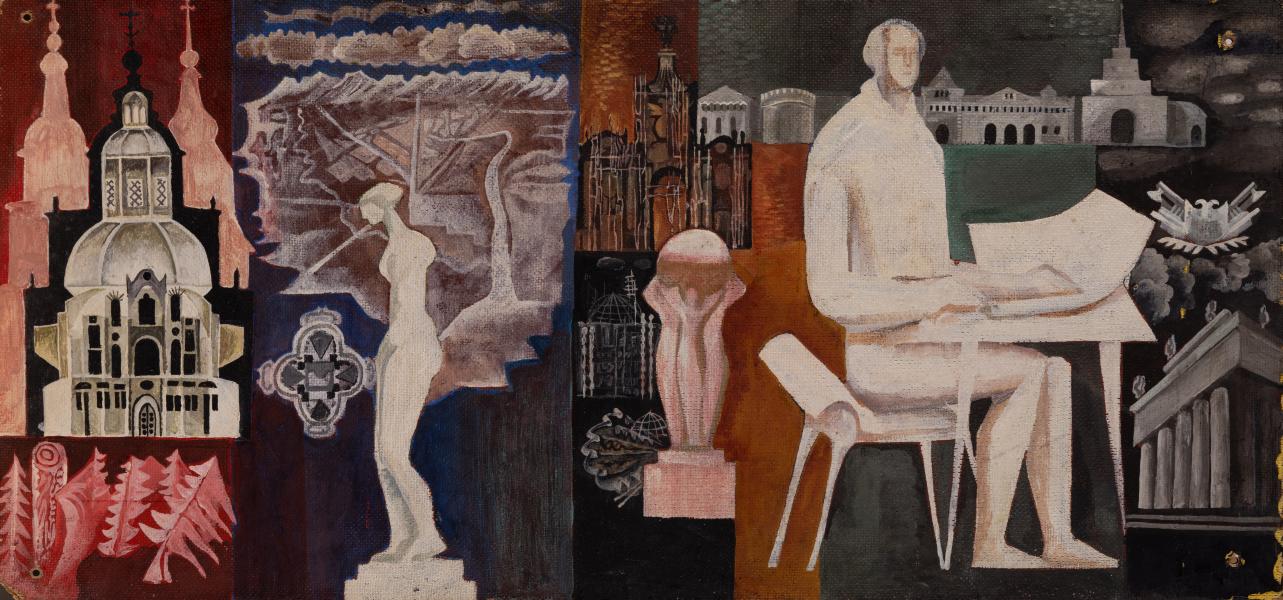
The sketch for the "Ruthenian Architects" mural series was made in collaboration with Yuliia Podohova. In the work dedicated to the architectural practices of the 18th century, one can trace the manifestations of Elizabethan Baroque, buildings in tune with Classicism, and local versions of Palladianism and Neo-Gothic through the works of Vasyl Bazhenov and Matvii Kazakov. The stylisations used by the author include both recognisable objects and variations on the theme of the architectural research of the time, in which one can trace direct references to current trends and attempts to understand local architectural traditions, taking into account the current stylistic context. As in other sketches of this series, the symbolic and allegorical approach is crucial, preserving the ideological hierarchy in which the main character, the architect, is represented as the largest, and the results of his intellectual work are proportionally smaller – large-scale cathedrals and silhouettes of palaces and defensive structures, an antiquated female figure and figures of majestic sea nymphs holding the globe. The figure of the architect is interpreted compositionally as an iconography of the Evangelists when they were depicted sitting on a chair near a table with the Gospel. This monumentality, which the author has emphasised as much as possible with the tonal solution of the sketch, determines a strict and solemn approach to the unveiling of the images. The colouring of the sketch is cold, with some warm parts mixed with achromatic components, emphasising the ideas of severity and regulation inherent in this period.
Legal regulation
Borys Voznytskyi Lviv National Art Gallery