Back

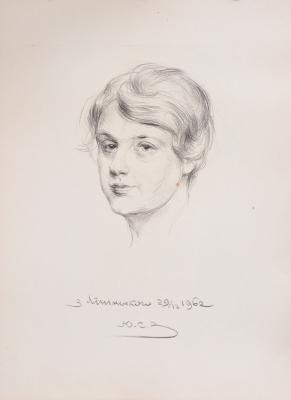
Girl Sitting on a Chair

Arnold Sharhorodskyi

  • Girl Sitting on a Chair 2
  • Girl Sitting on a Chair 3
  • Girl Sitting on a Chair 4
Basic information
ID
Ф.Шар.Арх.ЛКГ-49
Author
Arnold Sharhorodskyi
Name
Girl Sitting on a Chair
Date of creation
1963
Country
the USSR
Culture
Art of the Soviet period
Technique
drawing
Material
paper pencil
Dimensions (height x width, cm)
20.5 x 12.8
Information about author
Author
Arnold Sharhorodskyi
Artist's lifetime
1946–2015
Country
the USSR, the USA
Biography
Arnold Sharhorodskyi (Sharrad) (12.04.1946 – 12.04.2015) was a Soviet-American artist of Jewish origin, born in Odesa. For a long time, he lived and worked in Lviv, and later (1974) immigrated to the USA, where he spent the rest of his life. The Sharhorodskyi family moved from Odesa to Lviv because at the end of 1953, the Soviet Army Theatre of the Odesa Military District, where the artist's parents worked, was relocated to Lviv (on 31.12.1953, an official demonstration was held on this occasion with the participation of Iryna Vilde and Mykhailo Rudnytskyi). It is known that the artist's father, Davyd Sharhorodskyi (04.01.1911 – 03.01.1992), had a gift for comedy, as reflected in Dmytro Uhriumov's staging of the play "Chair No. 16" (the role of playwright-artisan Puzyriev, 1960), A. Ronstein's staging of "Ulugbek" and "The Muddled Apostle" (as part of a drama festival for the 50th anniversary of the USSR, roles of Farmanshakh Korchi and Grandfather, 1972), and "The Last Victim" (after Oleksandr Ostrovskyi, role of Saltan Saltanych, 1973). For the future artist, engaging in diligent self-education and approaching his professional communications selectively, particularly with Leopold Levytskyi, Mykhailo Lishchyner, Veniamin Siper, Ivan Skobalo, and Dmytro Shelest, was crucial. Arnold Sharhorodskyi took inspiration from the works of Volodymyr Herman, Francisco Goya, El Greco, Giorgio de Chirico, Rene Magritte, Henri Matisse, Joan Miro, Giorgio Morandi, Edvard Munch, Jackson Pollock, Ulo Sooster, Chaim Soutine, Oleh Tselkov, Sholom Shvarts, Mykhailo Shemiakin, as well as the practices of French Impressionists and German Expressionists, whose influence is evident in the author's artworks. Subsequently, Ihor Satanovskyi noted that the author's works during the American period "were characterised by his own 'psychopathological expression'". Among the Lviv artists, Arnold Sharrad distinguished Margit Selska and was critical of the official young artists, particularly Volodymyr Patyk, Laslo Pushkash, and Liubomyr Medvid. In addition to painting and graphics, the master created assemblages and collages and experimented with conceptual and pop art. From Arnold Sharhorodskyi's recollections, it is known that he studied piano under an apprentice of the composer Mykola Rymskyi-Korsakov (recorded conversation with Ihor Satanovskyi, Anatolii Hlants and Marta Yamiolkovska, Brooklyn, 13.06.2013). During his Lviv period, Arnold Sharrad participated in local exhibitions of young artists, particularly in the Lviv Art Gallery. He tried to enrol in the Lviv Institute of Applied and Decorative Art three times but failed to pass the entrance competition. In 1971, he participated in a remarkable art project "VI Exhibition of Young Artists" (in the Lviv Art Gallery, now Borys Voznytskyi Lviv National Art Gallery). In the exhibition's booklet, Arnold Sharhorodskyi's surname is mentioned among the shortlist of selected participants, alongside Mykola Andrushchenko, Vasyl Hudak, Yurii Dvornyk, Frants Cherniak, and Ihor Yanovych. In total, there were 109 participants. The booklet notes that for the majority of the young artists, it was their first exhibition (most of them were students of the Lviv Institute of Applied and Decorative Arts and the Ivan Fedorov Ukrainian Polygraphic Institute). He worked as a painter in one of the Lviv palaces of culture and also engaged in restoration work. Among his professional connections was Vadym Volkov. Later, in a New York restoration workshop, Arnold Sharrad met Salvador Dali. The artist's works of the Lviv period are dominated by experiments with various styles and the search for his manner, which later acquires a distinct expressionistic quality. The artworks from the Gallery's collection also include extensive explorations of Jewish culture, including writing. Arnold Sharhorodskyi was interested in Kabbalah, although, as he mentioned in a later period: "There is no difference: Synagogue, Catholic or Orthodox Church. God is one, the form of communication with Him doesn't matter. I do not adhere to any particular religion" (interview with Vasyl Ahafonov, 03.06.1988). In the same interview, Arnold Sharrad pointed out that the key problems of modern people and creativity stem from the influence of Sigmund Freud's concepts, where "the sense of meaningful existence disappeared," and consequently, the main enemy of a man is "...himself. Freud told them: you are worthless, and it is natural, don't be afraid and be that way. Freud's doctrine gave a certain positive impulse, inspiring the subconscious-oriented painting: abstract impressionism, surrealism, and several other 'isms', but the 'killing' of God is unforgivable". The works that are currently in the Gallery's collection were prohibited from being taken abroad. Later the author handed them over to the Museum. In one of his last interviews, he emphasised the importance of preserving these paintings in a place where there are works by Francisco Goya, Georges de La Tour and other prominent Polish and Russian artists. The works of Arnold Sharhorodskyi are preserved in the Borys Voznytskyi Lviv National Art Gallery, Museum of Russian Art (New Jersey, USA), and numerous private collections, including the WOLFS Gallery (Cleveland, USA) of the director Federico Fellini (Rome, Italy). The artist's autobiography mentions that his artworks were kept in the Museum of Russian Unofficial Art in Exile (Montgeron, France, 1976, organised by Alexander Glezer). Still, no official confirmation has yet been found. The artworks and information about the author have been published in the independent New York magazine "Novaya Koja" by Koja Press (Issue 5, 2014) and "The Blue Lagoon" anthology (3B, 1980–1986, Newtonville, Massachusetts, USA).
Object description
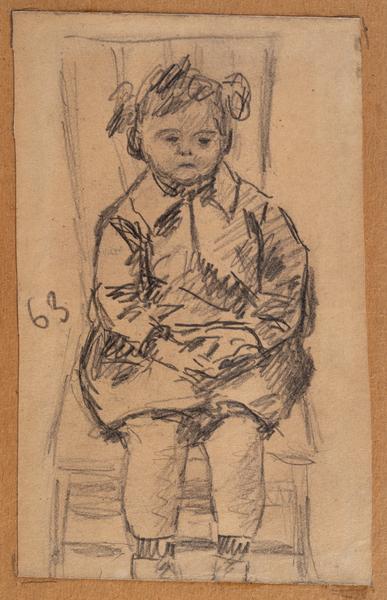
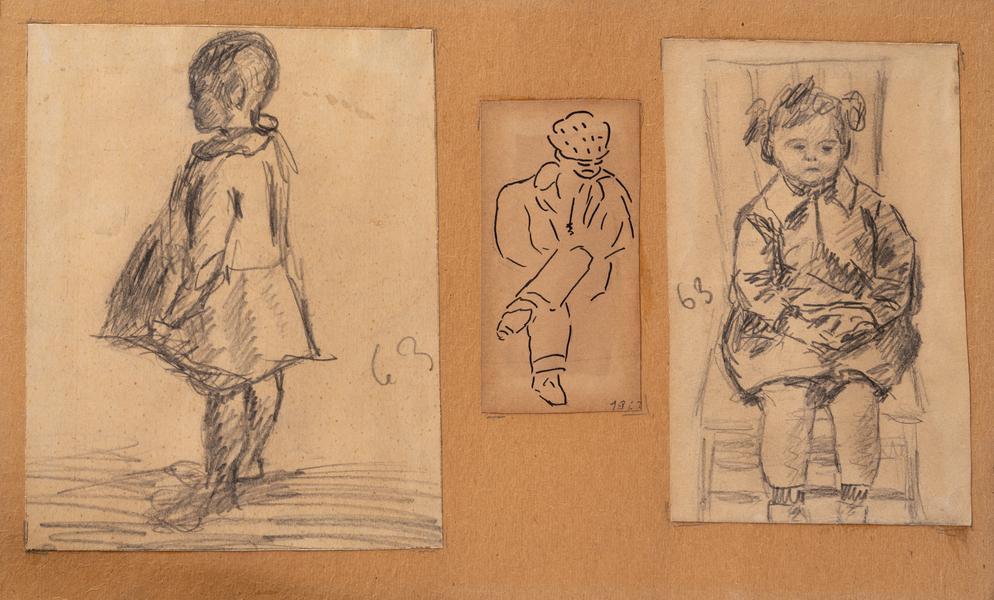
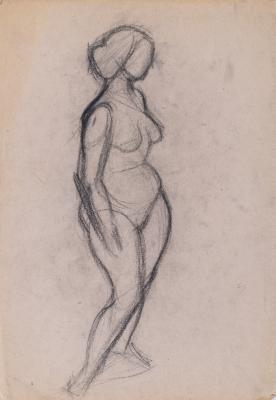
A pencil drawing on paper shows a lifelike portrait of a girl (probably 3–3.5 years old) sitting in a chair with a wooden back and padded seat. The child is wearing a dress with a turn-down collar, her medium-length hair is tied in two "ponytails" with two narrow satin (?) ribbons, and she is wearing short socks with a corrugated top. The expression on the girl's face suggests that she had been posing for some time and was tired. This type of life model drawing was quite common, both in the sense of preparation and during the actual artistic training. For example, Kuzma Petrov-Vodkin (1878–1939) made consonant drawings of children and young men (Ф.Шар.Арх.ЛКГ-48) at various stages of his artistic training (a drawing of a child with a teddy bear in 1926, ink illustrations in 1932, or life drawings in 1937). The theme of posing children is reflected quite thoroughly in the well-known diaries and notes of the avant-garde artist Alisa Poret (1902–1984), a student of Kuzma Petrov-Vodkin, who worked for a long time (from 1920 to the 1980s) on the design of children's books and magazines.
Inscriptions
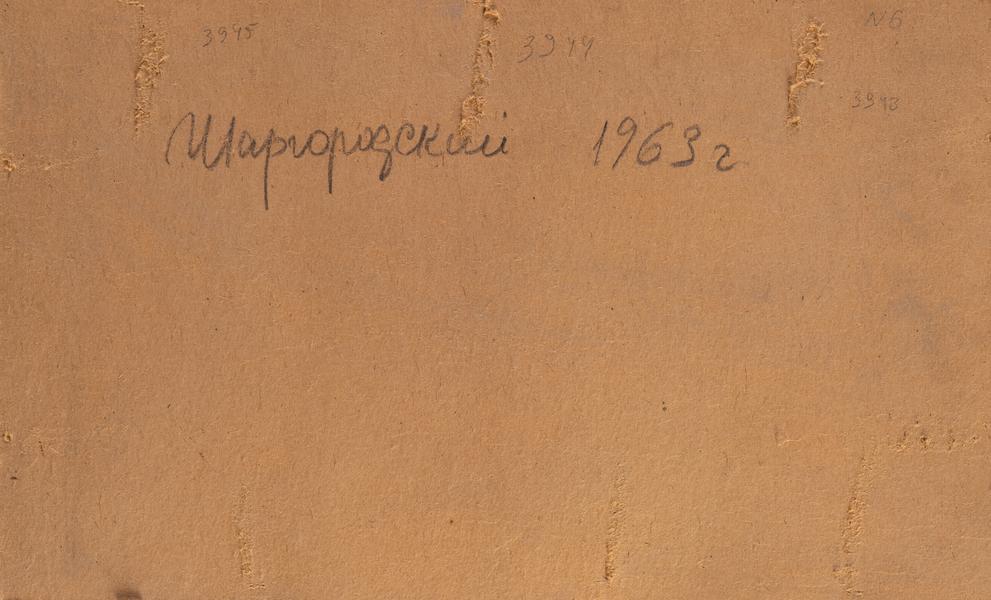
On the left side of the work are the numbers 63
Legal regulation
Borys Voznytskyi Lviv National Art Gallery