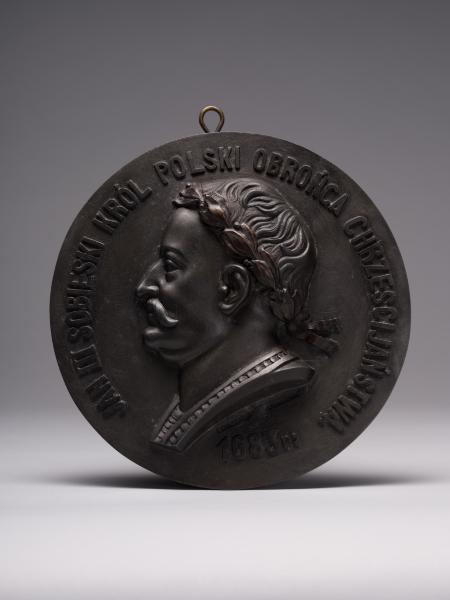
Medal "Jan III Sobieski"
Fabr. Kopachynskyi


Basic information
- ID
- С-II-601
- Author
- Fabr. Kopachynskyi
- Name
- Medal "Jan III Sobieski"
- Country
- Kingdom of Poland (?)
- Culture
- Modern times
- Technique
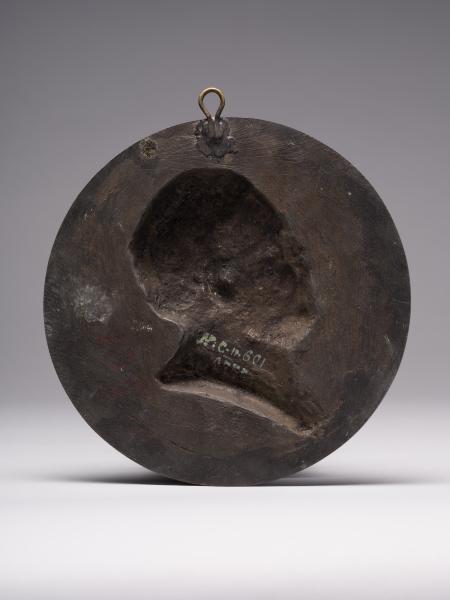
- casting
- Material
- iron
- Dimensions (diameter, cm)
- 17.5
Additionally
- Type
- sculpture (relief)
- Genre
- history painting
- Plot
- Portrait
- Provenance
- the Dzieduszycki collection
Information about author
Object description
Jan III Sobieski (August 17, 1629 – June 17, 1696) was a Polish military commander, King of Poland, and Grand Duke of Lithuania from 1674. He was born on August 17, 1629, in the village of Olesko (now in Lviv Oblast) into the family of magnate Jakub Sobieski (1591–1646) and his second wife, Zofia Teofillia(1607–1661) of the Polonized Ruthenian family of Daniłowicz. He spent his childhood in Zhovkva. From 1640 to 1643, he studied at the Novodvorsky College in Krakow. From 1643 to 1646, he studied at the Faculty of Philosophy of the Kraków Academy. After completing his studies, he travelled through France, Germany, the Netherlands, and England. He was distinguished by his education, knowledge of many European languages, and familiarity with classical and contemporary literature. He was a bibliophile and assembled several extensive libraries in his castles, palaces, and mansions in Lviv. He was passionate about geography and was an honorary member and patron of the first geographical society in history. He showed interest in mathematics, astronomy, architecture, and engineering, maintained contacts with prominent scientists, and corresponded with famous scholars, including Gottfried Leibniz. In May 1665, he married Frenchwoman Marie Marie Casimire Louise de La Grange d'Arquien (1641–1716), widow of Jan "Sobiepan" Zamoyski (1627–1665), Voivode of Sandomierz and Krakow. Of the couple's thirteen children, only four reached adulthood. In 1665, he was appointed Grand Marshal of the Crown, and from 1666 he held the position of Grand Hetman of the Crown. In 1673, he defeated the Turkish army at Khotyn. In June 1674, he was elected King of the Polish-Lithuanian Commonwealth and crowned on February 2, 1676. In 1684, he initiated the creation of an anti-Ottoman alliance between Austria, Venice, the Holy See, and the Polish-Lithuanian Commonwealth. That same year, after the victory at the Battle of Vienna, Pope Innocent XI granted the king the honorary titles of Defensor Fidei (Defender of the Faith) and Orthodox Majesty. In the last years of his life, he focused his efforts on cultural development, supporting Polish and foreign architects, artists, sculptors, mathematicians, and astronomers. Jan III Sobieski's private residences became some of the most outstanding examples of 17th-century architecture. He died on June 17, 1696, at the Wilanów Palace near Warsaw. He was buried in the crypt of St. Leonard's Church in Krakow.
Inscriptions
"JAN III SOBIESKI KROL POLSKI OBRONCA CHRZESCIJANSTWA. 1683 r.".
Portrayed person
- The name of the person portrayed
- Jan III Sobieski
- Lifetime of the person portrayed
- 17.08.1629–17.06.1696
Legal regulation
Borys Voznytskyi Lviv National Art Gallery