Zarzecze
Jan Nepomucen Glowacki


Basic information
- ID
- Ж-1353
- Author
- Jan Nepomucen Glowacki
- Name
- Zarzecze
- Date of creation
- 1832
- Country
- Austrian Empire
- Technique
- oil painting
- Material
- canvas oil
- Dimensions (height x width, cm)
- 60.5 x 84.5
Additionally
- Type
- painting
- Genre
- landscape
- Provenance
- the Dzieduszycki collection
Information about author
Object description
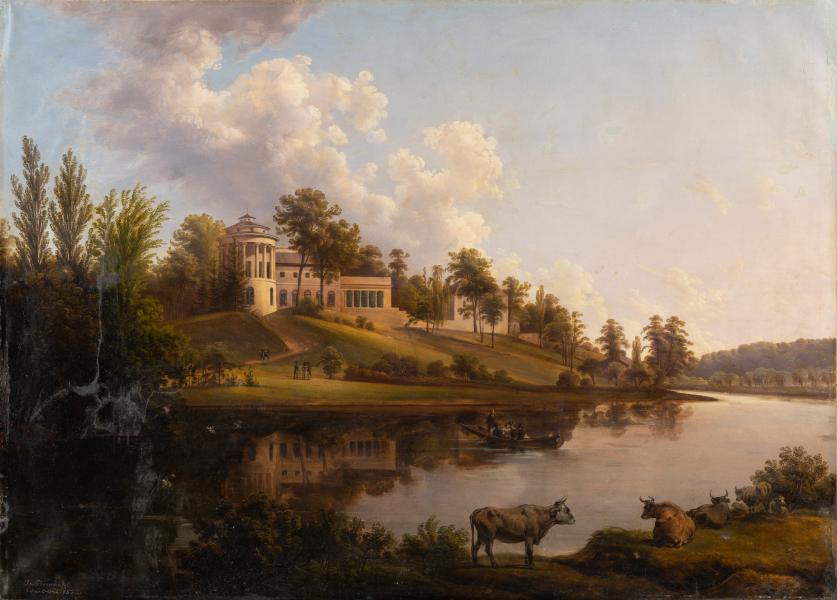
The landscape in the painting by Glowacki features all the elements of an ideal (imaginary) Romantic scene: a splendid view of a tranquil, wide river with grazing cattle on its banks; a palace on a high hill resembling an ancient temple, reflected in the water; staffage figures of people strolling through the park at dusk; a clear sky with light clouds and an atmosphere of calm and tranquillity. The painting accurately depicts a palace and park complex built over the Mleczka River in the early 19th century in the village of Zarzecze (Subcarpathian Voivodeship, Poland). This estate belonged to Countess Magdalena Morska (1762–1847) from the Dzieduszycki family, of the Sas coat of arms. The countess was an educated woman, artist, designer, and patron. Between 1817 and 1819, with the assistance of architect Chrystian Piotr Aigner, Magdalena Morska not only designed all the buildings, garden, and park of the palace complex in the Neoclassical style, inspired by the Temple of the Sibyl in Pulawy but also personally supervised their construction. To adorn her park, the countess annually imported new varieties of ornamental plants from Poland and abroad. After Magdalena's death, the estate was inherited by her nephew, Wladyslaw Dzieduszycki (1825–1899), the founder of the Natural History Museum in Lviv. Since 2008, a museum dedicated to the Dzieduszycki family has been established in the palace and park complex. Borys Voznytskyi Lviv National Art Gallery houses a portrait of Magdalena Morska-Dzieduszycka by Alojzy Reichan, as well as a portfolio of coloured lithographs featuring views of the palace and park complex, published by the countess in 1836. In addition to the illustrations, the album includes advice on construction and gardening.
Inscriptions
In the bottom left corner, there is a scratched artist's signature and date: "JN. Głowacki Cracovie 1832".
Legal regulation
Borys Voznytskyi Lviv National Art Gallery