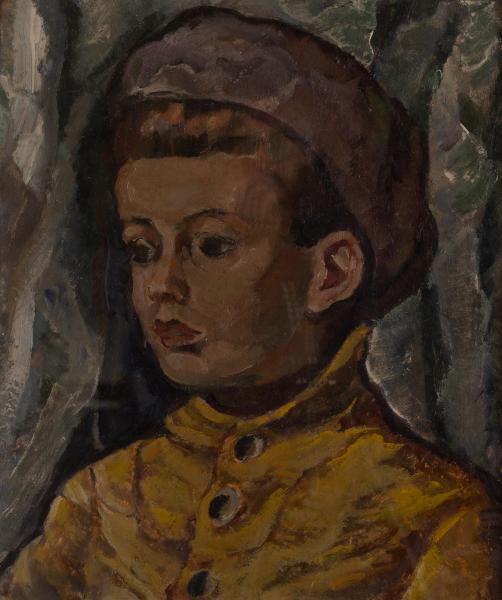
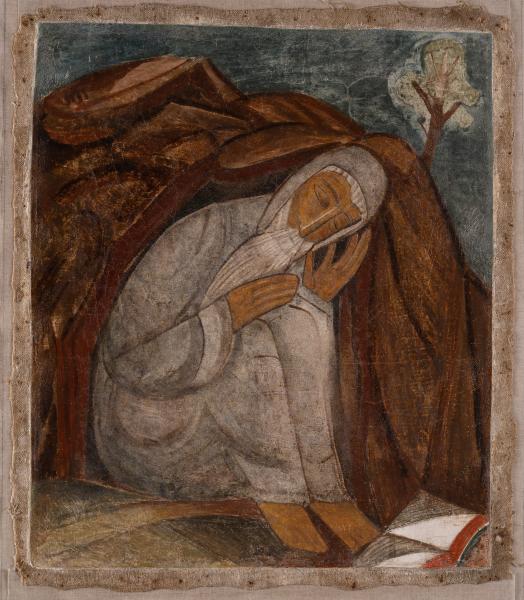
Portrait of the Son Oleksandr (Reverse: Saint Anthony the Great)
Mykola Fediuk


Basic information
- ID
- Ж-5808
- Author
- Mykola Fediuk
- Name
- Portrait of the Son Oleksandr (Reverse: Saint Anthony the Great)
- Date of creation
- 1930s
- Country
- the Ukrainian SSR
- Technique
- oil painting tempera painting
- Material
- canvas oil
- Dimensions (height x width, cm)
- 46.5 x 39.5
Additionally
- Type
- painting
- Genre
- portraiture religious
- Plot
- Portrait
- Provenance
- Purchased from O. Fediuk, 1983
Information about author
Object description
The work is an intimate portrait of the artist's younger son, executed in the impasto technique. The total height of the vertical composition features a bust-length depiction of a small boy in a slight half-turn to the left. The silver-grey drapery serving as the background for the portrait harmoniously contrasts with the child's clothing: a yellow-brown shirt with a high collar and a purple beret. The boy appears weary from posing and looks sorrowfully off to the side. On the reverse side of the portrait, during restoration in 2021, an iconographic depiction of Saint Anthony the Great, executed in tempera, was discovered and attributed. The image was concealed beneath a layer of white paint. The painting depicts an older man with a long white beard, dressed in light grey robes, sitting in front of the entrance to a cave. Near his bare feet on the ground lies an open book. The saint's head is tilted towards the palm of his left hand while his right hand rests on his knees. The man's eyes are closed. The work includes attributes characteristic of the iconography of the saint (the cave, the book, and the tree). The artist has portrayed Saint Anthony the Great in a moment of prayerful calm – he seems to have leaned towards the valley and is listening intently. Such a scene corresponds to the legend's text about the saint's life. Mykola Fediuk frequently explored themes related to the life of Saint Anthony the Great in his graphic series from the 1920s, notably in works such as "Thirst" and "The Temptation of Saint Anthony". In terms of style, the scene is also similar to another early work by M. Fediuk, "Ivan Vyshenskyi". This suggests that the work was likely created in the 1910s or 1920s.
Legal regulation
Borys Voznytskyi Lviv National Art Gallery